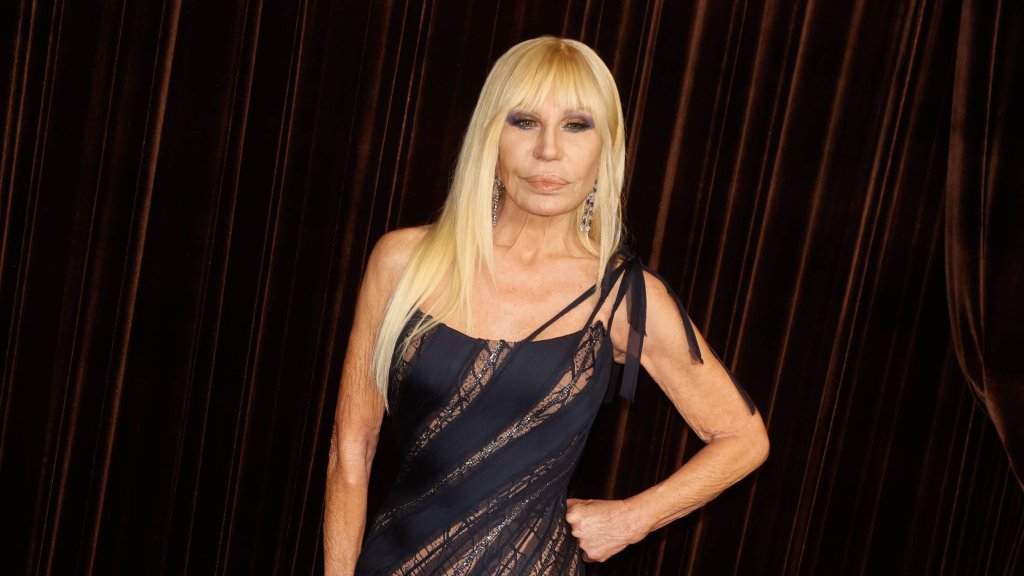
If Donatella Versace (71) could relive one day of her life, she would not have to think for long: she would bring back time spent with her brother Gianni (1946–1997) (German). The fashion designer, who was murdered in 1997, was the key creative figure behind the international fashion company Versace. The siblings founded the brand together in 1978. They had shared a particularly close bond since childhood.
Key points at a glance
- Donatella Versace still misses her brother Gianni, who was murdered in 1997. If she could bring back one day, it would be a day spent with him.
- The siblings founded the fashion company Versace together in 1978.
- The designer has championed the LGBTQ+ community for many years, supporting foundations and LGBTQ+ centres, among others.
- She criticises growing prejudice and setbacks in social acceptance of queer and gay people.
- In 2025, she handed over creative leadership of Versace and became a brand ambassador. She is now creative director at Revolve.
Self-expression and love
Her brother’s death was one of the greatest challenges of Donatella Versace’s life. Looking back, she describes how she got through that time with a mixture of determination and humour: “How did I get through it? By putting one foot in front of the other – day after day – albeit in fabulous and very high heels.” For her, Versace is much more than a fashion company. “For me, Versace stands for family, strength, uncompromising self-expression and love.” When the fashion house was founded, Donatella initially took on the role of vice-president. In the years that followed, the brand became an influential name in international fashion, while also shaping pop culture. In doing so, she says, Versace deliberately broke with established conventions.
“We took the codes of the street and turned them into the codes of haute couture,” she says, describing the company’s creative philosophy. At a time when understated elegance was particularly sought after, she says, Versace stood for rebellion, daring, boldness and sensuality. “We broke all the rules, invented new ones, and once we had found our community, there was no stopping us.” Donatella Versace was responsible for the fashion house’s creative direction until 2025. She then handed over leadership and moved into the role of chief brand ambassador. In September, it was also announced that she would become creative director at fashion retailer Revolve. There, she is tasked with driving the development of a new fashion and beauty division. She also wants to continue her social advocacy alongside this work.
A bond with the community
It was only in early October that the 71-year-old received the British Icon Award in recognition of her influence and advocacy. Recognition from the LGBTQ+ community means a particularly great deal to her. She said: “To be seen as an icon by the queer community is a very special honour.” At the same time, she points out that the term icon can also create a certain distance. “Somehow, the word ‘icon’ can also seem a little one-dimensional – perhaps that is sometimes the case in our world of social media. But we must not forget that we are all human.” In general, she takes a rather reserved view of awards. Given the efforts still needed to achieve equal rights and equal opportunities, she says there is much left to do. Nevertheless, she is delighted by the honour. “If you are going to be an icon, then a queer icon is definitely the right choice!”
Standing up for human rights
She says her commitment to social projects has been strongly shaped by people in her circle of friends. Early on, she supported Elizabeth Taylor in her efforts to combat HIV and AIDS. The foundation set up by her close friend Elton John (German) also remains close to her heart. She also names George and Amal Clooney as important role models. Their foundation works for justice and the protection of minorities worldwide. She is also impressed by King Charles III’s commitment to improving young people’s prospects. “When you are surrounded by friends who make such a difference, you want to contribute to change yourself. And above all, you want to support hope,” says Versace. Visits to LGBTQ+ centres in New York and Los Angeles left a particularly strong impression on her. There, she met people who depend on the centres’ support.
She was particularly impressed by the strong sense of solidarity at the centre in Los Angeles. The people there welcomed her warmly and gave her a sense of chosen family. Its services cater to different generations: children and young people with nowhere else to stay, as well as older people who find community and support there. Supporting such centres and their work on the ground is an enduring source of motivation for her. Particularly in light of current social developments, she says, these services are more important than ever.
Concern about exclusion
Looking at the situation of queer and gay people worldwide, Versace also sees troubling developments. In various countries, including Italy (German), she says, resistance to equal rights for LGBTQ+ people is growing. She draws hope above all from the community’s joy in life and creativity. “The LGBTQ+ community’s joy in life, positive energy and creativity give me hope.” At the same time, she sees a trend that worries her. “It feels as though we are going backwards when it comes to accepting other people. At precisely a time when we should be more open and tolerant and draw strength from supporting one another, some voices are growing ever louder, marked by more prejudice, insularity and intolerance than ever before. And yet the queer community continues to bring light, colour, optimism and laughter into our world.” As an ally, she wants to play her part by supporting people who are particularly affected by exclusion.
Fashion and self-confidence
Versace also spoke explicitly about gay men’s influence on the fashion industry. In her view, the industry is shaped to a considerable extent by gay men and strong women. “Without us, this industry would not exist.” For her, fashion is much more than choosing clothes. It stands for creativity, colour, joy in life and the opportunity to express one’s personality confidently. Clothing can also act as protective armour, helping people present themselves with greater self-assurance. These values can hold particular significance for queer people, but also for anyone else seeking greater confidence. Gay men, she says, also often have a keen sense of aesthetics and taste. For many, the fashion industry is therefore a natural professional and creative environment.
Lessons from her brother
Asked about the most important lesson a gay man has taught her, Versace answers without hesitation: her brother Gianni taught her to be true to herself. There could hardly be a better lesson for life. With a wink, she adds that he also advised her to be blonde. From her gay friends, she has learned unconditional affection above all. “To love unconditionally and to be loved unconditionally!” She says they are honest and sincere and make their shared experiences unforgettable. Above all, they make her feel accepted and supported without being judged.
Gianni’s own path
Donatella Versace has previously said that her brother came out to her when she was eleven years old. Asked whether Gianni had struggled to accept his sexual orientation, she describes him as someone who always remained true to himself. “Gianni was always Gianni – being gay was part of his personality.” In southern Italy, where the siblings grew up, being open about homosexuality could not be taken for granted at the time. Within the family, however, Gianni found support.
“My family was open-minded and liberal. So he had a safe environment to grow up in.” Their mother worked in fashion and ran her own boutiques. Through this, she came into contact with people from a wide range of backgrounds and identities early on. Gianni, she says, found personal expression primarily through his creativity. Both in his collections and in his private life, he never pretended to be someone else and consistently followed his own path.
A childhood full of creativity
Donatella describes their childhood together as exceptionally happy. As the youngest child in the family, she was particularly cherished and loved. She remembers her mother dressing her up for carnival and Gianni later designing clothes of his own for her. Their time together was full of imagination, humour and creativity. “Our childhood together was full of fun, laughter and creativity. I am very lucky to have grown up like that.” At the end of the conversation, she is asked which day of her life she would like to relive. Her answer is brief and unequivocal: “Any day with Gianni. It doesn’t matter which one.”