
Almost three decades after his involuntary coming out, American actor Danny Pintauro (German) has looked back on his experiences at the time. Now 50, he has shared memories on social media of 1997, when his homosexuality became public through a report in the tabloid National Enquirer.
The key points at a glance
- Coming out under pressure: in 1997, at the age of 21, actor Danny Pintauro (50) was confronted by the National Enquirer with plans to publish a story about his homosexuality.
- Known as a child star: Pintauro appeared in the American sitcom “Who's the Boss?” from 1984 to 1992.
- Rediscovered article: the actor found the interview from that time and shared his experiences on social media.
- Huge response: his post received more than five million views. Numerous people explained how his coming out had affected their own lives.
- Pintauro highlights the importance of public visibility and of the people who paved the way early on for greater acceptance.
Tabloid blackmailed actor
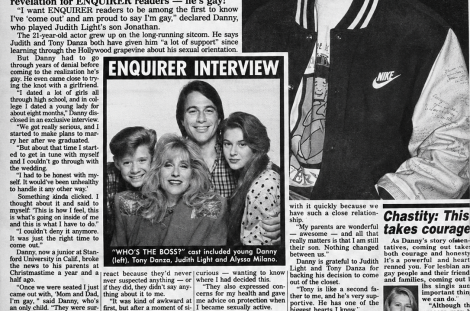
It began with the unexpected discovery of a copy of the original article. Pintauro said he had not seen the interview for a long time. His memories prompted an unexpectedly strong response online. Numerous people described what his coming out had meant for their own lives. Pintauro became known as a child star in the American sitcom “Who's the Boss?”, which aired from 1984 to 1992. On German television, the series was broadcast under the title “Wer ist hier der Boss?”. In 1997, the then 21-year-old publicly revealed that he was gay in an interview with the National Enquirer. The timing, however, was not his choice.
In his recent post, Pintauro described how the article came to be published. “I finally found it,” the actor began, referring to the rediscovered article. He then explained the circumstances at the time. “I was 21 years old, and the Enquirer had made it unmistakably clear that it would publish a story about my sexuality — whether I took part or not. So I made the decision to speak for myself.”
Mixed feelings
He said seeing the article again had brought up mixed feelings. “Seeing the actual article again almost 30 years later is surreal.” He had also discovered something he no longer remembered. “And here's something I'd forgotten: all things considered, the article is actually quite sensitive.” The headline at the time was particularly striking. “Yes, the headline is huge and very typical of 1997: ‘TV sitcom star reveals: I'm gay.’” The article itself, however, was more nuanced than its presentation suggested. “But the story is about the support I received from my family, Tony Danza and Judith Light, and even includes a message from Chaz Bono about courage and coming out.”
Tony Danza and Judith Light were among the stars of “Who's the Boss?” and had worked with Pintauro for several years. Chaz Bono also supported the young actor at the time with a public message. Pintauro recalled how unusual it still was in the late 1990s for celebrities to be openly gay. “It's crazy to think how short the list of openly gay public figures still was in 1997, and how many people would come out publicly in the years that followed.”
Proud of his younger self
Despite the positive aspects of the interview at the time, his involuntary coming out remains a difficult memory for Pintauro. He had not been able to decide for himself when and under what circumstances his homosexuality became public. “That doesn't change how complicated it was for something so personal to become national news before I was ready for it to happen on my own terms.” With the passage of time, however, he could also see how he had tried to regain control of the situation. “But reading it today, I also see my 21-year-old self trying to take control of a situation he hadn't chosen, and saying: ‘If this story is going to be told, I want my voice to be part of it.’”
Today, he said, he also feels proud of the decision he made back then. “And I'm kind of proud of that.” Looking back, he found Chaz Bono's support particularly moving. “And a little thank you to Chaz Bono, too. Seeing those supportive words alongside my story almost 30 years later means more to me today than I probably understood at the time.” Pintauro ended his post with a personal reflection. “Almost 30 years later, I'm finally holding this real piece of history in my hands again. Still gay. Still here. And very grateful that today I get to decide for myself how my story is told.”
Thousands of people react
The post prompted a wave of reactions on social media. Pintauro's post received tens of thousands of likes. Many people said his coming out at the time had helped them question their own attitudes or better accept their sexual orientation. One man from the American state of Oklahoma recalled how profoundly the news had affected him in 1997. “For a kid in Oklahoma, this was a pivotal moment in breaking free from the indoctrination of my fundamentalist upbringing,” he wrote.
As he was roughly the same age as Pintauro, he said he had felt as though he was growing up alongside the actor. “Your character was funny and lovable, and back then I felt like I knew him. So when this article came out, I was completely shaken.” Yet that very experience had challenged his previous beliefs. “But it created cracks in the hateful logic I'd grown up with: gay people are evil. But I knew you weren't evil.”
Criticism of past forced outings
Other commenters recalled the aggressive reporting of many tabloids in the 1990s and 2000s. One man criticised in particular how celebrities at the time were often confronted about their sexual orientation against their will. “I hated it when tabloids did things like that to people like you, Chad Allen and others. It was evil.” He also specifically mentioned the behaviour of American television journalist Barbara Walters towards singer Ricky Martin. “What Barbara Walters did to Ricky Martin was evil too.”
Despite continuing problems in society, he believed the media's treatment of LGBTQ+ celebrities' privacy had changed. “As imperfect as our world still is, at least those tabloids now have only minimal influence, and the media no longer seem to be actively trying to out actors, singers or athletes.” Another commenter thanked Pintauro for his openness at the time. “Men like you went ahead and pulled progress along into the future so that men like me could run! Thank you for setting the pace, Danny!”
More than five million views
Shortly afterwards, Pintauro posted again. His original post had by then received more than five million views. He said he had been deeply moved, particularly by other people's personal messages and memories. He had received numerous letters back in 1997, too. At the time, however, the opportunities offered by today's social media had not yet existed. As a result, he had long been unaware of how many people his coming out had actually affected. In another video, he explained that he had originally only intended to share a personal memento with the post. “I could never have imagined how many of you would tell me that it was a piece of your past, too.”
“Our history matters”
For Pintauro, the many responses have changed the significance of his coming out at the time. What he had seen for decades primarily as a difficult personal experience turned out to have been an important moment in many other people's own development. Their memories made him realise that public visibility can have an impact even when the person concerned is initially unaware of its significance. “Almost 30 years later, I'm learning that the impact of that moment reached much further than I ever realised,” the actor explained. He concluded by stressing the importance of the LGBTQ+ community's shared history and of those who had publicly championed acceptance early on. “Our history matters. Our visibility matters. And the people who helped pave the way matter. Thank you for reminding me.”