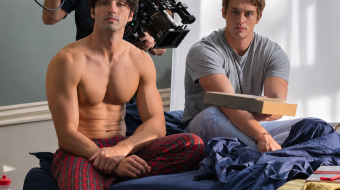
British comedian, actor and writer Leo Reich has spoken about his experiences as a gay man, the difficulties of modern dating and his new comedy series “It Gets Worse”. The 28-year-old is particularly critical of the pressure he believes dating apps create.
The key points at a glance
- New comedy series: British actor, writer and comedian Leo Reich (28) discusses his new Channel 4 series “It Gets Worse”, in which he deliberately includes unpleasant gay characters.
- Celebrity guest appearances: Andrew Scott, Lena Dunham, Zadie Smith, Amelia Dimoldenberg and Blake Harrison appear in the series. A scene featuring Scott spitting into Reich’s mouth has already attracted attention.
- An unusual coming out: At 19, Reich came out to his parents as gay during a stand-up performance at the Edinburgh Fringe Festival.
- A difficult adolescence: At an all-boys school, Reich experienced a homophobic environment and struggled with shame, anger and self-doubt.
- Criticism of dating apps: Reich sees online dating services as a threat to personal relationships. He finds the expectation that a meeting must inevitably lead to sex or a romantic relationship particularly stressful.
- Freedom in gay relationships: At the same time, he emphasises that friendships, sexual encounters and romantic relationships within the gay community can often flow into one another.
The Daddy scene with Andrew Scott
A scene in his new series in which Irish actor Andrew Scott spits into his mouth is already attracting considerable attention. Reich finds it almost regrettable that the scene with Andrew Scott should have been the first to attract widespread attention online. “I feel so bad that this was the first thing from the series to go viral. He’s only in one scene.” In it, Scott plays a therapist who demands sex from Reich and declares: “You’re just a hole for Daddy.” However, Scott impressed him with his willingness to collaborate. “He’s wonderful. I love him so much.” Reich already knew the actor a little from working together on the series “Too Much”. So he sent him the script for the scene in question.
He explained that he had immediately thought of Scott while writing it. “Which, given the scene, is a really strange thing to say to someone you don’t know particularly well.” Scott was appearing in a theatre production in New York at the time and did not reply at first. During the roughly week-long wait, Reich said he became increasingly worried that his message had given entirely the wrong impression. “I thought: ‘I’m going to prison. He’s going to take out a restraining order against me. That’s the strangest way I could possibly have phrased it.’ As in: ‘This made me think of you!’ What?!”
Filming without inhibitions
According to Reich, the spitting scene was already in the script and did not happen spontaneously during filming. “Imagine if that had been improvised,” he joked. Although he feels nervous before every scene, he said Scott made the work easy for him. The two improvised numerous other moments, so the individual takes differed. “He’s so wonderful and so up for having fun with it.” The atmosphere on set was particularly relaxed. “It felt so free and relaxed. As soon as we had one take in the can, I thought: ‘This is going to be a great day.’”
Reich also praised the other guest actors, including Lena Dunham, novelist Zadie Smith, Amelia Dimoldenberg and Blake Harrison. “It’s a Channel 4 series; nobody’s making money from it. The reason all these people said yes is that they thought it would be fun.” Their agreement to take part meant a great deal to him. He said he had written each role with a particular person in mind and then approached them directly. Contacting Zadie Smith was especially unusual. He had previously spoken to the writer only once, at the premiere of “Too Much”. He sent her a detailed email about her work and his reasons for wanting to cast her. Her reply was surprisingly straightforward. “Sounds great. When are we doing it?”
Gay characters on television
After the pilot was commissioned, Reich wrote the series in just under a year. He had not originally planned to play the lead himself. That decision came relatively late, when drafts of most of the series already existed. He said this helped him write more freely. His biggest concern had not been having to perform in the sex scenes himself later on. Instead, he had worried that viewers might equate him with his character, Ethan. “Because he’s obviously completely unbearable.” By the end of the series, though, he considers Ethan someone whose faults can be forgiven.
At the beginning, however, the character is particularly trying. “At the start, you think: ‘Fucking hell, man. Shut up.’” Reich sees this as a deliberate alternative to many stories about gay people. The title “It Gets Worse” is a variation on “It Gets Better”, a well-known message intended to give young LGBTQ+ people hope. “Sometimes there’s something forced about these cosy, optimistic stories about queer representation.” Such narratives are important and can give people encouragement, he said. But they do not reflect the full reality of people’s lives. “But at some point you reach the stage where you think: ‘Well, lots of the gay people I know are really hard to put up with. Where are they on television?’”
Insects and football
Reich grew up in the London neighbourhoods of Holloway and Tufnell Park. His primary school was at the end of his street. As a child, he was particularly interested in animals and insects. At one point, he said, he kept around ten different salamanders, a gecko, two species of toad, at least ten praying mantises and a Madagascar hissing cockroach. He also regularly attended insect fairs where breeders and dealers offered live animals for sale. Alongside the fun, he said, what fascinated him was a sense of wonder and mystery. “Tiny, beautiful things.” His siblings did not always share his enthusiasm, however. His sister still feels traumatised by having had to accompany him to numerous nature reserves. Conversely, his older brother regularly took him to football matches, which did not interest him at all.
A homophobic school
Reich said he only began to grapple more deeply with being gay during his time at secondary school. He attended an all-boys school where homophobic remarks were part of everyday life. “I don’t think I was ever bullied, but at a boys’ school, being very homophobic all the time was just a big part of everyday life.” Not every remark was meant seriously. For a teenager struggling with his own sexuality, however, even supposedly harmless jokes could be hurtful.
“When you’re wrestling with your sexuality in that environment, even the supposedly ‘casual’ banter feels very personal.” The effects were primarily an internal burden. Asked whether he had experienced feelings of shame at the time, Reich replied: “That’s not an exaggeration at all. Enormous shame. Enormous anger.” That anger was directed at himself. “I was angry with myself.” As he had been an extremely ambitious child, he had long viewed being gay as a personal failure. “Like a major flaw. It felt very unfair.”
Coming out on stage
Although Reich grew up in a liberal and progressive family, he did not initially speak openly to his parents about his sexuality. He describes his family environment as a typically British form of reserved liberalism. “There’s a sense that everything is fine, but not necessarily that you talk about it.” At 19, he finally chose an unusual way to come out. He performed as part of a student comedy night at the Edinburgh Fringe Festival and invited his parents to be in the audience.
He was the second performer on stage and delivered a ten-minute set with some particularly explicit jokes. His opening joke was about a man he had been involved with, with whom he had had sex for the first time and who had then cut off contact without explanation. “I find it so ironic that I lost my gay virginity to an arsehole, of all people.” That was the line with which he began his performance – in front of his parents.
His parents were not allowed to say anything
After his ten minutes, Reich left the stage. His parents then had to sit through around another 50 minutes of comedy performances. Afterwards, he sent them a message with a clear instruction. “I don’t want you to say anything. I’ll meet you at this time, at this place, so we can go and see another show together. I don’t want you to say anything other than that it was really funny.” His parents complied. “They said it had been really funny.” There was no subsequent in-depth conversation about him being gay. Nobody was upset. Reich himself had simply wanted to avoid a serious discussion.
At the time, he said, he had found the prospect of such a situation embarrassing. He had also struggled to accept his sexuality fully himself. “When you’re not really comfortable with something yourself, having to hold someone else’s hand through it as well was too much for me.” He had feared that any possible response from his parents would upset him. “Every single response would have been wrong.” So he preferred to have no reaction at all. “I’m in complete control. And we’re having fun as well.” Today, he can view that decision in different ways: as an affectionate, humorous way of coming out, or as an expression of a particularly strong tendency to avoid difficult conversations. Perhaps both are true.
Dating life in London
In the interview, Reich also spoke about his love life as a 28-year-old gay man in London. Asked what was particularly enjoyable about dating, he initially responded with irony. “What’s good about it? Ha. I’m really racking my brains to find something positive.” He then described an aspect of gay relationships that he particularly values. “When it comes to being gay, there’s a sexual, romantic, erotic quality that’s part of the fabric of the community. A shared desire.” That shared desire, he said, can dissolve traditional boundaries between different kinds of relationship.
“It’s a really beautiful way to soften some of the boundaries or restrictions that determine what kind of relationship you can have with someone.” This makes it clear that people can take on very different roles in one another’s lives over time. “You realise that people can be all sorts of things to you.” Reich said some of his friendships had originally begun as romantic or sexual relationships. He had also experienced the reverse: friendships that later became sexual or romantic relationships. “You go through phases where things change, and that’s beautiful and liberating.”
Reich sees this openness as a particular advantage of gay relationships. Rather than following rigid social expectations, people do not have to decide from the outset what kind of connection they will have. “There are fewer rigid expectations about what your relationship with someone has to look like and what it can become.” The boundaries between friendship, love and sexuality can blur and change. “You can work that out with that particular person. It doesn’t have to follow certain conventions.” For Reich, this means greater freedom to shape relationships individually. However, he sees that freedom as increasingly restricted by modern dating apps.
Sharp criticism of dating apps
Reich describes online dating services as the opposite of the open, evolving relationships he values in the gay community. “The flip side is this more isolated, atomised form of app dating, which does exactly the opposite.” Within an app, encounters are already shaped by certain expectations and procedures. “Every interaction you have with someone in that context has to follow certain conventions, because it takes place in an app that imposes those conventions on you.” In his view, this creates a particularly restrictive form of dating.
He now barely uses such services. “I don’t really engage with it any more, because I found it a horrendous nightmare to be in a situation where you meet someone for the first time and you’ve basically failed if you don’t have sex.” Reich is particularly critical of the expectation that a meeting must lead to either a sexual or a romantic relationship. As both people have already seen photos of each other, a basic physical attraction is often established before they meet. “You’ve seen each other’s photos. You know that, in theory, you would have sex with each other. And if you then don’t, it’s because your personality is so bad.” This was deliberately expressed in stark terms.
Anonymity and ghosting
His main point was that encounters on dating apps often have only two possible outcomes. “The date goes well and becomes romantic, or you go back to being strangers for ever.” Friendships can occasionally emerge from such meetings. Often, however, there is no shared social setting that might encourage things to develop differently. Unlike a chance encounter in a bar, those involved have no connection to one another before the date. That means they can just as easily disappear completely from each other’s lives afterwards.
In Reich’s view, this anonymity also changes how people treat one another. If two people have no mutual friends or social contacts, they have less need to consider the possible consequences of their behaviour. “There’s no sense that you’ll be held accountable for your behaviour by a community of people you’re involved with.” He said this had changed the standards for interpersonal encounters. As an example, Reich cites so-called ghosting, where someone cuts off contact without explanation. “You wouldn’t just ghost someone if they were a friend of a friend.” For Reich, this reveals a fundamental contradiction: while he experiences the gay community as a space in which relationships can be particularly free and fluid, he finds app-based dating increasingly rigid and impersonal.