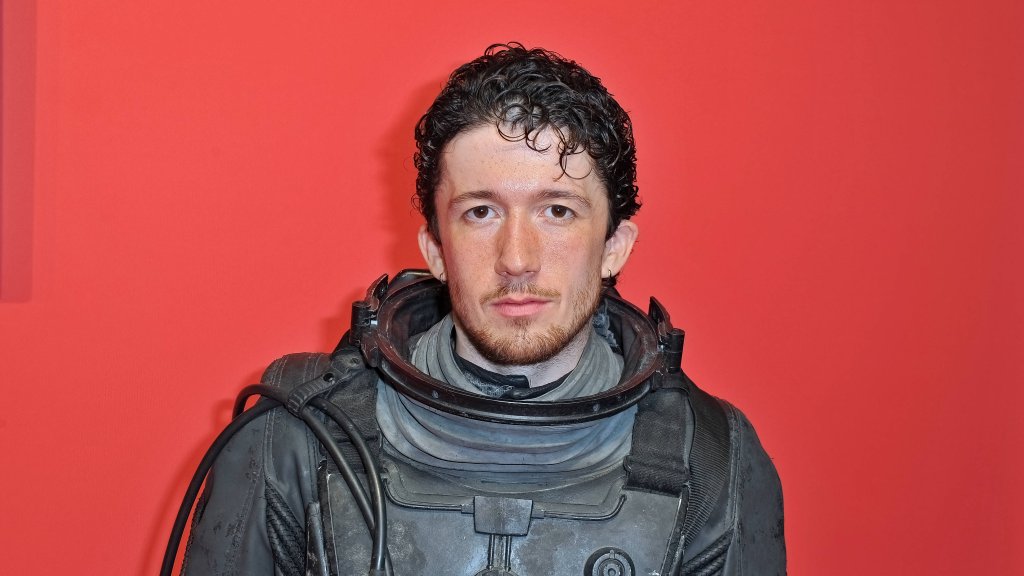
In his new series “Ballz”, actor Maximilian Mundt (30) (German) tackles a subject many men are reluctant to discuss: testicular cancer. Although the illness is central to the plot, the production is conceived as a comedy. For Mundt, the story also offers an opportunity to question traditional notions of masculinity.
The key points at a glance
- New series: In “Ballz”, Maximilian Mundt plays a young man who develops testicular cancer. The story is told as a comedy.
- Personal experiences: Preparing for the role prompted the actor to visit a urologist himself.
- Challenging gender roles: Mundt sees traditional notions of masculinity gaining ground again, including among young people.
- Childhood memories: Even as a schoolboy, he felt under pressure from aggressive behaviour and expectations placed on boys.
- Coming out publicly: Mundt took part in the #ActOut initiative and, contrary to earlier warnings, continued to be cast frequently in heterosexual roles..
Drama and comedy
The actor became known primarily through the Netflix series “How to Sell Drugs Online (Fast)”. In an interview with the FAZ, he explains why the new role particularly appealed to him and which experiences have shaped his own attitude towards gender roles. In “Ballz”, Mundt portrays a young man, Julian, who has to deal with physical changes, uncertainty and social expectations after being diagnosed with testicular cancer. Before an operation, one of the decisions the character faces is whether he wants a testicular prosthesis. Mundt sees the humorous approach as a particular strength of the production. He says he thought it was brave not to tell a story about a serious illness solely as a drama. He also found the script highly entertaining and sharply written.
Exploring the illness had immediate personal consequences for the actor. Mundt describes himself as a bit of a hypochondriac. He says he began thinking about possible symptoms as soon as he read the script. “All I could think was, oh God, wow, what are the symptoms of testicular cancer? How would I recognise it?” he recalls. Mundt then made an appointment with a urologist and had himself examined. This made him realise that many men do not take such examinations for granted. He says testicular cancer had not been a topic of conversation in his own circle for a long time either. The actor therefore hopes that “Ballz” can now help raise awareness as well as entertain. The series could encourage men to engage with their bodies and talk more openly about illnesses.
Old models of masculinity
Mundt says he has been exploring questions of masculinity for some time, both professionally and privately – the current film has brought them to the fore again. He sees the fact that the media occasionally describe him as a representative of a new masculinity as a consequence of his public statements and the roles he has played so far. In “How to Sell Drugs Online (Fast)”, he already played a character whose behaviour was driven by a pronounced ego, criminal ambitions and a need to take up as much space as possible.
His new character Julian, by contrast, embodies a different conflict. He suffers under the expectations associated with traditional notions of masculinity. Mundt does not believe that younger generations have long since moved beyond such ideas. He points, among other things, to young people’s voting patterns in various German federal states, seeing them as signs of a return to conservative social attitudes. In his view, social networks such as TikTok also play a part in this development.
Diversity and security
Mundt also remembers his school years and the years that followed as a period when social diversity was particularly strongly emphasised. He says there was a mood of optimism ten to fifteen years ago. Diversity was celebrated publicly, and major companies presented themselves with corresponding messages. Looking back, however, Mundt also takes a critical view of this development. Major brands also exploited public displays of diversity for commercial purposes. In his view, the coronavirus pandemic subsequently contributed to many people feeling that their previous sense of security was under threat. The multitude of possible ways to live as an individual could also be overwhelming, because it required personal decisions. Traditional ways of life, by contrast, offered seemingly simple guidance. Mundt suspects this is why more people are once again looking to their parents’ and grandparents’ ideas for direction.
Questioning gender roles
According to Mundt, his own childhood was also shaped by traditional gender roles. Although the women in his family often called the shots at home, they were also responsible for almost all household and family duties. At the time, Mundt took it for granted that women both worked and did the bulk of unpaid care and housework. Only later did he begin to question this division of responsibilities fundamentally. His doubts about traditional models of masculinity, however, go back as far as primary school.
Mundt says he certainly enjoyed playing football. He was particularly enthusiastic about the children’s film series “Die Wilden Kerle”. Yet he could not relate to the aggressive behaviour he experienced from some boys on the football pitch. He found the loud shouting, the inability to accept defeat and the competition between the children unpleasant. War games were alien to him too. He says this led him to question his own sense of belonging. “What’s wrong with me if I tend to like the things girls like too?” he asked himself at the time.
Coming out without consequences
As an adult, Mundt also found inspiration in film and television productions for his exploration of gender roles and social expectations. He says the Netflix series “Sex Education” in particular gave him food for thought and opened up new perspectives. He also counts the Swedish series “Young Royals” among the productions that have particularly impressed him. Mundt has explored questions of sexual identity not only in his own roles. He was also among the actors who publicly came out as gay as part of the #ActOut initiative – despite warnings against taking this step, he continues to play many heterosexual roles to this day.
“In a way, I’m pleased about that, because when I took part in the #ActOut campaign in the ‘Süddeutsche Zeitung’ with many other actors back then, I was often warned that coming out might mean I would only get queer roles. Instead, I now often even play men who fit certain hetero-masculine stereotypes, or believe they have to.” He therefore still has no regrets about coming out: “Taking that step felt very good. Of course, now the first headlines you see when you google my name are always about sexuality. Apparently, my queerness is the first defining characteristic about me. Which is also quite interesting, isn’t it? Why that is should definitely be something to think about.”