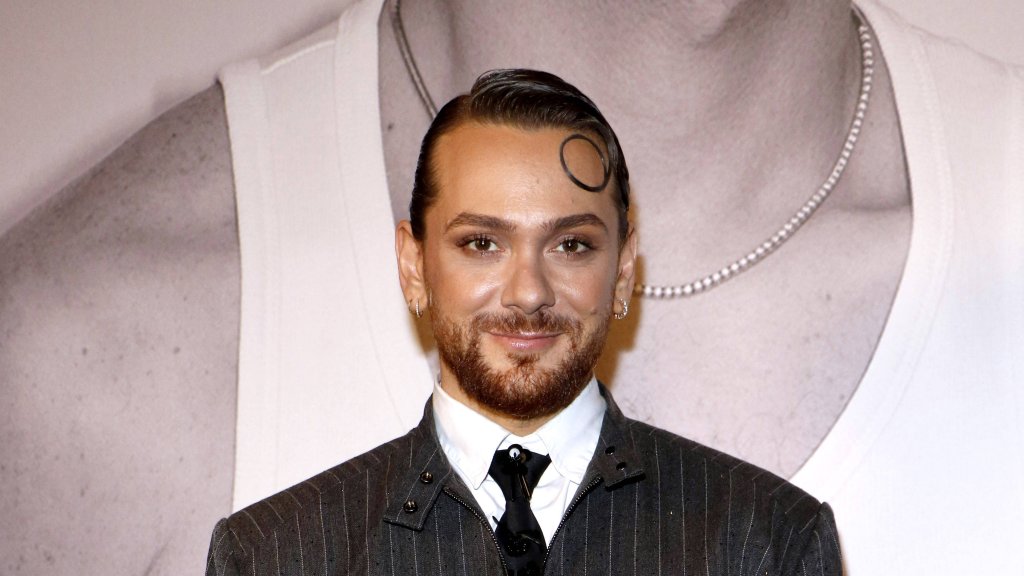
Even as a child, Riccardo Simonetti felt the weight of what others expected of a boy. Because he did not fit that image, he says he was excluded and later even physically attacked. Today, the entertainer, author and presenter feels comfortable as a gay man – and is calling for a broader understanding of what masculinity can mean.
The key points at a glance
- In his new book, Riccardo Simonetti explores masculinity, gender roles and social expectations.
- As early as nursery school, he was made to feel that he was not a “real” boy. Later, Simonetti was spat on and beaten.
- As a teenager, he considered taking hormone blockers, but later realised that he felt comfortable as a man.
- Simonetti also sees rigid ideas of masculinity within the gay community.
- He says he has been refused entry to clubs because of his long hair and make-up.
- He does not reject traditional masculinity outright.
- What matters, he says, is that different ways of life and forms of masculinity are respected.
- Simonetti believes that heterosexual men in particular could learn from queer men to question social expectations and live more independently.
Masculinity in the gay community
In his new book, “Wann ist ein Mann ein Mann?!” (“When Is a Man a Man?!”), Simonetti, who was born in Bad Reichenhall, Bavaria, in 1993, explores a question that he says has been with him for almost his entire life. Speaking to ZEITmagazin, he discusses his childhood, his experiences as a gay man and social expectations that can still put men under pressure today. Simonetti does not spare his own community from criticism. Among gay men in particular, he says, masculinity carries powerful symbolic meaning. Hypermasculine bodies, muscles or beards can become status symbols.
“Male status symbols and male body ideals are often used like a currency in the gay world. The more masculine, the more valuable.” Simonetti deliberately does not conform to such expectations. He wears his hair long and uses make-up. In the past, he says, this has even led to him being refused entry to certain clubs. At one entrance, he was told directly: “We are a club for men.” Although he is a man himself, he was apparently “not the right sort of man” in the eyes of those in charge. Simonetti stresses that such experiences are not confined to him: “The gay community is not free from prejudice either. There are hierarchies. In some places, only a particular form of masculinity is supposed to be celebrated.”
Gender roles change
For Simonetti, many ideas about what is masculine or feminine are shaped by society and can change. “All forms of gender expression are a performance,” he says. He cites high heels, make-up, wigs and dresses as examples. Things now associated primarily with women were also used by men in earlier centuries to display power and social status, he says. Simonetti also points to the history of the colour pink. For a long time, he says, it was considered a masculine colour because it was seen as a lighter shade of red, a colour associated with blood, war and strength.
During the Nazi era, homosexual men in concentration camps were forced to wear the pink triangle. Only after the Second World War, he says, did pink become the classic colour for girls. “The example of pink shows clearly how performative and socially learned gender norms are,” says Simonetti. Understanding that such norms can change helped him personally. “For a very long time, I struggled with the questions of whether I was a real man and how I could live up to my role. It was a blessing when I realised that I did not actually want to conform to this traditional image of a man and could simply live according to my own ideal.”
“Real boys don’t feel pain”
Simonetti grew up in Bad Reichenhall in the Berchtesgadener Land region. Even at nursery school, he says, toys were clearly assigned to either boys or girls. He grew up hearing phrases such as “Real boys don’t feel pain”. Boys were sent to sports clubs from an early age. Simonetti tried fencing and karate, but felt more drawn to the stage and theatre. He grew up as the only boy in a household shaped by women. His mother was a single parent, and his sister, grandmother and aunt were also among the people closest to him.
Looking back, a male figure to identify with might have been helpful in some situations, says Simonetti. Nevertheless, he did not feel the absence of a male role model as a child or teenager. “The women in my life taught me values that society often associates with men: strength, courage, ambition. I am glad that, at home, I was not under pressure to please a man as well.”
Male stereotypes and dolls
At home, Simonetti says, he was allowed to try things that were considered unmanly outside his family. If his sister painted her nails and he wanted to join in, nobody minded. By contrast, he found some of the other men around him intimidating. He recalls teachers and fathers he was afraid of. One experience has stayed with him in particular. As a child, he left a doll at a friend’s house. The next day, his friend told him that his father had thrown it away because he would not tolerate anything like that in his house. His friend would therefore never have dared to play with a doll at home himself.
For Simonetti, a picture that won him a drawing competition at primary school illustrates how limited his own idea of masculinity was at the time. The children were asked to draw how they imagined themselves as adults. Simonetti drew a muscular man with short hair, chest hair and a full beard. He placed a woman on either side of him. While he drew their clothes, hair and make-up in detail, the man was given only a shirt and trousers – and a rose in his mouth. “I had no sense at all of what masculinity could look like for me,” says Simonetti.
Violence because of how he presented himself
As early as nursery school, he says, other boys claimed he was a girl. They mocked him because almost all his friends were girls. As he grew older, Simonetti says, it went beyond words. “I was regularly spat on and beaten, and on the school bus my clothes were even set on fire. All because other people could not cope with the fact that I was a boy who looked and behaved differently.” The constant threat traumatised him, he says. “For a long time, I believed I would be happier as a girl.”
As a result, Simonetti spent years examining his own gender identity. As a teenager, he says, he considered taking hormone blockers. “Not because I was sure I was a girl, but simply to stop time. I longed to extend that neutral state of childhood.” Later, he realised that he was happy with his gender identity. “I feel very comfortable as a man. I just like things that society tends to classify as feminine.”
Privileges and limits
Simonetti says he likes his body, his height and his broad shoulders. At the same time, he is aware of his privileges as a man. As a queer man, however, he cannot benefit equally from all of them. “I cannot walk down the street at night without being afraid, and other men do not automatically see me as an equal either. Above all, I like being a gay man.” Today, Simonetti sees grappling with social expectations as a valuable experience. In his view, gay men often have to consider whether they want to conform to social norms or to their own ideal. What he experienced as a burden in his younger years, he now sees as a “great gift”.
Useful for heterosexual men
Simonetti therefore believes that heterosexual men could benefit from the experiences of gay and queer men. In his view, many of them live “in a cage of social rules” and are afraid of losing their status as men as soon as they depart from traditional expectations. Many gay men, by contrast, have realised that they themselves hold the “key to this cage”, he says. They experiment with their appearance, show emotion and live more openly on their own terms.
“I would wish that kind of self-determined life for heterosexual men too,” says Simonetti. That also means not having to hide supposedly feminine preferences: “A heterosexual man does not have to hide the fact that he likes Britney Spears or paints his nails either. Ordering a matcha does not make anyone unmanly.” However, Simonetti does not want to abolish traditional role models altogether. “I believe stereotypes can be fun too. Norms can provide guidance, and not everything about traditional masculinity is bad. But that should not rule out self-reflection.”
Masculinity is not a problem
For Simonetti, the fact that masculinity is increasingly associated with terms such as toxic masculinity or debates about the so-called manosphere does not mean that masculinity itself is inherently problematic. “I understand that; men cause a lot of problems too. But I do not believe that masculinity itself is the problem. Men turn it into a problem for themselves.” In principle, Simonetti believes it makes sense to “bring a progressive, multifaceted image of men into the mainstream of society”. In his view, a traditional family model can work too. If a man takes on the role of breadwinner and his wife is a housewife, he sees nothing wrong with that, provided those involved choose it freely and also accept other choices.
“Then live your traditional life. My only wish is that these men also respect other ways of life and alternative forms of masculinity.” There is, however, one form of demonstrative masculinity that makes Simonetti chuckle: “gym bro culture”. He observes that heterosexual men work out to achieve a particular physique that will make them more attractive to women – yet, in his perception, the attention they receive comes mainly from other men. “I have never heard a woman say: My God, he is so toxic, but he has really big biceps.”