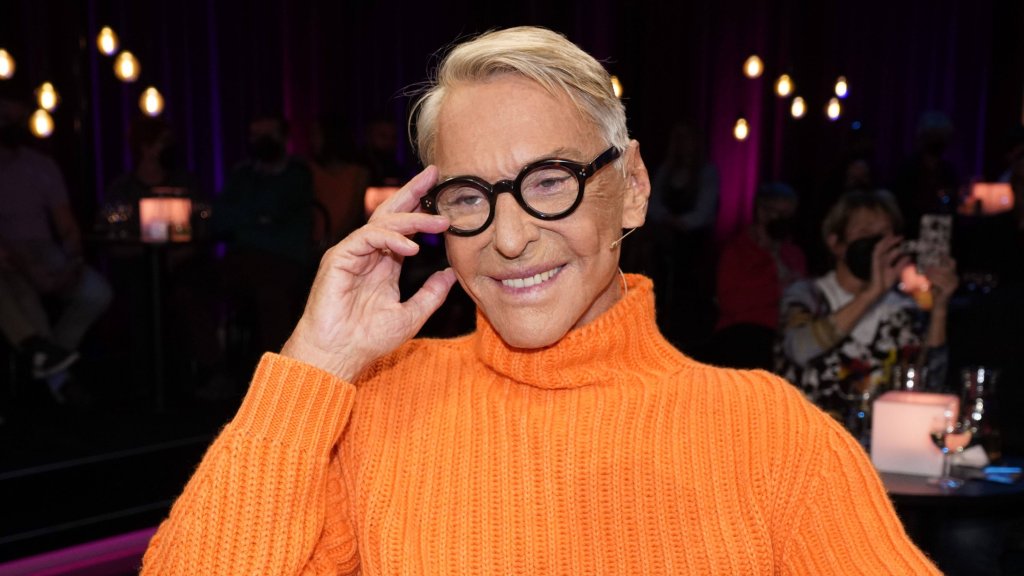
Wolfgang Joop (German) is one of the few German fashion designers whose names have become known far beyond the fashion industry. His designs, his personality and his flair for public presentation made him an established figure in Germany's cultural and media landscape. Today, the designer celebrates his 82nd birthday. His life has taken him from a rural childhood to the world's great fashion capitals.
Key points at a glance
- 82nd birthday: Wolfgang Joop was born in Potsdam on 18 November 1944 and is one of Germany's best-known fashion designers.
- International career: He enjoyed worldwide success with his brand JOOP! He later founded the fashion label WUNDERKIND with his long-term partner Edwin Lemberg.
- Family and private life: He has two daughters, Jette and Florentine, from his marriage to Karin. Joop has been in a romantic relationship with Edwin Lemberg for more than four decades.
- Openness about his sexuality: Joop spoke publicly about his bisexuality as early as 1996. He rejects a strict division of people into homosexual and heterosexual categories.
- Significance for LGBTQ+ people: Through his openness about his sexuality and his long-term relationship with a man, Joop contributes to the visibility of bisexual people and same-sex partnerships.
- Return to his roots: After decades in the international fashion world, Joop is once again living on the family estate in Potsdam-Bornstedt, where he spent part of his childhood.
Sanssouci and Braunschweig
Wolfgang Joop was born in Potsdam on 18 November 1944. He spent his early years on his grandparents' farm in Bornstedt, not far from the grounds of Sanssouci Palace. The rural surroundings, with their gardens, animals and historic buildings, left a lasting impression on him. His childhood fell in the immediate post-war period. After his father returned from captivity as a prisoner of war, the family's circumstances changed. In 1954, they moved to Braunschweig, where Joop spent the rest of his youth.
He developed a keen interest in clothing and design at an early age. While other children followed mainstream fashions, he combined unusual items of clothing and experimented with his appearance. His fondness for unconventional combinations made him stand out even during his school years. He later recalled how he developed a personal style from his family's clothes. His artistic talent was evident early on, but there was initially no sign of a straightforward path into the fashion industry. In Braunschweig, Joop began various courses of study, including advertising psychology and art education. He also explored painting and sculpture, without completing the courses he had started. It was only when he met his future wife that a professional direction began to emerge.
First success with his wife
Karin Benatzky, who was studying costume design and designed clothes herself, became an important creative partner for Joop. While she worked with fabrics and cuts, he produced drawings and designs. The couple married in 1970. That same year, they entered a fashion competition run by the women's magazine “Constanze” and won the top three prizes. Their success opened up new professional opportunities for Joop. Among other things, he began drawing designs for sewing-pattern publications from Bauer-Verlag. A visit to the Paris fashion shows provided another decisive impetus.
There, Joop encountered the work of international designers such as Karl Lagerfeld and Yves Saint Laurent. His encounter with the Paris fashion world changed his understanding of clothing and its creative possibilities. He realised that fashion is not governed solely by fixed rules, but is always also an expression of a particular time and its social changes. In the years that followed, Joop developed his own distinctive design style. His creations combined striking colours and shapes with a feel for the wishes of an international audience.
Global success with JOOP!
Joop achieved his decisive breakthrough in 1979 with a collection of dyed fur coats with a camouflage look. The unusual pieces proved particularly popular with American customers. This success gave rise to the JOOP! brand in the early 1980s, which grew into one of Germany's best-known fashion labels. The company did not limit itself to clothing. Its range gradually expanded to include perfumes, eyewear, jewellery and other accessories. Joop understood early on that a fashion brand depends not only on its products but also on its public image. He therefore made his own personality part of the brand's identity and appeared as the face of its advertising.
This combination of fashion, design and marketing enabled him to reach a wide audience. Alongside Karl Lagerfeld and Jil Sander, he soon became one of Germany's most internationally successful fashion designers. His career took him to New York and Paris, among other places. There, he moved in international cultural and fashion circles that shaped his personal and professional development. In the late 1990s, Joop sold his shares in the JOOP! brand. He left the company in 2001. This marked the end of an important phase of his professional life, but not of his work as a designer.
A new chapter: WUNDERKIND
After leaving JOOP!, the designer turned to a new venture. Together with Edwin Lemberg, he founded the WUNDERKIND label in the early 2000s. The new brand gave him the opportunity to work more closely in line with his own artistic vision. Unlike the broad-based JOOP! brand, the focus was now once again on individual fashion design. WUNDERKIND was shown on international catwalks, including at Paris Fashion Week. The collections were characterised by elaborate patterns, unusual colour combinations and a distinctly artistic approach to design.
Edwin Lemberg was also involved in the work. The two men's relationship thus extended beyond their shared private life to creative and business projects. Joop also remained active in other artistic fields. He published drawings, pursued painting and worked as an author. His versatility made it clear that he had never confined himself solely to the role of a conventional fashion designer.
A distinctive family story
Alongside his professional success, family has always played an important role in Joop's life. His marriage to Karin produced two daughters: Jette and Florentine. Jette Joop became known as a fashion and jewellery designer in her own right. Florentine Joop followed an artistic path and works as a writer and painter. Their parents' marriage, however, did not last. Wolfgang and Karin separated in the early 1980s and divorced in 1985. Nevertheless, the former spouses maintained a close personal bond. Joop has repeatedly spoken publicly about Karin's importance to his development as a person and an artist. Later, the two even lived in close proximity again on the family estate in Potsdam-Bornstedt. Joop also described their shared family history in his autobiography “Die einzig mögliche Zeit”, published in 2019. In it, he explored his childhood, his relationships, his professional development and his role as a father. He did not shy away from difficult memories.
A love spanning decades
One of the most important people in Joop's life is Edwin Lemberg. The two men met in 1977 on the Caribbean island of Martinique. Joop was still married to Karin at the time, and Lemberg was working as a photographic assistant. Their connection began as a friendship. A romantic relationship developed only later, after Joop's marriage had broken down. In interviews, the designer said that he had not immediately recognised the significance of his feelings for Lemberg. The emotional closeness had already been there before he realised that it could turn into love.
Lemberg eventually became not only his life partner but also a close professional partner. Their relationship has lasted for more than four decades. In 2013, the two officially registered their partnership. They did not marry, even after marriage was opened to same-sex couples in Germany. In a joint interview with the magazine “Bunte” in 2024, Joop explained why they had chosen not to. “Perhaps because we did not simply want to copy marriage as an inherently heterosexual and conformist moral institution,” he said. Lemberg described the relationship as a bond sustained by working together and continuing personal development. “We are a team, accomplices, partners who work together and keep working at the relationship, too. Marriage is a state of matter, rather passive and taken for granted,” he explained.
The two stressed that their partnership had not always been free of difficulties. However, their shared enthusiasm for art, culture and creative work had connected them over many decades. Joop described their life together in these words: “We had to take a few deep breaths along the way. But we were united by the euphoria of discovering art and people who make an art of living together. Our daily work together forged a strong bond between us. Living and experiencing life overcame our fears.”
Bisexuality and the community
Wolfgang Joop's attitude towards his sexuality is an essential part of his public persona. In 1996, the designer spoke publicly about his bisexuality. In later interviews, he repeatedly challenged the expectation that people should define their sexuality unequivocally as homosexual or heterosexual. In 2014, he told the newspaper “Bild”: “I no longer want to hear someone say that they are gay or straight. Those days are over.” In the same context, he stressed: “Of course I'm attracted to women too. When you close your eyes, what matters is that it feels good.”
Joop has never tried to hide his long-term relationship with Edwin Lemberg. At the same time, he refused to let himself be defined solely by that partnership. In an interview with Schweizer Radio und Fernsehen (SRF) in October 2019, he spoke at length about sexual identity, social expectations and the question of coming out. Asked why his autobiography did not contain a conventional coming-out story, he replied that his personal development could not be reduced to a single moment.
He also took a critical view of the distinction between homosexuality and heterosexuality. “A homosexual person constantly has to come out,” he said in essence, asking why heterosexual people did not have to explain their orientation in the same way. He described his sexuality as a personal matter that he was certainly willing to discuss, but which could not be fully described in simple terms. “My sexuality has nothing to do with these categories; it is simply my private business,” he explained. At the same time, Joop made it clear that his own path through life had not been without difficulties. Speaking about his personal development, he said: “I took the path I wanted to take.”