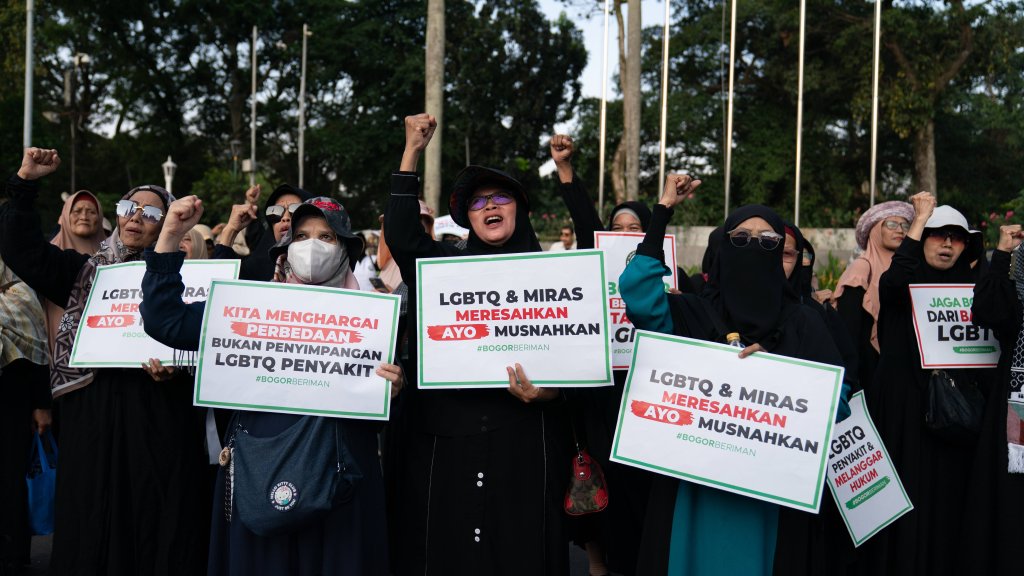
Indonesia's highest Muslim clerical body apparently wants to make significant changes to the way LGBTQ+ issues are addressed in the country. The Indonesian Ulema Council (MUI) proposes replacing the term “LGBT” with “LGSP”. This would group lesbian and gay people together with sodomy and sexual obscenity.
Key points at a glance
- The Indonesian Ulema Council wants to replace the term “LGBT” with “LGSP”.
- This would group lesbian and gay people together with sodomy and sexual obscenity.
- The body is working on a bill intended to criminalise behaviour it considers forbidden, along with related advocacy.
- Human rights organisations report increasing discrimination and violence against LGBTQ+ people.
- A presidential regulation from 2025 classifies the spread of LGBTQ+ culture as a non-military threat to the state.
- Representatives of Indonesian LGBTQ+ organisations warn of potential consequences for education, healthcare and human rights work.
Sweeping bans
Asrorun Niam Sholeh, chair of the council's Fatwa Commission, announced proposal E in Jakarta. The body is preparing an academic basis and a bill to be submitted to the government and members of parliament. The stated aim is to criminalise behaviour and forms of LGBTQ+ that the council considers forbidden. Back in August, the council took a stand against a tradition practised in some Indonesian communities. Men were warned against wearing women's clothing during Independence Day celebrations.
In some communities, men wear dresses and hijabs for football matches held as part of the annual celebrations. In a published statement, the Fatwa Commission described wearing women's clothing as “haram”, meaning forbidden under Islamic law. It also linked the practice to what it described as a covert campaign by the “Lesbian, Gay, Sodomy and Obscenity (or LGSP)” movement.
Growing pressure
According to human rights organisations, the pressure on LGBTQ+ people extends beyond religious institutions and continues to grow. Human Rights Watch reported that attacks on LGBTQ+ students had risen sharply during Pride Month in June. It also said that at least ten state universities had recently introduced discriminatory rules. At the same time, reporting by student media and discussion of gender and sexual diversity on social media had been restricted. The organisation believes these measures undermine freedom of expression and academic freedom. In response to Pride Month events, the Indonesian Ulema Council demanded that “sexual deviance” be subject to harsher penalties than adultery. The body also announced that it was preparing a bill to criminalise LGBTQ+ behaviour and related campaigns.
LGBTQ+ culture as a threat
A similar development is also taking place at state level. President Prabowo Subianto signed Presidential Regulation No. 111 in October 2025. The 2025 regulation sets out Indonesia's general national defence policy for the period from 2025 to 2029. It classifies the spread of LGBTQ+ culture as a non-military threat to the state. It is listed alongside other developments perceived as threats, including terrorism, radicalism, separatism and the spread of banned ideologies. The regulation was first discussed publicly in July, after Indonesian media reported on the relevant passage.
Usman Hamid, executive director of Amnesty International Indonesia, warned that the regulation could institutionalise discrimination against LGBTQ+ people. “Amnesty International Indonesia unequivocally condemns these attacks and intimidation by state and non-state actors on the basis of perceived sexual orientation or gender identity. We urge the Indonesian government to repeal this regulation and fulfil its constitutional obligations and comply with the international human rights treaties it has ratified.”
Sex outside marriage
At the beginning of January this year, a new national criminal code came into force in Indonesia (German). It replaced criminal legislation dating from the Dutch colonial era that had been in force for more than 80 years. The 345-page law had been passed by members of parliament following years of debate and public protests. Provisions on morality, religion and individual rights were particularly controversial. Article 411 criminalises sexual intercourse outside marriage. This can carry a prison sentence of up to twelve months — automatically making sex between gay people illegal. Article 412 also provides for a prison sentence of up to six months for living together as a married couple outside a legally recognised marriage. The new rules also apply to gay tourists.
LGBTQ+ organisations warn of consequences
Purba Widnyana, chair of GAYa Nusantara, an Indonesian LGBTQ+ human rights organisation, told the Washington Blade that the situation for LGBTQ+ people in Indonesia was becoming increasingly worrying. The development was not limited to increasing violence, Widnyana said. He also pointed to growing anti-LGBTQ+ sentiment in public spaces, on social media, in educational institutions and in politics. “The effects do not always take the form of physical violence. Many LGBTQ+ people are beginning to lose professional opportunities because they are seen as a ‘risk’ to organisers. There is also concern that growing stigmatisation and fear could prevent people from accessing healthcare services, including HIV tests and screening for sexually transmitted infections, because they fear that their identity or sexual orientation could become known.” According to Widnyana, the development is also putting a strain on the work of LGBTQ+ organisations. “We are constantly on alert,” he said.
On the planned LGSP regulation and the decision to replace the term LGBTIQ+ with a classification that links sexual orientation to sexual misconduct, Widnyana said the council was conflating fundamentally different concepts. “I really don't know where to begin. They are clearly confused because they are conflating identities — in this case sexual orientation — with sexual misconduct and acts understood to be violations or criminal offences, namely sodomy and sexual obscenity. The change shifts the way Indonesians understand or perceive LGBTQ+ issues — away from identities, rights and existence towards misconduct, morality and crime. We also see this in the context of a narrative that has been developing for a long time and portrays LGBTQ+ as a ‘product of the West’ or as ‘Western propaganda’. In this context, LGSP can be understood as their attempt to reject the way LGBTQ+ people define themselves and replace it with a category determined by those who reject the existence of LGBTQ+ people.”








