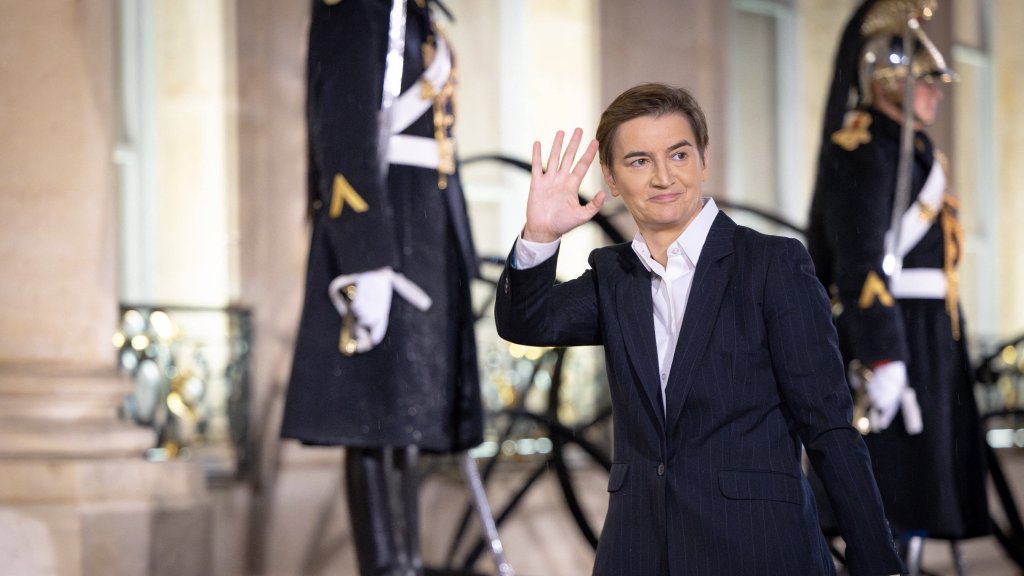
Former Serbian prime minister Ana Brnabić (51) has assumed the presidency on an interim basis following the resignation of Aleksandar Vučić (German). The openly lesbian politician has thus become head of state for the first time. The official handover took place in Belgrade on Monday.
The key points at a glance
- Ana Brnabić has assumed the Serbian presidency on an interim basis following Aleksandar Vučić’s resignation.
- The openly lesbian politician previously served as prime minister and speaker of the Serbian parliament.
- Brnabić has therefore held all three of the country’s highest political offices.
- Under Serbian law, she may serve as acting president for a maximum of three months. An election for a new head of state must take place within that period.
- Brnabić was prime minister from June 2017 to March 2024, becoming the first woman and the first openly gay person to hold the post.
- Despite her own sexual orientation, as head of government she had opposed making LGBTQ+ reforms such as same-sex marriage a political priority.
- Homosexuality is legal in Serbia, and several laws also prohibit discrimination against LGBTQ+ people.
Brnabić assumes the presidency
“It is a great honour for me to take over this office from such a person, and it is now my duty to fulfil this role until the people elect Serbia’s next president,” Brnabić said after the handover. Vučić resigned as president on Sunday. Under Serbian law, in such a case the speaker of the National Assembly temporarily assumes the duties of head of state. This transitional period may last no longer than three months. For the Serbian Progressive Party politician, this is already the third of her country’s highest political offices. Brnabić was Serbia’s prime minister from June 2017 to March 2024. She subsequently became speaker of the National Assembly.
Brnabić had already made history when she took office as head of government in 2017. She was the first woman and the first openly gay person to lead the Serbian government. At the time, however, Brnabić did not want to put her sexual orientation at the centre of her political role. “Serbia is changing, and changing fast, and if you like, I am part of that change. But I do not want to be labelled ‘Serbia’s gay prime minister’,” she said at the time. “The message we need to convey is competence, professionalism and trustworthiness.”
No priority for same-sex marriage
Homosexuality is legal in Serbia. The country also has laws against discrimination against LGBTQ+ people in areas including employment, housing, education and the media. Trans people can also have their legal gender markers changed. However, this requires a psychiatric diagnosis and prior hormone therapy. Although Brnabić herself is openly gay, after taking office as prime minister she made it clear that she did not intend to make further LGBTQ+ reforms, such as the introduction of same-sex marriage, a political priority.
“The reason I am not focusing on this now is that I deeply and genuinely believe that Serbia will be a more tolerant society once people have jobs, better-paid jobs, do not have to worry about their own livelihoods or their own children’s future, and do not have to think about two or three generations living in the same flat,” she said.
Serbia is not homophobic, she says
Brnabić also said that she did not regard Serbia as homophobic, despite differing social attitudes towards homosexuality. She spoke of journalists who had asked residents of villages in central Serbia about their sexual orientation. The response, she said, had been: “Well, listen, in this part of Serbia we grow raspberries, fruit and vegetables, and we do not grow discrimination.” Brnabić made it clear at the time that, in her view, differences within society did not necessarily have to be resolved through legislation. “The citizens of Serbia have a right not to be portrayed by a vocal minority,” she said. “We can have a culture in which we disagree, as long as there is tolerance and no violence. We all have different views and values, but I do not want to change people’s thinking by law.”
All three top offices held
By assuming the presidency on an interim basis, Brnabić has now become the first person in Serbia to have held all three of the country’s highest political offices: prime minister, speaker of parliament and acting president. Serbia’s foreign policy direction is also likely to play a role during her interim presidency. Under Vučić, the country pursued the goal of joining the European Union while also maintaining ties with Russia and Chinese investors. Vučić explained his resignation by saying that he wanted to take part in the forthcoming snap parliamentary elections as an ordinary citizen. These are scheduled for 25 October. Following his resignation, the presidential election must take place by the end of December at the latest.








