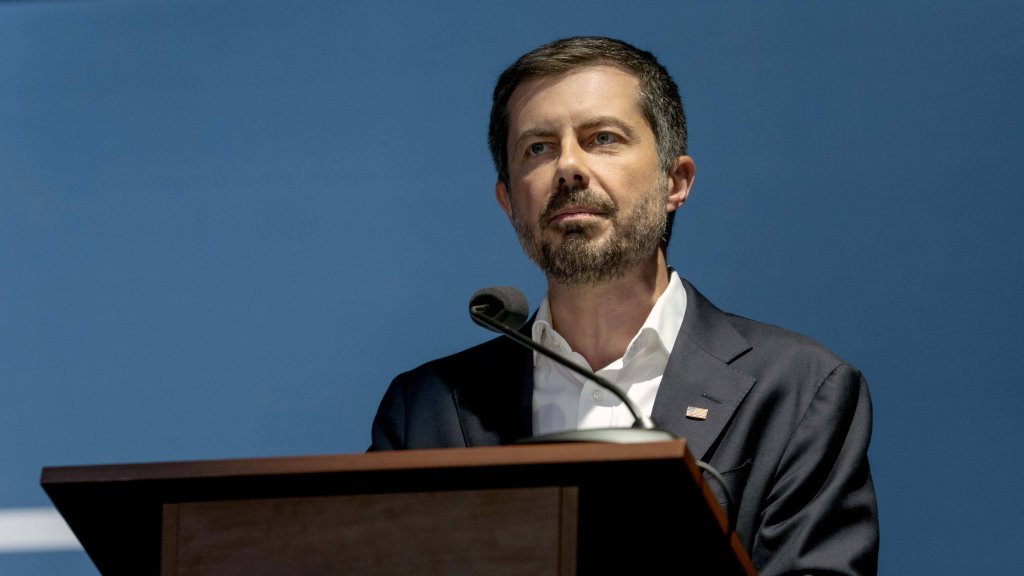
If Pete Buttigieg really does not intend to run for president after all, he is currently doing little to make that impression credible (German). The former US transport secretary is on the campaign trail, supporting his preferred candidates. That is not unusual for a potential presidential contender at this stage of the political cycle. What stands out, however, is that Buttigieg is investing a large share of his time and energy in candidates for state legislatures.
Key points at a glance
- Pete Buttigieg is increasingly supporting candidates for US state legislatures.
- The former transport secretary and potential presidential contender wants Democrats to learn from the Republicans’ successful strategy at state level.
- Republicans currently control 28 state legislatures, Democrats 18.
- Democrats want to strengthen their party structures in all 50 states again.
- The strategy is seen as an indication of what a potential Buttigieg presidential campaign would look like: no state should be abandoned entirely.
Republican dominance
Buttigieg began doing this in his home state of Indiana. He is apparently also working on a list of endorsements in other states. Buttigieg points to the Republicans’ success in building political power at state level. Democrats should learn from this, he told the political news outlet Politico: “This is an area where Democrats should learn from Republicans, who have patiently and skilfully built power over many years from the school board level upwards.”
The Republican Party has used its control of state legislatures to advance its political agenda. This includes numerous measures against trans people, as well as partisan gerrymandering: the deliberate redrawing of electoral boundaries to favour one party. The Supreme Court has upheld some such electoral maps. State legislatures are also an important springboard for politicians who later want to pursue careers at federal level. Almost half of the current members of the US Congress previously served in a state legislature.
Making up lost ground
Developing new political talent is also important for Democrats because their party leadership is seen as too old. State legislatures provide an important pool of talent for this purpose. However, Buttigieg is also pursuing his own interests through his involvement. If he launches a presidential campaign, political contacts and supporters at state level could work to his advantage. Regardless of this, Democrats have invested comparatively little in state legislative elections in recent years. Republicans currently control 28 legislatures, Democrats 18. Control of three legislatures is split between the parties. In Alaska, a cross-party coalition governs.
Buttigieg will not, however, find it easy to lead a movement that brings, for example, the legislature in his home state of Indiana under Democratic control. Many states traditionally lean strongly towards one party. Changing that political alignment can take a long time – if it can be done at all. The aim, therefore, need not be to turn a strongly Republican state such as Idaho into a Democratic-dominated one. Rather, it is about building on the party’s political advantages wherever possible and limiting Republican influence as much as possible. Democrats currently see good opportunities to do this. In several states, they could take control of one or both legislative chambers. In others, they could break Republican supermajorities.
A strategy for all 50 states
“By and large, Republicans are currently playing defence rather than offence,” Katy Owens Hubler, director of elections and redistricting at the National Conference of State Legislatures, told Stateline. Democrats are therefore returning to a strategy in which the national party invests in the respective party organisations in all 50 states. However, many influential politicians and strategists in Washington opposed the strategy. They included people who later served in Barack Obama’s administration.
Buttigieg is therefore now pursuing the strategy on his own initiative. How much influence an individual politician can have in this remains an open question. For the high-profile gay politician and the Democrats, the effort could nevertheless pay off if the currently anticipated wave of Democratic success does materialise. At the same time, Buttigieg’s approach could offer an indication of what a potential presidential campaign by the former transport secretary would look like: not writing off any state entirely.








