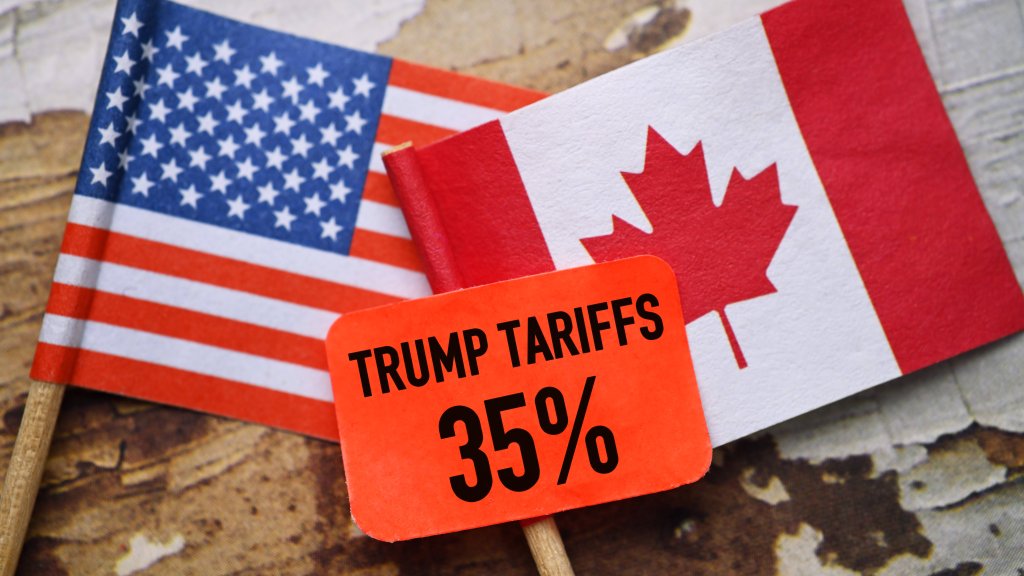
Trade tensions between Canada and the US are repeatedly and increasingly affecting Canada's queer economy too. Small businesses that have previously sold a large proportion of their goods to US customers in particular must prepare for higher costs, falling sales and new sales channels.
Key points at a glance
- US tariffs and growing trade tensions are making cross-border sales significantly more difficult.
- Canadian businesses can face duties of up to 50 per cent on goods entering the US.
- Canada responded with retaliatory tariffs on US products worth almost US$30 billion.
- Almost 70 per cent of businesses surveyed by the Canadian Queer Chamber of Commerce (CQCC) describe the US market as important.
- Almost 90 per cent expect moderate, significant or severe financial impacts from the tariffs.
- According to the CQCC, more than 120,000 queer businesses contribute around US$86 billion to annual gross business revenue in Canada and employ almost half a million people.
- The CQCC wants to open up new international markets, including in London, Madrid, Mexico City, Amsterdam and Tokyo.
New tariffs make matters worse
Kelly Blenus, an artist from Halifax, is experiencing this too. Her small business, Resting Pride Face, sells accessories, stickers and paintings featuring Pride designs. She has not sold anything to the US for around six months. The reason, she says, is simple: US tariffs and growing trade tensions have made selling across the border “almost impossible”. “When I started, my sales were mainly to the US, but now I sell practically nothing there,” says Blenus. “Unfortunately, many of my online customers were in the US. I put a great deal of work into my online shop, but now most of my work comes from local markets because doing business online is simply becoming more and more difficult.”
Blenus is not alone. At the end of August, US President Donald Trump imposed a new round of tariffs on Canadian goods. This expanded the range of Canadian products subject to high import duties. For Canadian business owners supplying US customers, charges at the border can reach up to 50 per cent. Additional tariffs apply to other imported goods such as steel and aluminium. These also affect costs throughout supply chains and, in turn, manufacturers. Earlier in the week, Trump also announced an import ban on certain Canadian goods, including Canadian alcohol. Canada responded with retaliatory tariffs on US products worth just under US$30 billion.
Challenges and potential
Liana Georgiewa, Chief Operating Officer of the Canadian Queer Chamber of Commerce (CQCC), says the ongoing trade disputes are creating uncertainty for queer entrepreneurs in Canada. At the same time, she says, this is an opportunity to explore potential new business prospects. The non-profit CQCC advocates for LGBTQ+ entrepreneurs and businesses in Canada. Among other things, it offers training programmes and organises accreditation initiatives that connect consumers with queer-friendly businesses.
“I believe the tariffs are actually not just a challenge, but hold great potential for us,” says Georgiewa. “It is a chance to unlock the potential that is already here.” This week, the CQCC published the results of a new survey of its member organisations. The findings suggest considerable concern among businesses. Almost 70 per cent of respondents said the US market was important to their business. “People do not want to lose their customers because of political decisions at the highest level,” says Georgiewa. “The reality is that relations between the US and Canada have developed over many years and continue to be an important source of growth and opportunity.”
New opportunities – including in Germany
Almost 90 per cent of LGBTQ+ respondents expected the tariffs to have moderate, significant or severe financial impacts on their businesses. Almost 60 per cent expected falling sales or revenue. Almost 50 per cent anticipated higher operating costs and additional pressure on cash flow. Uncertainty over the tariffs could fundamentally change the long-standing trade relationship between the US and Canada. Georgiewa sees this as a reason to seek new opportunities in other countries. She says the CQCC survey showed that businesses wanted to explore new partnerships. Help finding connections with new customers outside the US was among the most frequently requested forms of support.
“There is a strong desire among businesses to find practical ways to adapt and grow, and we are actively seeking to diversify markets,” says Georgiewa. “We are taking part in global trade missions because there are more countries we can form partnerships with, and more economies we can work with, than just the US.” The CQCC wants to establish international trade missions involving London, Madrid, Mexico City, Amsterdam and Tokyo, among others. Georgiewa also highlights potential trade opportunities with countries such as Germany. “I really feel that this is a moment when Canada can play a bigger role geopolitically. And because Canada's queer economy is already so strong, I believe it too should play an important role at this moment,” she says.
More than 120,000 queer businesses
Georgiewa emphasises the importance of queer businesses to the Canadian economy. According to her, more than 120,000 queer businesses in Canada generate around US$86 billion in gross business revenue annually and employ almost half a million people. Despite the opportunities for new forms of growth, Georgiewa acknowledges the immediate negative consequences for businesses. She says businesses with a large US customer base and those with few employees are particularly affected.
Queer businesses, she says, are often small operations rather than large corporations. In the CQCC survey, 86 per cent of respondents had fewer than 50 employees. This could mean they have fewer ways to cushion the effects of difficult economic times. “Such businesses often have less flexibility to absorb unexpected costs or lost revenue, so the financial impacts can be greater,” says Georgiewa. “The biggest challenge really is the uncertainty about how to manage costs and what that will mean for customers and growth.”
Growing demand for Canadian products
For other queer entrepreneurs in Canada, shifting business away from the US is not solely a consequence of the current tariff disputes. Kelsi Morris, owner of the yarn shop Bistitchual in Toronto, has made selling exclusively Canadian products part of her business model. “Many people shop in the US or elsewhere without realising how talented Canadian yarn dyers are,” she says. “I really wanted to show people that we do not necessarily have to shop internationally. We have great talent here in Canada.”
Georgiewa sees the way forward primarily in cooperation, solidarity and political advocacy. She says businesses must stick together and advocate at government level for their interests and stronger representation. “We are seeing a very resilient community, and despite the ongoing uncertainty over tariffs, our organisations have shown a high level of confidence in their ability to adapt,” she says. “Throughout history, our communities have had to find so many ways to adapt and grow. The same applies to major economic developments. That is a great strength of our community.”








