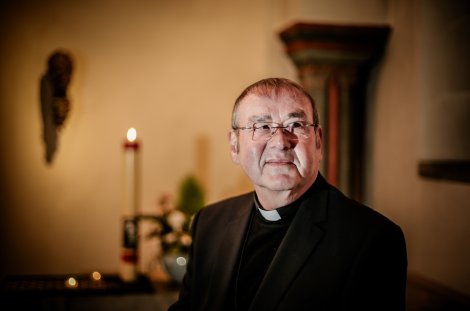
Ludger Schepers (73), Auxiliary Bishop of Essen, has been the first commissioner for queer affairs at the Deutsche Bischofskonferenz (DBK) since 2023. It is a position and a line of work that may initially surprise many LGBTQ+ people. SCHWULISSIMO wanted to find out more and invited the auxiliary bishop for an exclusive interview.
What motivates your commitment?
I can really only answer that question in very personal and emotional terms, because my commitment is not an obligatory exercise in Church politics, but something deeply rooted in my own life story. Looking back, a firm outlook on life runs like a thread through everything: since my youth, I have been positively allergic to any form of discrimination. That began in very concrete ways at school and was later profoundly shaped by my historical awareness — by knowing about the atrocities of the Nazi era and the systematic persecution not only of Jewish people, but also specifically of homosexuals and other groups. For me, it was always clear: as a Christian, I must never look away when people are excluded. What drives me is a firm belief in a Church that must be a safe, protective place for every person — without exception.
How do you define your work as commissioner for queer affairs?
If I had to sum up my daily work in a single word, it would be: networking, networking and more networking. That is the heart of my role. I do not see myself in this role as a lone decision-maker, but as a bridge-builder and a connecting point in a vast, growing network. In practical, everyday terms, that means maintaining links between the newly appointed commissioners for queer affairs in almost all German dioceses, Catholic school providers, associations and, above all, gay, lesbian and queer initiatives themselves. My most important goal is to create spaces where these different stakeholders can reliably enter into dialogue, exchange experiences and learn from one another. This also defines the central focus of my work: raising awareness and keeping the concerns of queer people firmly in view and on the agenda in our Church. We must no longer allow this issue to disappear behind closed doors or be forgotten in bureaucratic drawers. We must keep bringing the lived realities of queer Christians onto the agenda of the bishops' conference and into the heart of our parishes. It is about turning words on paper into lived reality. In short: my daily work is about bringing the threads together behind the scenes so that a culture of appreciation in our Church becomes irreversible.
Can you understand why some LGBTQ+ people are taken aback when they first hear about a Catholic commissioner for queer affairs?
I not only fully understand that scepticism and sheer disbelief — I also consider them entirely justified. When you have the official, often hurtful rhetoric of the past ringing in your ears, a “commissioner for queer affairs at the bishops' conference” initially sounds like a contradiction in terms, almost like a PR stunt. As a Church, we do, after all, look back on centuries of exclusion. People's distrust is a logical consequence. I respond to this discrepancy with two things: unsparing honesty and concrete action. First: I do not sugar-coat the situation. The position is not a sign that everything is suddenly fine. Rather, it is the bishops' acknowledgement that we have a huge amount of work to do here and an obligation to deliver. And second, I say to the sceptics: do not look at the titles, look at the movement. There are now people responsible for queer pastoral care in almost all German dioceses. Creating the role at national level was not a token gesture, but an institutional acknowledgement that queer people are part of God's plan for creation and therefore, quite naturally, part of our Church. My job is not to paint a pretty picture for the outside world, but to tackle difficult, entrenched obstacles through constant, sometimes tough dialogue with my fellow bishops and the Vatican, so that this initial bewilderment can one day give way to a dependable, fear-free normality for all believers.
What changes have you already been able to initiate?
In an institution like the Catholic Church, change is rarely measured in quantum leaps. It is often the small, persistent steps that ultimately shift the foundations. But when I look back over the past few years, we have reached very concrete and pioneering milestones. One particularly important success is the publication of the widely discussed guidance document “Created, Redeemed, Loved” for Catholic school providers. With it, we have created a powerful tool for day-to-day practice, enabling our schools finally to offer queer young people appreciation, protection and openness. Another milestone is virtually ready to go to print: the synodal paper “Gender Diversity”. Of course, I also say quite openly that there is still enormous room for improvement, and the road ahead is long. But being queer is more visible as an issue in our Church today than ever before. It can no longer be pushed back — and that irreversible presence is perhaps the greatest success of all.
How do you perceive the mood within the Catholic Church?
I perceive the mood as deeply ambivalent — and, to be honest, in many respects the Church reflects what we are currently experiencing in society too. We must not close our eyes to the fact that the treatment of queer people in public debate has also become harsher, more polarised and more ambivalent again. The Church does not exist in a vacuum; we feel these social tensions directly within our own ranks. On the one hand, I encounter wonderful, profound support. There are so many people in pastoral ministry, so many parishes and committed believers who are advancing this issue with incredible empathy, openness and theological foresight. They are already living out a Church in which everyone is welcome without reservation. On the other hand, however, I still encounter open, painful rejection. But that is precisely why our work is so important: it is about overcoming the inability of these camps to speak to one another, creating spaces for genuine encounters and making it unmistakably clear that human dignity is non-negotiable — in society and in the Church alike.
Where do you encounter the greatest internal resistance?
The greatest resistance can rarely be pinned on particular individuals or groups. Rather, it lies in a deep-seated, structural culture of fear of change and an insistence on what is supposedly familiar. In an institution that has been geared towards stability and absolute clarity for centuries, allowing diversity and new perspectives understandably unsettles some people. The greatest resistance is often a deeply rooted inability to talk and a fear of losing one's theological foundations through reform. It is not primarily about ill will, but about the fear of losing control and disrupting established habits. My approach is therefore to respond to this resistance not with confrontation, but with patience.
What is your assessment of the fact that blessings for same-sex couples are so far offered in only around half of Germany's dioceses?
I would rather not embark on a simplistic classification of “good” and “bad” dioceses here. Far more important than these percentages is the theological and pastoral reality behind them: with the document Fiducia supplicans, Pope Francis opened a door in the worldwide Church that no one can slam shut again. It is now officially possible to bless couples living in what canon law calls irregular or difficult circumstances. The fact that there are major theological reservations about this in other parts of the world, such as Africa, is part of the reality of a worldwide Church. We have to live with that. What matters to me is this: if two people take responsibility for one another and want to walk through life together trusting in God, then we must be able to give them this blessing. What matters is that God's blessing is there wherever people love.
What does this lack of consistency mean for credibility?
Let me answer with a question: is consistency in the sense of uniformity even a desirable state for a living Church? I do not think so. Struggling, debating and even arguing within a worldwide Church is entirely normal and, historically speaking, profoundly Catholic. A lack of consistency does not in itself damage credibility — it is the diversity of life. What really does enormous damage to credibility is something quite different: the polemics we are currently experiencing. In many places, we see deliberate division that serves only to consolidate or justify one's own position at any cost. The other side's theological or pastoral competence is dismissed wholesale, often simply to conceal one's own insecurity and remain safely within one's comfort zone. The crucial step is for us finally to enter into genuine discussion and leave destructive polemics behind. We must make the debate more objective and stop artificially inflaming emotions. Only when we learn to live with different perspectives without immediately stigmatising the other person as un-Catholic or backward will we genuinely move forward as a Church.
How do you experience the relationship between the German Church and the Vatican on sexual morality?
Media perceptions often suggest an unbridgeable divide here, but that falls far short of the reality. And above all: constantly reducing everything to sexual morality is simply too easy. As a Church, we must finally stop constantly peering into people's bedrooms. That is not our job. People in our society — and therefore also in the Church — are concerned with quite different, far more fundamental questions today. How can we achieve a just society? How can we create spaces in which everyone can freely develop their individual abilities and talents and lead a life that is meaningful to them — without devaluing or excluding others? Here in Germany, we are witnessing a massive social shift, a worrying rise in support for the AfD and a polarisation that extends into the younger generation. We see young people suddenly once again sharing a view of humanity and society that we thought we had long since overcome — a view based on exclusion, nationalism and the devaluation of others. The real fault line — or, rather, the real challenge for us bishops, whether in Germany or at the Vatican — is to restore the standing of our shared Christian understanding of the human person. As a Church, we must be a clear, unmistakable voice for the dignity of every individual and for social cohesion.
How do you deal with German reform efforts repeatedly meeting with rejection at the Vatican?
I do not want to sugar-coat anything: this tension affects me deeply, and sometimes it is damn hard to bear. There are days when I, too, feel profound frustration. When you see how much passion, hope and pain countless people invest in these reforms, and then the next “no” comes from Rome — that hurts. This is not a theoretical conflict; it is an emotional ordeal. As an auxiliary bishop, I am very aware of my limitations. I do not have my hands on the most powerful levers of the worldwide Church; I cannot rewrite major decrees single-handedly. But I have learnt not to let this powerlessness paralyse me. My personal way of dealing with this tension lies in everyday life, in direct encounters locally. Wherever I am, I can make my contribution. And for me, that contribution means resisting the temptation to engage in polemics, even when the anger is great. Staying in dialogue, especially when it hurts. And above all: listening deeply to people. The worldwide Church may change agonisingly slowly, but the Kingdom of God begins in small ways, from person to person.
Do you see a risk of a rift?
People are quick to use the word “rift” or even “schism”, but I do not see that danger as inevitable. Yes, the tensions are real, and they are painful. But wrestling with the right way forward has been part of the Church's DNA for as long as it has existed. We are a worldwide Church — by definition, that means we encompass an enormous diversity of cultural, social and historical contexts. A rift threatens only if we confuse unity with uniformity. There must be a legitimate diversity of pastoral approaches. What is timely and urgently needed in Germany today may still require a longer process of maturation in other parts of the world. But I want to make one thing absolutely clear: for me, reaching out to queer people and recognising their dignity and their partnerships is not a matter of following the modern zeitgeist, but a fundamental consequence of God's love for every individual. For me, this position is non-negotiable.
How important is the personal attitude of local bishops?
It is not just important — it is fundamentally the decisive key to everything. We can write the best reform papers and pass the wisest resolutions, but unless those texts are underpinned by a tangible attitude that is lived out, they remain lifeless words on paper for local people. Credibility depends on faces, not file numbers. For me, personal attitude means one thing above all: a willingness to engage wholeheartedly with people who may live, love and think very differently from me. A bishop must not be a distant administrator of principles. He must have the courage to leave the comfort zone of his own certainties, to listen and to allow the lived realities of queer people to move and challenge him.
What do you say to queer believers who feel hurt by the Church?
The starting point here cannot and must not be a theological argument, but only a completely honest acknowledgement: I am deeply sorry. As a Church, we must have the courage to say that through our language, through exclusion and through a narrow moral theology, we have inflicted deep wounds — wounds that often endure for generations. If you ask me for my specific message, it is this: you are not a mistake of creation. You are absolutely intended, you are blessed and you are an integral part of this Church. Your faith and your identity are not a contradiction. And I want to say to people: do not let anyone deny you your place in this Church. Without you, the Church is simply incomplete. Your presence and your voice are prophetic — they hold a mirror up to the institution and challenge us finally to take the radical breadth of the Gospel seriously.
How can queer people rediscover the Church as a home?
It is certainly no longer enough simply to leave the doors slightly ajar and talk about a “culture of welcome”. Nobody wants merely to be tolerated. We need to work on the architecture. A sense of home only emerges where I no longer have to explain, justify or disguise myself. For the Church to become a home, structural and theological development is needed. It is about openly establishing blessing ceremonies everywhere, about genuine visibility in Church offices and about employment law that protects diversity rather than threatening it. As long as people have to fear discrimination because of their identity, the promise of a “home” remains fragile. We must move from mere tolerance to genuine equality.
What does “pastoral care on an equal footing” mean to you when working with LGBTQ+ believers?
For me, it means one thing above all: radical equality of dignity. As pastoral carers, we must leave behind the perspective of the instructor once and for all. I do not meet another person as an authority laying down norms or as someone who has to correct a supposedly “deficient being”. Engaging on an equal footing means listening first. Making room for the pain and people's experiences of the institution without immediately explaining them away. And it means unconditionally respecting the individual's conscience as the highest authority. I do not presume to judge a person's capacity for love and relationships. Pastoral care on an equal footing means looking together for traces of God in the other person's life. It is accompaniment, not lecturing — we are simply fellow travellers in faith who see the diversity of creation as an enrichment.
Auxiliary Bishop Schepers, thank you very much for speaking to us.