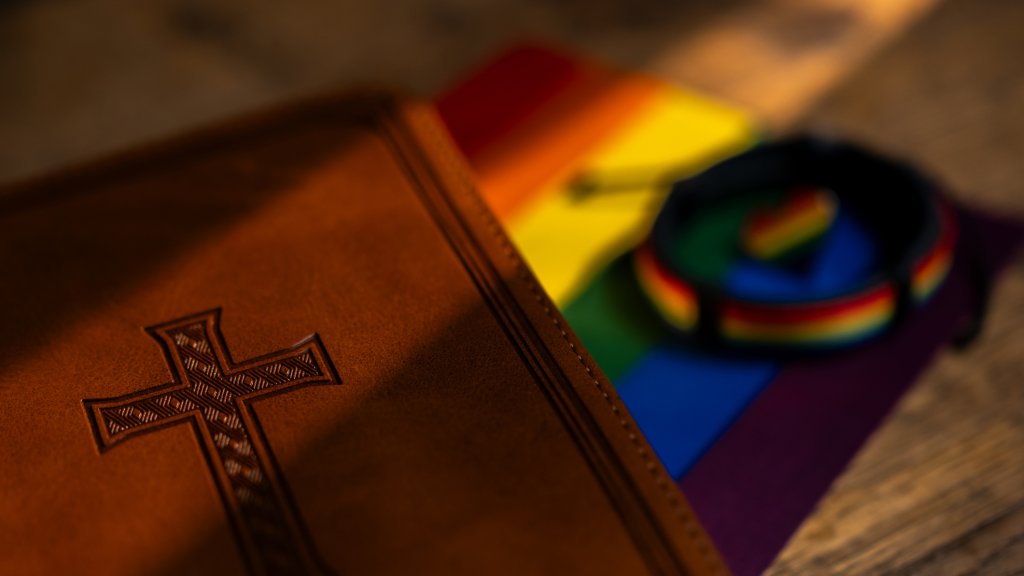
Many LGBTQ+ people grow up in religious communities – and experience rejection or conflict there because of their identity. As a result, some lose their familiar congregation and their social support.
The key points at a glance
- Many LGBTQ+ people experience rejection, exclusion or pressure to hide their identity in religious communities.
- Experts increasingly describe religious trauma as a consequence of such experiences.
- LGBTQ+-friendly churches in the USA focus on visible diversity, inclusive language and greater self-determination.
- Those affected report that accepting congregations have helped them reconcile their faith and sexual identity.
Between exclusion and a fresh start
Jacob May from Virginia describes one such experience. When he was 22, he discussed his homosexuality with his pastor. The clergyman referred to Bible passages frequently used to reject homosexuality. May countered by pointing to translation errors and historical context. “We should keep meeting every week,” his pastor said. He wanted to continue impressing upon May that homosexuality was a sin punishable by eternal damnation. After this conversation, May broke off contact.
He later lost his former church community. “I just felt really alone,” May, now 34, tells the investigative outlet Uncloseted Media. “I felt like I basically had to start my life over because so many of my connections, friends and basically my entire subculture were in the church … I remember times when I just sat on my bed and cried.” It was only through the LGBTQ+-friendly St. Paul’s Episcopal Church that May found his way back to faith.
Religious trauma and its consequences
Research shows that religion plays an important role in childhood for many LGBTQ+ people. A study published in 2016 found that 86 per cent of LGBTQ+ people grow up in faith communities. Almost two-thirds of LGBTQ+ people with a Christian upbringing no longer identify as Christian later in life. Psychologist Tyler Lefevor, who studies queer and gay people’s relationship with religion, says that hiding one’s identity can have psychological and physical consequences. These include post-traumatic stress disorder, anxiety, elevated cortisol levels and high blood pressure.
Losing a religious community can also be distressing, he says, because it leaves people “cut off from community and a source of meaning and a way of understanding the world”. Many LGBTQ+ people therefore seek congregations where faith and identity are compatible. According to a multi-year study by researcher Andrew Marin, 76 per cent of queer people who had left the church were open to returning to faith.
More than just token gestures
LGBTQ+-friendly churches are trying to help people work through such experiences. Zach Lambert, pastor of Restore Church, warns against merely presenting an inclusive image. “They think that a rainbow flag at the entrance or a mention of Pride is enough to help someone overcome what happened to them, and that simply isn’t the case,” Lambert says. What matters, he says, is a church culture in which queer people are not only welcome but also take on responsibility and are represented “in every area of leadership”.
Visible diversity is another important factor. Mariah Montgomery-Lindsay, who grew up in a conservative religious environment, describes her first visit to Restore as a formative experience. “It was so frightening to enter a church with my partner as a visibly lesbian couple,” she says. But seeing another gay couple outside the church changed how she felt about that fear. “Nobody even looked twice,” Montgomery-Lindsay says.
Language and self-determination
Language also plays a central role in many LGBTQ+-friendly congregations. In some churches, members introduce themselves with their pronouns, and prayers and songs deliberately use different terms for God. Lucius Seo, a 31-year-old teacher from a Korean Presbyterian background, sees this as an important difference from earlier experiences. “In the churches I grew up in, God was very neatly put into the box of a father figure. In the Bible, however, God is very mysterious and infinite,” Seo says. “At River, our songs use all pronouns and all forms of expression.”
Alongside inclusive language, some congregations take a trauma-informed approach to their services. People should be able to decide for themselves whether and how they participate. The Rev. Alison Noll of The River congregation says: “We won’t pressure you into anything here, and so you need to take responsibility for yourself and decide how much you want to participate.”
A new understanding of faith
Some LGBTQ+-friendly churches avoid specific statements about Bible passages or Jesus so as not to hurt anyone. Experts also see a challenge in this, however: for some people coming from strongly Bible-centred congregations, an overly open-ended theology can be unsatisfying. The Lighthouse congregation therefore focuses on engaging closely with religious texts. Karlyn Meyer says the church does not shy away from difficult Bible passages. “If there’s something terrible in there, then let’s find out the context,” she says. “Let’s find out what it was and why.”
For Jacob May, precisely this opportunity was crucial. “Once I had found an affirming church, it was no longer about arguing over whether it’s possible to be gay and Christian,” he says. Instead, he was able to focus on faith, service and the “beloved community”. May now attends St. Paul & St. Andrew Church and completed a master’s degree in religious studies in April. “This church was the first place where I didn’t feel I had to hide,” May says. “The best thing affirming churches have done for me was to give me space to process things. They didn’t try to convert me or make me believe what they believe. They accepted me as I am.”








