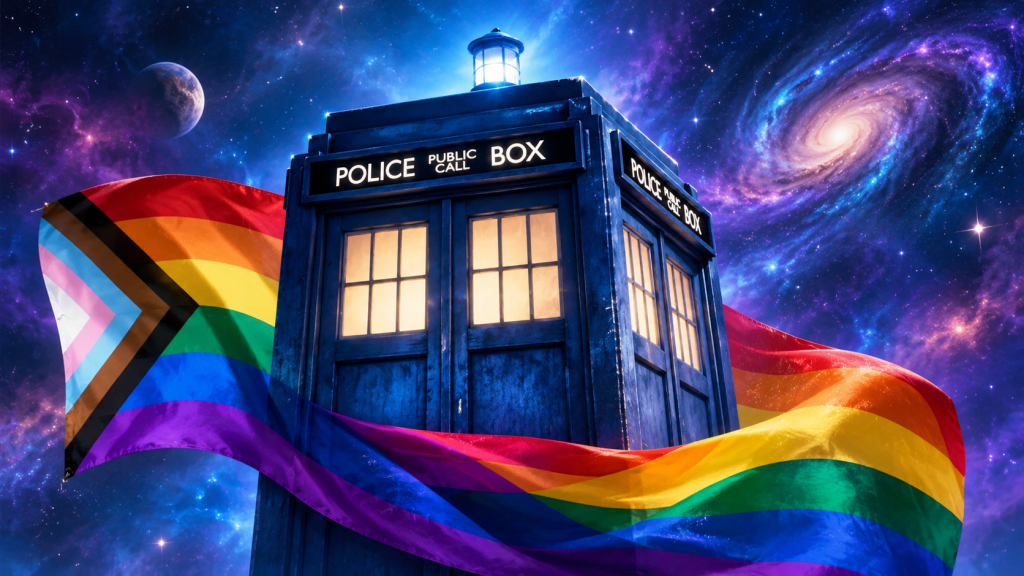
A blue police box (Tardis) that is bigger on the inside than on the outside, an alien with two hearts and enemies that look like oversized salt shakers in a chronically bad mood: welcome to “Doctor Who”. What began as a British science-fiction series on 23 November 1963 has long since become a global cult phenomenon. That is why fans are celebrating Doctor Who Day this Monday. For many LGBTQ+ people, it is more than just another television anniversary.
The key points at a glance
- A cult series celebrates its birthday: the first episode of “Doctor Who” was broadcast on the BBC on 23 November 1963. The date has since become known as Doctor Who Day.
- A hero beyond fixed identities: the Doctor can change his appearance, his body and even his gender. This makes the character particularly interesting to many LGBTQ+ fans.
- Diverse characters: through Captain Jack Harkness, Bill Potts, Yasmin Khan and Donna Noble’s trans daughter Rose, the series has brought different LGBTQ+ lives into view.
- LGBTQ+ talent behind the camera: writers and actors such as Russell T Davies and Ncuti Gatwa have helped shape the series.
- More than entertainment: for many fans, “Doctor Who” also tells stories about self-determination, acceptance and the courage to be different.
Being different is not a flaw
While other science-fiction heroes prefer wielding laser guns and flaunting their masculinity, the Doctor would rather solve problems with brains, compassion and a sonic screwdriver. And when all else fails, he simply saves the entire universe. Once again. Above all, though, the series has spent decades conveying a message that has particular significance for many LGBTQ+ people: being different is not a flaw. It can even be your greatest strength. Perhaps the Doctor’s most unusual trait is his ability to regenerate. Rather than dying for good, the time traveller can take on a new body. His appearance, personality and occasionally even his gender change in the process. What would trigger a fairly serious identity crisis in other television series is practically part of the day job in “Doctor Who”. New hairstyle, new face, new personality – and yet the Doctor remains the Doctor.
This idea particularly fascinates people who grapple with society’s expectations around gender and identity. Regeneration is not a direct portrayal of a queer experience. It does, however, offer an unusual metaphor for the idea that identity is not determined solely by outward characteristics. When Jodie Whittaker first appeared as the Thirteenth Doctor in 2017, it was the first time a woman had played the character. For some traditionalists, this was apparently a greater threat than all the Daleks put together. Yet the series had long since established that the alien Time Lords could change gender. Later, Ncuti Gatwa became the first black actor to take on the regular lead role (German). The openly LGBTQ+ actor gave the Fifteenth Doctor a particularly emotional, joyful and self-assured presence. His character was allowed to dance, cry, flirt and travel through the universe in extravagant clothes. And none of this was taken as a reason to question his ability to save the world.
Flirting across the galaxy
The series’ revival in 2005 played a crucial role in LGBTQ+ visibility. The man responsible was gay screenwriter and producer Russell T Davies, who had already made television history with “Queer as Folk” (German). Under his leadership, the Doctor’s universe became considerably more diverse. This was particularly striking in the case of Captain Jack Harkness, played by John Barrowman. The charming time agent from the 51st century cared very little about gender boundaries in his romantic adventures. Men, women or aliens: Jack flirted with an enthusiasm that might occasionally have overwhelmed even the sonic screwdriver.
His character was remarkable precisely because his sexuality was not constantly treated as a problem. Jack was brave, funny, sometimes rather exhausting and, above all, a fully fledged hero. He later even got his own television series, “Torchwood”. His love story with Ianto Jones became a particularly popular part of the wider Doctor Who universe. Other characters also broadened LGBTQ+ representation. Bill Potts, played by Pearl Mackie, was the Doctor’s first openly lesbian regular companion. Yasmin Khan developed romantic feelings for the Thirteenth Doctor, who eventually reciprocated them, although the two did not enter into a relationship. The message behind this was strikingly matter-of-fact: even in a galaxy full of talking potato creatures, alien dictators and murderous statues, different sexual orientations are simply part of life.
Trans character wins over the Tardis
The series took another important step in 2023 with Rose Noble, Donna Noble’s daughter. Rose is played by trans actress Yasmin Finney, who had already become known through the Netflix series “Heartstopper”. Rose is herself trans and faces rejection and transphobic hostility in the story. At the same time, she receives support from her family, particularly her mother Donna. The character thus represents a development that goes beyond mere visibility. LGBTQ+ characters should not be defined solely by discrimination, but portrayed as people with their own desires, relationships, strengths and weaknesses. A trans teenager having an important role in one of Britain’s longest-established television series would have been almost unimaginable when the first episode aired in 1963. At the time, sexual acts between men were still criminal offences in England and Wales. Partial decriminalisation did not come until 1967. Today, portraying different identities is part of how the Doctor Who universe sees itself.
LGBTQ+ fans and the Doctor
The special relationship between “Doctor Who” and the LGBTQ+ community, however, goes back further than its explicitly LGBTQ+ characters. The Doctor has always been an outsider. A being who has left his home, does not quite fit society’s norms and would rather travel with unusual people than with the powerful figures of the universe. His companions are often people underestimated by those around them. Together, they discover that their supposed weaknesses can become particular strengths.
For many LGBTQ+ viewers, this is a familiar experience. People who feel different from an early age or do not meet society’s expectations may find something in such stories that is missing from everyday life: a place where difference does not have to be explained or apologised for. Russell T Davies has himself described how closely his love of the series was connected to his experiences as a young gay man. While other boys were interested in football and girls, he remained devoted to the Doctor. At times, he felt that both sides of his identity were something he would rather keep to himself. That relationship has since changed fundamentally. What was once sometimes seen as an embarrassing passion has long since become part of a confident fan culture.
Extravagant villains
Another reason “Doctor Who” is such a good fit for the LGBTQ+ community is its pronounced fondness for the offbeat, the theatrical and the over-the-top. The series often takes its stories very seriously, but fortunately does not always take itself quite so seriously. There are alien rulers with questionable fashion sense, monsters with an impressive flair for self-presentation and villains who would clearly never enter a room without making a spectacular entrance. In 2024, for example, drag artist Jinkx Monsoon caused a stir as the musical villain Maestro. The character combined a supernatural threat with an appearance so extravagant that even an average Eurovision performance would have looked restrained alongside it. Neil Patrick Harris (German) and Jonathan Groff were also among the prominent LGBTQ+ actors who took on important roles in more recent episodes. A romantic attraction even developed between the Doctor and Groff’s character Rogue. This shows just how far the series has moved away from the television conventions of its early years.
A special community
The connection between “Doctor Who” and LGBTQ+ people is evident not only in its stories but also in its fan community. Over the decades, conventions, fan gatherings and online communities have created spaces where fans can share their enthusiasm and make connections. These include events specifically aimed at LGBTQ+ people. Fan fiction, costumes, artworks and discussions frequently explore questions of identity, relationships and self-determination.
This is hardly surprising. After all, the series depicts a universe in which almost anything is possible. Anyone who can accept a living plastic person, an intelligent space station or a library full of deadly shadows should not really have much difficulty with two men in love. And yet “Doctor Who” has not escaped criticism either. Individual portrayals of LGBTQ+ characters have been criticised as superficial or clichéd. More recent storylines have also sparked debates about gender roles and representation. So the series is by no means free of contradictions. Its long evolution does, however, show just how much society’s ideas can change.
The Doctor’s future
As it marks its 63rd birthday, “Doctor Who” once again faces an uncertain future. Ncuti Gatwa left the role in May 2025. The series finale featured a surprise appearance by Billie Piper, who had previously played companion Rose Tyler. What this appearance meant for the Doctor’s next incarnation initially remained unclear. Further changes followed in 2026. Russell T Davies announced his departure as showrunner. The Christmas special originally planned was also scrapped. The BBC said it intended to continue working towards a long-term future for the series. For fans, this is probably just another dramatic twist in a television story that has regularly survived the end of the universe anyway. And perhaps that is precisely where the loveliest message of Doctor Who Day lies: change does not have to mean the end. Sometimes it is the beginning of something new.
That is why 23 November is about far more than nostalgia for a British science-fiction series. Doctor Who Day is also a reminder of how important stories can be when they allow people outside society’s norms to find their place. The Doctor does not need flawless heroes. He trusts people who have doubts, make mistakes, are unusual and still have the courage to do the right thing. Perhaps that is why the series means so much to many LGBTQ+ people. It does not promise a perfect world, but one in which difference need not be a barrier to friendship, love or heroism. And if the universe should ever decide otherwise, there is bound to be a blue police box standing ready somewhere. With a rather eccentric alien inside who will put things right again.








