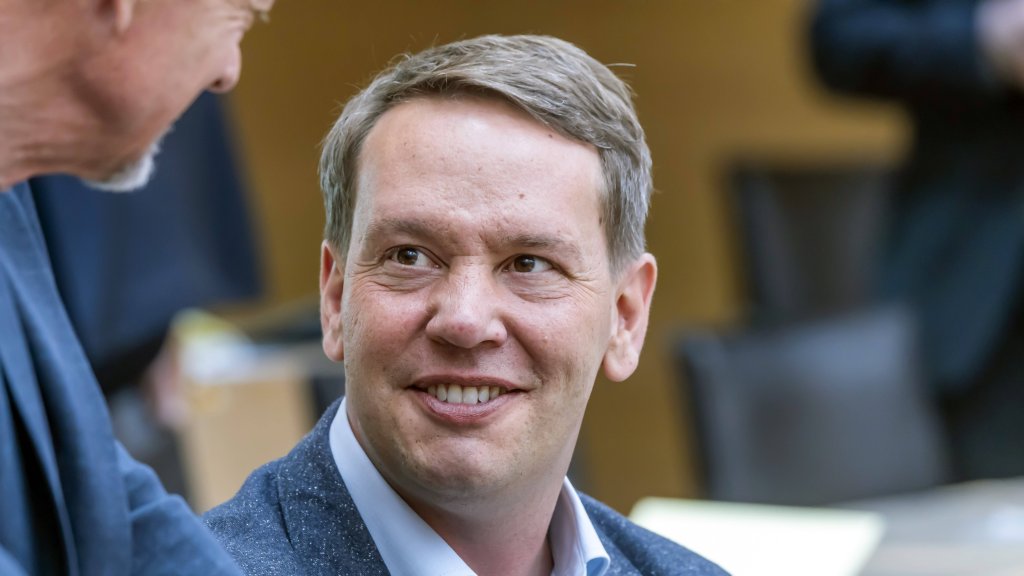
What is it like to grow up as a gay boy in a small, rather conservative community? And how do those experiences later inform your political work? Baden-Württemberg’s Social Affairs Minister Oliver Hildenbrand (Greens) explored these questions in a personal conversation with broadcaster Südwestrundfunk.
The key points at a glance
- Personal insights: Social Affairs Minister Oliver Hildenbrand (Greens) talks about his childhood in a small, conservative community and his experiences as a gay teenager.
- The 38-year-old is openly gay and wants to encourage others not to hide their identity.
- The SWR conversation covers rainbow families, different family models, the desire to have children and the controversial issue of surrogacy.
- Greater equality: Hildenbrand supports a fairer division of care work between women and men.
- Warning about a shift to the right: the Green politician sees minorities coming under increasing pressure and calls for legal proceedings to ban the AfD.
Openly gay in Stuttgart
In the episode of SWR’s video podcast “Zur Sache! intensiv” released yesterday, the 38-year-old spoke about his childhood, coming out and how social acceptance affects the lives of gay and queer people. Hildenbrand grew up in Freudenberg in the Main-Tauber district. In the conversation, he recalled his youth in a small community of around 160 residents and the experiences that shaped him as a gay boy. This also touched on the feeling of being different and possibly not quite belonging. Today, Hildenbrand is openly gay. According to his ministry, he lives with his boyfriend in Stuttgart. Since May 2026, the former state chair of the Greens has been Minister for Social Affairs, Labour and Health in the state government led by Minister-President Cem Özdemir. His personal experiences also play a part in how he sees his political role.
Giving people courage
Hildenbrand wants to use his public position to offer guidance and support, particularly to young LGBTQ+ people. “It’s also simply about giving people the courage to embrace who they are, to be who they are and to live the way they want to live,” the minister said in the SWR conversation. He sees himself not only as a member of the government, but explicitly also as a representative of the interests of gay and queer people. “It really is important to me to be an advocate for the queer community in Baden-Württemberg.” Hildenbrand regards the visibility of lesbian, gay, bisexual and queer people in society as an important political concern. He warns that people from minority groups are coming under increasing pressure and could therefore withdraw from public life. There are attempts, he said, “to push people back into invisibility, to silence people too, so that they don’t dare to speak out, don’t dare to show themselves”. In the minister’s view, the state has a duty to counter such developments and protect minorities.
Rainbow families in focus
Alongside his personal experiences, Hildenbrand used the SWR conversation to explore how family policy can accommodate the different ways people live in Germany. Topics included rainbow families, different forms of living together and the desire to have children among people who do not fit the traditional family model of a mother, a father and their children together. One focus was the declining birth rate and the question of why people decide against having children or do not fulfil an existing desire to have them. This also covered balancing work and family life. Hildenbrand called for a fairer division of care work between men and women. Different family structures also play a part in this debate. Social recognition of rainbow families is just as relevant here as the legal and practical conditions for parenthood.
The Jens Spahn case
The socially and legally controversial issue of surrogacy was also discussed. In Germany, both arranging surrogacy and carrying out the associated reproductive medical procedures are prohibited in principle. Some other countries have different rules. The debate touches on questions of reproductive self-determination, the protection of women and children, and the legal recognition of different family structures. Supporters of legal reform to permit surrogacy point, among other things, to the opportunities it could offer people whose desire to have children remains unfulfilled. Critics warn in particular of economic pressure on women carrying pregnancies for others and possible forms of exploitation.
Hildenbrand did not explain his specific position on surrogacy legislation, but addressed the Jens Spahn case, which had made headlines this year: “All those people who felt called upon to pass judgement on Jens Spahn’s family model, and the tone some of them used — well, I don’t know whether that was appropriate.” He also stressed: “The personal is always political too. And I think the debate might have gone differently if Jens Spahn had campaigned to change the CDU’s policy in that respect — to change its very firm opposition to surrogacy.” Finally, he also said: “These are very difficult things to weigh up, and I can’t make any statement about them today because I haven’t looked into the issue enough either.”
Loneliness as a problem
Beyond family policy, Hildenbrand addressed a development that affects people regardless of their sexual orientation: increasing loneliness (German). The SWR conversation focused particularly on young adults and why people often feel isolated despite being digitally connected. Topics discussed included the influence of social media, a lack of places to meet and declining social cohesion. Hildenbrand does not regard loneliness solely as an individual problem. Rather, he sees it as a challenge for society that politicians must also address. He wants to tackle the problem with a state-level strategy.
Responding to the AfD’s successes
Towards the end of the conversation, Hildenbrand also commented on political developments in Germany. He views the AfD’s recent electoral successes in eastern Germany and its growing importance with concern. The Green politician accuses the party of becoming increasingly radical and attacking people who do not fit its worldview. “These are open attacks on the values of our Basic Law and our constitution. And they are also very clearly attacks on people who do not fit this party’s worldview. And that has an impact on those people too,” Hildenbrand said. He also lamented increasing social division.
“There are clearly more and more people who spend all day thinking about how to turn people against one another, how to play people off against one another, how to belittle people.” Hildenbrand described the election of an AfD politician as president of the state parliament in Saxony-Anhalt as a “dramatic turning point”. He expressed surprise that the public reaction had not been stronger. The minister is calling for proceedings before the Federal Constitutional Court to ban the AfD. “It has long been too late to ‘nip it in the bud’, and we should act. Protecting our democracy in our open society matters to us, and we will also use the instruments our constitution provides for that purpose.”
Cuts to “Demokratie leben”
Hildenbrand also criticised the plans by the CDU/CSU–SPD federal government to end funding for numerous projects under the federal “Demokratie leben” programme (German). Federal Family Affairs Minister Karin Prien (CDU) wants to withdraw funding from around 200 projects, including numerous LGBTQ+ projects. Critics accuse the programme of politically one-sided funding. Hildenbrand believes the cuts are the wrong approach. “In my view, this is not a strategy for weakening the opponents of democracy; rather, it is liable to weaken the defenders of our democracy.” At the same time, he called on the established parties to be more self-critical and pursue policies with a stronger focus on concrete results. “Less political theatre, less pointless arguing, more joint results, more clear implementation — these are, of course, things we need to take on board.” Politicians need to seek out conversations with citizens more often and give them the feeling that their concerns are being heard.








