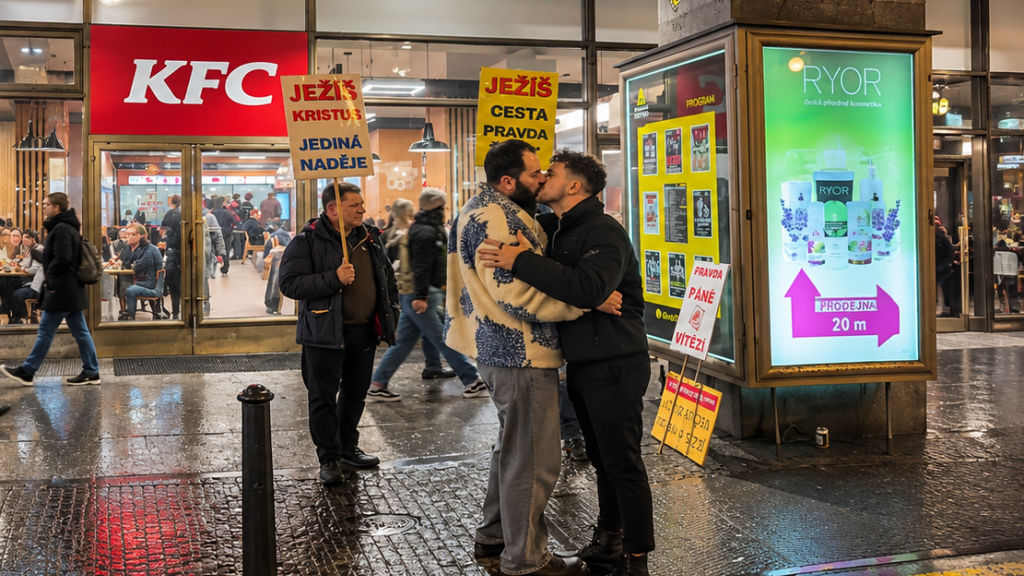
Two gay men have taken a stand against homophobia by kissing in front of a group of religious demonstrators in the Czech capital, Prague. The gesture by journalist Filip Titlbach and psychologist Přemysl Khýr quickly spread on social media. But alongside widespread support, the footage also prompted fierce hostility.
The key points at a glance
- A kiss in protest: Two men kissed in Prague in front of a group of religious demonstrators who, they say, regularly protest against LGBTQ+ people.
- Video spreads rapidly: The footage received more than 230,000 likes on Instagram within a day.
- A symbolic location: The gesture took place on Národní třída, where the Velvet Revolution began in 1989.
- A stand for equality: Journalist Filip Titlbach and psychologist Přemysl Khýr wanted to defend the right to show affection as publicly as religious beliefs.
- Death threats after publication: Alongside numerous positive reactions, the two men received hate messages and several death threats.
A kiss at a historic site
The two men posted the video on their Instagram accounts. Within 24 hours, it received more than 230,000 likes. In the caption, they explained: “My boyfriend and I fight narrow-mindedness and hate with love. Freedom is for everyone.” The kiss took place on Národní třída, a central street in Prague. Every year, people gather there to commemorate the beginning of the Velvet Revolution of 1989. On 17 November 1989, a student demonstration on Národní třída marked the start of the protest movement that brought an end to communist one-party rule in what was then Czechoslovakia within five weeks. After more than four decades of communist rule, parliamentary democracy was restored. The anniversary is a national holiday in Czechia and symbolises freedom and democratic self-determination.
Khýr explained that the location’s historical significance had been crucial to their gesture. “Here in Czechia, this is a national holiday when we commemorate the Velvet Revolution and celebrate freedom and democracy,” the psychologist said. According to him, the two men were facing a group of religious demonstrators who regularly appear at public events. “The men behind us regularly come to these events carrying banners with images of Christ,” Khýr explained. The banners read “Jesus Christ: The only hope” and “Jesus: The way, the truth and the life”.
The right to show affection
Titlbach and Khýr said their kiss was not intended to challenge religious demonstrators’ public presence in principle. Rather, their point was that the freedom to express beliefs publicly must apply equally to everyone. “We felt that we had just as much right to show each other affection as they had to express their faith in public. On a day when we celebrate freedom, that seemed particularly meaningful to us,” Khýr said. His boyfriend Titlbach stressed that the gesture had not been planned in advance.
“The whole thing happened spontaneously. We regularly encounter these people at events such as Prague Pride, where they try to spread hatred against LGBTQ+ people,” the journalist explained. Titlbach covers LGBTQ+ issues in his work. Khýr works as a psychologist and psychotherapist, and his clients include LGBTQ+ people. Both say they are familiar with homophobic remarks and protests. “I think we have both simply had enough. And sometimes you have to stand up visibly and symbolically for what you believe is right,” Titlbach said.
Several death threats
The public response to the kiss was predominantly positive. They said the rapid spread of the footage and the many supportive comments had encouraged them. However, the response was not entirely supportive. After posting the video, Titlbach and Khýr also received hate messages. “Most of the reactions online were positive, which encouraged us,” Khýr reported. “But we also received hate messages, including several death threats.” He said he found it particularly frightening that an everyday gesture between two men could provoke such aggressive reactions. “It is disturbing to imagine that the sight of two men kissing can lead someone to threaten us with death,” the psychologist said.
Same-sex marriage
The gesture also draws attention to the legal situation of same-sex couples in Czechia. The country legally recognises same-sex partnerships. The partnership provisions grant couples extensive rights equivalent to those of married couples. However, marriage has still not been fully opened to same-sex couples. Political initiatives to that effect have so far met with resistance from conservative MPs and church circles. A legal distinction therefore remains between same-sex and different-sex couples.








