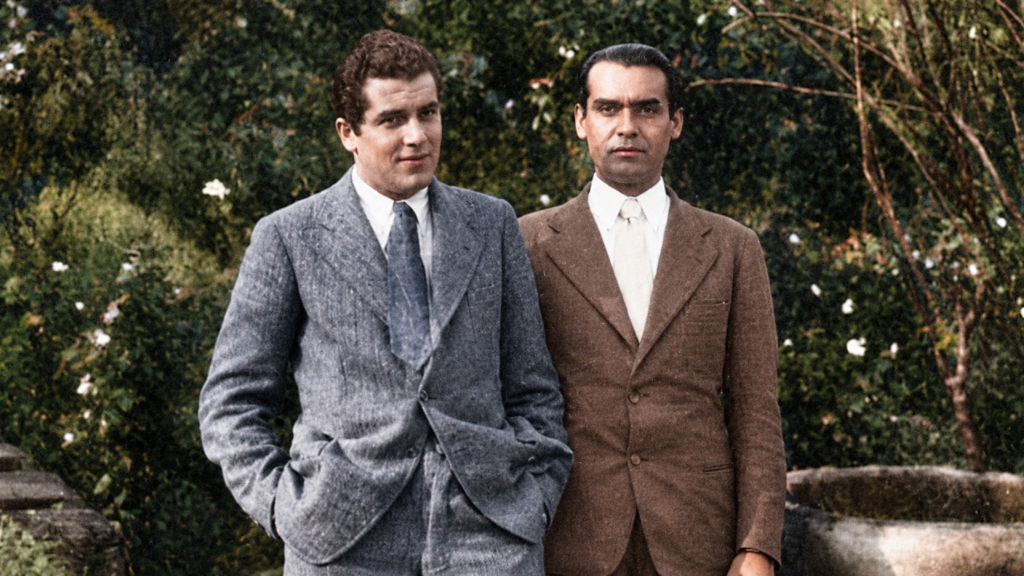
A secret love, two violent deaths and an unfinished play: the gay historical drama ‘La Bola Negra’ tells the story of a largely suppressed chapter of Spanish history. At its heart is the poet Federico García Lorca, whose relationship with Rafael Rodríguez Rapún was a major inspiration for the film.
Key points at a glance
- A gay historical epic: ‘La Bola Negra’ by Javier Ambrossi and Javier Calvo brings together three stories spanning a century of Spanish history.
- A true love story: the film draws on the relationship between the poet Federico García Lorca and Rafael Rodríguez Rapún.
- An unfinished work: Lorca wrote just four pages of his play ‘La Bola Negra’ before he was murdered in 1936.
- A tragic fate: after Lorca’s death, Rapún joined the Republican army and died in 1937 from injuries sustained in a bombing raid.
- The filmmakers combine documented events with fictional scenes, recalling queer lives long suppressed in accounts of history.
The true story
Directors Javier Ambrossi and Javier Calvo bring together three storylines from different eras. Spanning a century, the work explores same-sex love, social exclusion and the legacy of gay people. The film is currently being discussed as a potential Oscar contender and has already been acclaimed at several film festivals. It is expected to be released on Netflix at the end of the year (German). Yet the truth behind the film remains far less well known.
Federico García Lorca ranks among the most important Spanish poets and playwrights of the 20th century. His works shaped Spain’s cultural development. His homosexuality was also an important part of his life, yet one that was often overlooked in public perceptions of him for many years. In 1936, Lorca was shot dead at the beginning of the Spanish Civil War. His left-wing political beliefs and his homosexuality are considered possible motives for his murder by Nationalist forces. Shortly before his death, the writer had begun work on ‘La Bola Negra’. It was his only known play intended to place an explicitly gay character at its centre. He was able to write no more than four pages. The filmmakers draw on this fragment and develop it into a broader story.
Homosexuality as a problem
The first historical storyline is set in Granada in 1932. It centres on Carlos, played by emerging actor Milo Quifes. Like his father, the young man wants to become a member of an exclusive social club at the local casino. But rumours about his homosexuality lead to his application being rejected. This part of the film follows Lorca’s unfinished play relatively closely.
A second story takes us to 1937, in the midst of the Spanish Civil War. The trumpeter Sebastián, played by musician Guitarricadelafuente, survives an attack on his home town by posing as a supporter of the Nationalist troops. He is then forced to work as a guard in a military hospital. There, he is tasked with watching over a wounded political prisoner portrayed by ‘Élite’ actor Miguel Bernardeau. The prisoner is Rafael Rodríguez Rapún. The plot is based on Alberto Conejero’s play ‘La Piedra Obscura’. While Sebastián is a fictional character, Rapún was a real person.
Rapún was Lorca’s lover
Rapún came from a working-class family in Madrid and was involved in the socialist youth movement. He met Federico García Lorca through the capital’s vibrant theatre scene. He joined ‘La Barraca’, the theatre company co-founded by Lorca, initially as an actor. During a tour in 1935, he took on organisational duties. The two men are said to have fallen in love during this period. Surviving letters offer an insight into their relationship. Lorca affectionately called Rapún ‘the man with the three Rs’ – a reference to his initials. He also wrote of the ‘strong attraction’ he felt towards him. Many literary scholars believe that Lorca’s last known poems, the ‘Sonnets of Dark Love’, were inspired at least in part by the relationship.
Lorca’s murder and Rapún at war
The two men’s relationship was brought to an end by political events in Spain. When Rapún learnt of Lorca’s murder in 1936, he decided to join the Republican army and fight against the Nationalist troops. He served as a lieutenant on the front line. In 1937, he was seriously wounded in a bombing raid and died a short time later in a military hospital near Spain’s northern coast. Both men thus lost their lives within a short period during the Civil War. The film does not reproduce these historical events entirely unchanged. The directors take artistic liberties, particularly in their portrayal of Rapún’s final days.
One particularly important scene in the final part of the film is an encounter between Lorca and Rapún for which there is no historical evidence. In a black-and-white flashback, the two lovers have one last conversation. Lorca, played by Alberto Cortés, tells Rapún about his idea for a new play called ‘La Bola Negra’. He hopes it will reach young gay people who are afraid to be open about their identity. The scene gives the two men a farewell that history denied them. The filmmakers also draw on historical photographs here. At the end of the flashback, for example, an actual group photograph of Lorca, Rapún and friends is recreated. This illustrates how closely historical records and fictional narrative are interwoven in ‘La Bola Negra’.
Suppressed gay history
With their historical drama, Ambrossi and Calvo aim to do more than tell a tragic love story. They also turn the spotlight on people whose homosexuality has often been concealed or treated as incidental in historical accounts. This is particularly evident in the case of Federico García Lorca. Although his works are still taught in schools today, his sexual orientation is still barely given its due weight in public interpretations of them. Perhaps the film can now bring about lasting change.








