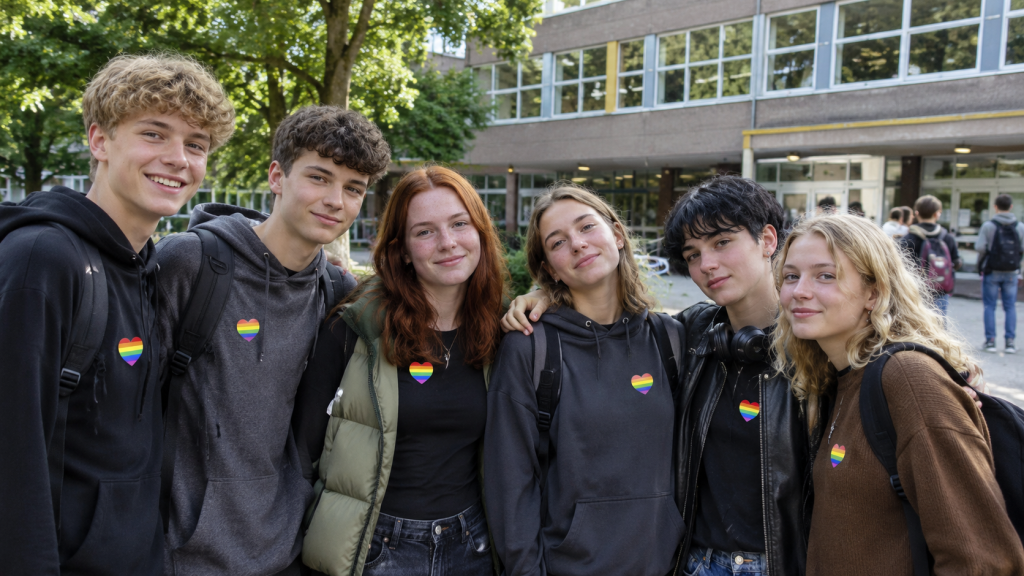
Around 11.26 million students attended a general or vocational school in Germany in the 2025/2026 school year. This is according to current figures from the Federal Statistical Office (Destatis). According to the latest Ipsos study, around 22 per cent now identify as gay, lesbian, bisexual or queer, amounting to around 2.48 million students. For many, bullying and hostility are part of everyday life.
Key points at a glance
- More than eleven million students: in the 2025/2026 school year, around 8.99 million children and young people attended general schools, with a further 2.26 million attending vocational schools.
- LGBTQ+ share among young people: according to the latest Ipsos study, 22 per cent of students identify as gay, lesbian, bisexual or queer, equivalent to around 2.48 million students.
- Violence and discrimination: according to the findings of the latest FRA study, 70 per cent of LGBTQ+ students report attacks or hostility. This proportion is above the European average.
- Many hide their identity: 52 per cent of the students concerned said they concealed their sexual orientation or gender identity at school. Only 28 per cent receive support there.
Figures from the statistical office
According to the Federal Statistical Office, a total of 8,998,200 students were taught at around 32,800 general schools in the 2025/2026 school year. This sector therefore accounted for just under 80 per cent of all students. A further 2,258,000 young people attended one of Germany's roughly 8,300 vocational schools. At general schools, 7,529,500 students held German citizenship. This represented a share of 84 per cent. The remaining 1,468,700 students, or 16 per cent, did not hold German citizenship. The vast majority were taught at state schools. In total, around 8,179,300 students, or 91 per cent, attended a state general school. Private institutions accounted for around 818,800 students, or nine per cent.
The proportion of foreign students differed considerably between state and private educational institutions. At state general schools, around 6,770,600 students held German citizenship. This represented 83 per cent. A further 1,408,700 students, or 17 per cent, did not hold German citizenship. At private general schools, by contrast, the proportion of students without German citizenship was around seven per cent. This amounted to around 60,000 students in total. A similar picture emerges at vocational schools. There, around 1,827,600 students, or 81 per cent, held German citizenship. A further 430,100 students, or 19 per cent, held only foreign citizenship. Around 2,023,700 students attended a state vocational school. This represented around 90 per cent. Around 234,300 students were taught at private vocational schools, representing a share of about ten per cent.
School-leaving qualifications in Germany
In the 2025/2026 school year, 811,200 children started school nationwide. The previous year's figure had been 829,700. The number starting school therefore fell by around two per cent. In the 2025 leaving year, a total of 769,000 students left general schools in Germany. Of these, 228,700 gained the general higher education entrance qualification, the Abitur. Around 339,800 school-leavers completed their schooling with an intermediate school-leaving qualification, such as the Realschulabschluss. A further 134,800 students gained a first school-leaving qualification, a category that includes the Hauptschulabschluss. Some 64,900 young people left general schools without a school-leaving qualification.
The official data show considerable differences in school-leaving qualifications by citizenship. Among school-leavers with a general higher education entrance qualification, only five per cent did not hold German citizenship. Among students with an intermediate school-leaving qualification, this proportion was 13 per cent. Among those with a first school-leaving qualification, 25 per cent held only foreign citizenship. The proportion was particularly high among those leaving school without a qualification. Here, 35 per cent did not hold German citizenship. The figures describe the distribution of qualifications by citizenship. On their own, they provide no information about the causes of these differences. General schools also employed a total of around 760,300 teachers in the 2025/2026 school year. The large majority were women. According to the Federal Statistical Office, around 556,800 female teachers worked there, representing a share of 73 per cent.
Bullying of LGBTQ+ students
Alongside broader developments in the school system, the situation of gay, lesbian, bisexual, trans and queer students is increasingly coming into focus. While schools educate millions of young people, many of those affected report exclusion, verbal abuse and attacks because of their sexual orientation or gender identity (German). A particularly troubling aspect is that such experiences can occur not only outside lessons, but also within schools. Bullying can take various forms. These include homophobic insults, derogatory remarks, spreading rumours, targeted social exclusion and physical assaults. Hostility can also continue online, for example through abusive messages, the publication of private information or targeted humiliation on social media. For the students affected, this can mean that the strain does not end when lessons finish.
Fear, hostility and attacks
Particularly concerning are the findings of a study by the European Union Agency for Fundamental Rights (FRA). (German) According to these findings, 70 per cent of LGBTQ+ students in Germany report attacks or hostility. This proportion is above the European average. Within five years, the number of such incidents has increased by almost 60 per cent. Fear of negative reactions also has a considerable impact on how open young people are about their sexual orientation or gender identity at school. According to the FRA findings, 52 per cent of LGBTQ+ students conceal their identity in the school environment.
Another figure from the cited research findings concerns support from educational institutions. According to these findings, only 28 per cent of the LGBTQ+ students surveyed report receiving support at their school. Repeated hostility and exclusion can have a considerable impact on young people's mental health and educational development. Students affected may suffer from anxiety, stress, sleep problems and reduced self-esteem. Difficulty concentrating, declining academic performance and avoidance of certain classroom situations can also be possible consequences. The situation becomes particularly distressing when young people experience rejection not only at school but also within their families.








