If someone threatens you with your nude images, do not pay any money or send any more pictures or videos. Do not respond to new demands. Keep messages and information about the perpetrator, and discuss with the police how to document evidence safely. Report the incident to the platform and seek support. Responsibility for the blackmail lies with the perpetrators.
Updated on 13 October 2026. The following police interview by Michael Schmucker was first published on 23 August 2024.
The key points at a glance
- Do not pay, do not send any more images and cut off contact.
- Document threats, profile names, links, times and payment demands; agree with the police how to handle intimate images.
- Report the account and any published content to the relevant platform.
- If you are threatened with being outed, involve someone you trust or an LGBTQ+ victim support service.
- If you are in immediate danger in Germany, call the police on 110.
Should I pay or negotiate?
No. Polizeiliche Kriminalprävention advises against transferring money or meeting other demands. The blackmail often does not stop after a payment. Additional images or videos can also give perpetrators more material to use as leverage. If you have already paid, that is no reason not to seek help or report the crime.
How do I preserve evidence?
Do not rush to delete the chat or the account concerned. Make a note of profile names, contact addresses, links, times and the sequence of events. Keep threats and payment information. It is best to discuss with the police early on how messages and existing files should be preserved in your particular case. Ask someone you trust for support if reading the messages is distressing. The guidance for people affected by cybercrime can help with the next step.
Particular caution is needed with sexualised images of minors: do not download such content again, take additional screenshots of it or forward it. Agree with the police how to preserve the evidence. The location of the content and account details may be important when making a report.
What should I do if someone threatens to out me?
The fear of being outed against your will can create additional pressure. You do not have to face this alone. Think about who could support you without compromising your privacy. When seeking advice or reporting the crime, explicitly mention that you fear being outed against your will, and ask how your information will be handled going forward.
MANEO, the gay anti-violence project in Berlin, offers confidential advice, anonymously if requested; you do not need to report the crime to access it. Its victim support helpline is available daily from 5pm to 7pm on 030 216 33 36. Nationwide, the free, anonymous WEISSER RING victim helpline offers help on 116 006, daily from 7am to 10pm.
How do I report images and accounts?
Report threats using the reporting function of the service where you receive them. If images have already been published, also report the specific content and where it can be found. Reporting an account does not automatically report every individual post. Keep confirmations or reference numbers. Block the contact without engaging with further demands; before doing so, you should have saved the necessary information or agreed with the police how to preserve it.
For intimate images in which you are an adult, StopNCII.org may offer additional help. The service creates a digital fingerprint of the file on your device and shares it with participating platforms. The image itself is not uploaded for this purpose. However, StopNCII does not automatically remove every copy from the internet.
For images created when you were under 18, Take It Down is the relevant service – even if you are now an adult. Only use files already on your device; do not download any new images or videos for the service or ask anyone to send them to you. Here too, only participating platforms are involved.
Is a threatening email always genuine?
No. Alongside blackmail involving actual images or videos, there are mass-sent messages that merely claim to have compromising material. A threat does not prove that the sender controls your camera or possesses images of you. Do not click on any links or attachments sent with the message. Use the message as a prompt to check your account security, and ask the police if you are unsure.
Consensual sexting justifies neither blackmail nor unauthorised sharing. Our police interview offers further background on dealing with secret filming during sex (German). For future dates, you can also find safety tips for a first Grindr date. Precautions do not change the fact that perpetrators are responsible for their actions.
Police interview from 2024
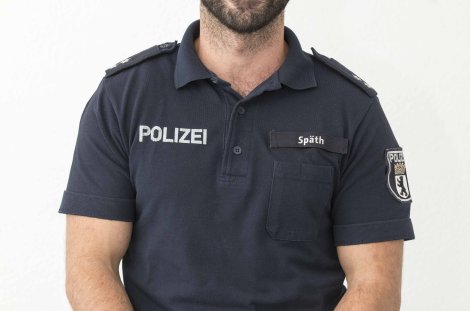
In the following conversation, Chief Inspector Michael Späth, introduced at the time as an LGBTQ+ liaison officer for Polizei Berlin, explained the risks of sextortion and how to deal with it. The questions and answers reflect the situation at the time of the original interview.
IT experts have repeatedly warned about online sextortion recently. LGBTQ+ people are often particularly affected: depending on the case, as well as the potentially embarrassing initial situation itself, they may also fear being forcibly outed at work or to family and friends. In your view, how can LGBTQ+ people best protect themselves?
Sextortion is a form of online blackmail in which fraudsters persuade their victims to perform sexual acts, then blackmail them by threatening to publish images or videos recorded without their knowledge and demanding large sums of money, preferably in cryptocurrencies. The fraudsters often contact their victims through social networks such as Twitter, Snapchat, Instagram or Facebook, or through dating platforms, and initially gain their trust. Once they are talking, they persuade them to send nude photos or videos, or soon move the chat to a video call. There, they get their chat partners to perform sexual acts on camera. The perpetrators then threaten to publish images or videos recorded without the victims' knowledge or sent by them on the internet unless the ransom demanded is paid. The perpetrators are often organised in gangs and operate from abroad. Polizei Berlin warns against paying the money demanded. The blackmail usually does not stop after payment. Men are generally targeted by sextortion more frequently, but women are also affected. There are also cases in which victims receive a blackmail email demanding that they pay a certain sum of money; otherwise, the perpetrators claim, compromising material or nude images of the recipient will be published. As a general rule, the same advice applies to LGBTQ+ people as to everyone else: be cautious about sharing personal information and be wary of strangers you meet online. Use strong passwords and, where possible, two-factor authentication to keep your accounts safe from hackers. Use antivirus software or spam filters so that fraudsters cannot access your personal data. Keep your software up to date.
When dating online through apps such as Grindr or Romeo, gay men in particular often send explicit images or videos very quickly and carelessly. Especially when the person's face makes them clearly identifiable, this can soon become a problem. Would you generally advise greater caution when it comes to gay dating? Or are there at least certain aspects or safety precautions that gay people should pay closer attention to?
As a general rule, we advise against giving personal information, such as your home address, to strangers too hastily. The same applies to sending nude images: under no circumstances should you send images showing both intimate areas and your face. Do not agree to a video chat too hastily, and do not let yourself be pressured into intimate acts during video chats. It is not just sending nude images that carries risks; arranging to meet strangers through dating platforms can also lead to becoming a victim of crime, including robbery. Particular caution is always needed when dating online: Protect yourself by, for example, arranging to meet in public places, or let someone you trust know when and where you are meeting strangers.
If it has happened nevertheless and a stranger is trying to blackmail you, what is the best way to respond as a victim? Such blackmail attempts often involve time pressure, with perpetrators giving victims only a few hours to transfer money.
If you are already being blackmailed, do not transfer any money under any circumstances. The blackmail usually does not stop after payment. Contact the relevant website operator if images or videos of you have been published. Do not comply with the blackmailers' demands, point out that their actions are a criminal offence and cut off all contact with the person. Contact the police and discuss the next steps. Local police officers can then advise you, for example, on whether you should take screenshots and whether the chat should be saved. Report the crime to the police.

Going to the police to report the crime is certainly an important step. However, looking at the statistics (EU Agency for Fundamental Rights, 2024), we see that 90 per cent of hate crimes against LGBTQ+ people are never reported, mostly because victims feel afraid or ashamed. For online sextortion, this figure is likely to be even higher. Why do you nevertheless think it is important to involve the police? And what might you say in response to victims' fears?
Alongside shame, other reasons why crimes are not reported to the police include the past criminal prosecution of gay people by the police and the associated lack of sensitivity and/or fear of discrimination. Many Polizei Berlin staff have already received training on LGBTQ+ issues through initial and further training sessions, to increase their expertise and further improve the community's trust in the police. In addition, Polizei Berlin now has an internal LGBTQ+ network of around one hundred staff who are particularly aware of LGBTQ+ issues, creating a basis of trust and understanding. My colleague Anne von Knoblauch and I work tirelessly as LGBTQ+ liaison officers for Polizei Berlin to further strengthen trust in Polizei Berlin and break down existing prejudices against the police. As well as being able to report a crime at a local police station, there is also Polizei Berlin's online reporting service, where you can conveniently report a crime from your computer or smartphone. We as the police can only help if we become aware of a crime. So once again, my appeal is: please report crimes to the police!
IT experts stress that most cases involve fake blackmail, meaning that the perpetrators do not actually have any compromising images. If you are personally affected, however, that statement is probably not particularly reassuring. In your view, are there any signs that might indicate whether or not you are dealing with fake blackmail?
If you can rule out having or having sent any such images yourself, then of course you can be fairly relaxed, and everything points towards it being fake blackmail. Are the details the blackmailers give about the alleged nude images credible, or is the message very general, without any personal information? Do you even use the online dating apps or platforms, such as Grindr or Romeo, that the fraudsters mention? Despite the pressure and personal stress you face in cases of sextortion, we recommend always responding calmly and not acting hastily. Consider for yourself whether the blackmail could be fake. Several dating apps, such as Scruff, have now even restricted screen recording and taking screenshots, so that it is no longer so easy for other users to obtain explicit images unlawfully. If you have further questions about sextortion, or any other questions relating to LGBTQ+ issues and the police, you are welcome to contact us on our advice line on 030 4664 979 444.
Mr Späth, thank you very much for speaking to us.








