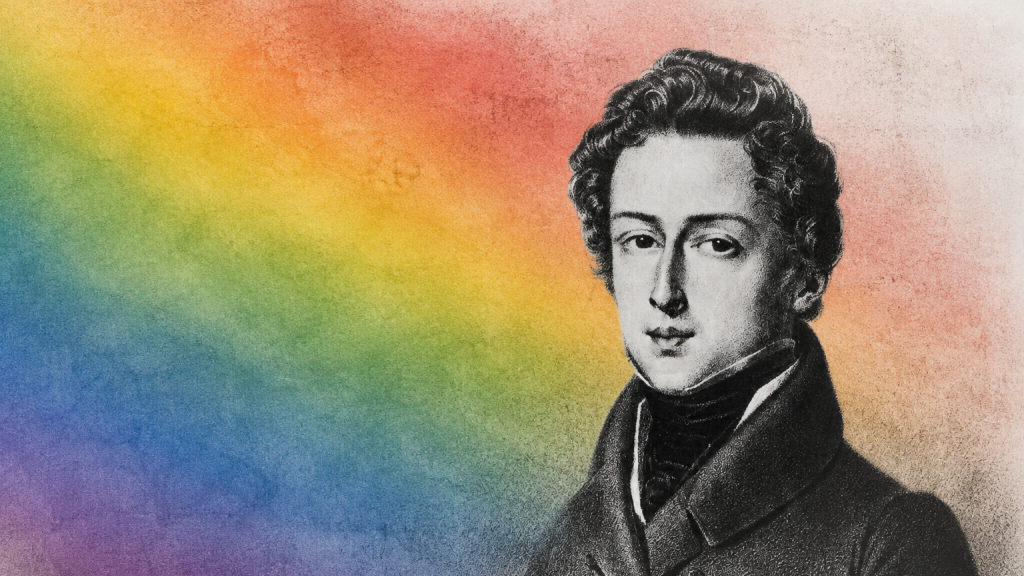
His music speaks of longing, intimacy and farewell. Yet the question of whom Frédéric Chopin himself loved continues to occupy the music world. The Polish composer died in Paris on 17 October 1849, aged 39. Today, on the 177th anniversary of his death, attention turns to letters in which he expressed his affection for men – and to the question of why these feelings were given so little space in accounts of his life for so long.
The key points at a glance
- Frédéric Chopin died in Paris on 17 October 1849; today marks the 177th anniversary of his death.
- His surviving letters to men contain intimate and, at times, erotic passages.
- Moritz Weber interprets these sources as evidence of Chopin's love for men.
- His book “Chopins Männer”, published in July 2026, expands on the research he first presented in 2020.
- This interpretation remains disputed: the Chopin Institute points, among other things, to the letter-writing conventions of the time.
A man named Tytus
Chopin had a particularly close bond with his childhood friend Tytus Woyciechowski. He dedicated his Variations, Op. 2, to him and wrote to him with great longing. “As always, I carry your letters with me,” he wrote in a letter dated 27 March 1830. Elsewhere, Chopin speaks of having received a letter asking him to kiss Tytus.
For Swiss cultural writer and pianist Moritz Weber, lines like these are not casual expressions of friendship. In his research published by SRF in 2020, he describes Woyciechowski as a central figure whom Chopin loved. Jan Matuszyński and Julian Fontana, with whom the composer shared a home in Paris at different times, also feature in his investigation.
What translations change
Weber also criticises some translations for having changed masculine references to feminine ones. In his SRF investigation into Chopin's relationships with men, he compares passages from the Polish letters with various translations. His argument is that translations and explanatory footnotes repeatedly created the impression that Chopin's feelings were directed towards women.
This also raises the question of how a familiar image of an artist takes shape. Anyone reading letters solely through the lens of an already established love story may overlook other clues. Similar questions arise in the historical debate about Leonardo da Vinci's sexuality (German).
A new book, a familiar objection
Weber's book “Chopins Männer” was published by Schwabe Verlag in July 2026. According to an SRF report in September, he compiled around 200 new or previously overlooked documents for it, including archival material. Weber maintains his view that Chopin loved men and questions established accounts of romances with women.
The Chopin Institute in Warsaw disputes this interpretation. It points out that an effusive tone was common in letters between friends at the time and rejects accusations of deliberate distortion. Institute spokesperson Aleksander Laskowski told SRF in September that the institute had not yet been able to examine the new book; in its view, robust studies were still lacking. That position at the time does not constitute a final assessment of the book.
Love cannot be smoothed over
The letters survive; how far they support a modern label such as “gay” is part of the historical debate. Weber's interpretation should therefore be read as his conclusion. Equally, Chopin's intimate language towards men need not disappear from his biography simply because its interpretation is disputed.
The discussion of Cary Grant's possible relationships with men also shows how far public images and private lives can diverge. In Chopin's case, his own words invite us to listen more closely: to the music – and to the people to whom he wrote.
First published on 24 July 2026. Updated for the 177th anniversary of his death on 17 October 2026, with the state of the debate as reported in September added.








