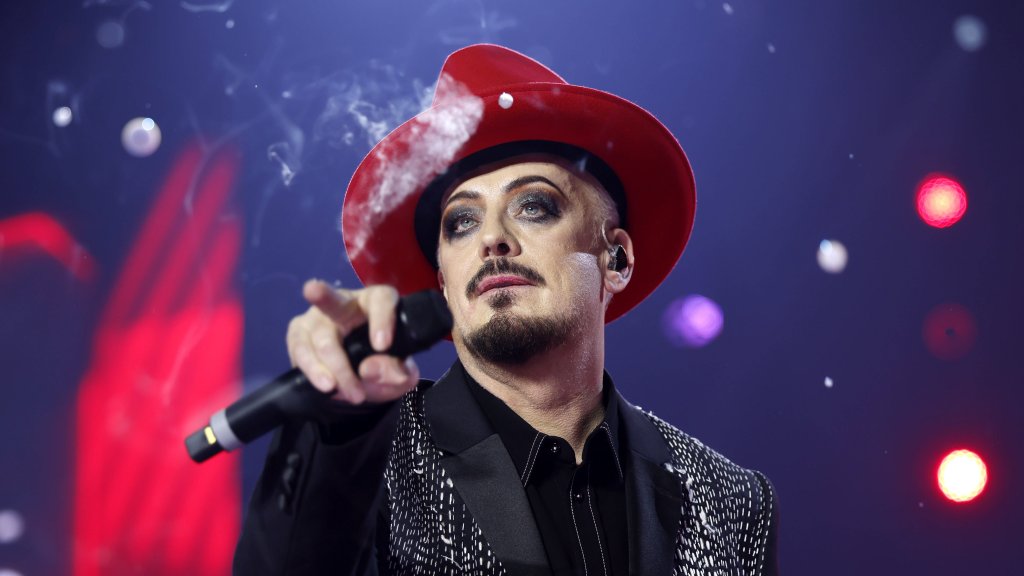
Boy George (65) will not appear in the current West End production of “Jesus Christ Superstar” at the London Palladium, withdrawing at short notice. The singer had been due to play King Herod from today until 15 August. Instead, Richard Armitage, who has been playing the role, will initially cover the performances. Layton Williams and comedian Julian Clary are then due to take turns in the role.
Key points at a glance
- Boy George will not appear in “Jesus Christ Superstar” at the London Palladium as planned.
- His withdrawal follows criticism of his new song “We Will Dance Again”.
- In his new song, he takes a stand in support of Israel in the Gaza conflict.
- Richard Armitage will now initially take on the role of King Herod.
- Boy George’s manager says the decision was made in the interests of the artist and the production.
Manager explains decision
The withdrawal comes after Boy George faced criticism over his new song “We Will Dance Again” (German). The song, reportedly created with the help of artificial intelligence, expresses support for Israel and rejects the allegation of “genocide” in the Gaza Strip. The reggae song opens with the lines: “You say genocide / I say war / When you’re attacked / That’s what the army is for / Does it get ugly? / You bet it does / When I know you want to kill / Every last one of us…” (“You call it genocide, I call it war. When you’re attacked, that’s what the army is for. Does it get brutal? Absolutely – when I know you want to kill every one of us.”)
Boy George’s manager, Paul Kemsley, announced the withdrawal. In a statement, he said: “After careful consideration, I have decided in my capacity as Boy George’s manager that he will no longer appear in ‘Jesus Christ Superstar’ at the London Palladium. This decision was made with the utmost respect for the producers, the creative team and the entire cast. We thank them for their professionalism and understanding and wish everyone involved every success with the production.”
Apology to fans
Kemsley also apologised to fans: “We are also aware that many people bought tickets because they wanted to see George on stage. We would like to sincerely apologise to those fans for any disappointment this decision may cause. We are very grateful for their continued loyalty and support.” His manager also said of the singer: “George has never been afraid to stand by his personal convictions, and I have always respected him for that.”
In closing, Kemsley explained the move in terms of the interests of everyone involved: “At the same time, I see it as my responsibility to make decisions that are in my artist’s best interests while also showing respect for others. In this case, I felt it was right to take a step back so that the production can take centre stage and everyone involved can move forward with mutual respect and goodwill.” Online, many of the star’s fans insist that persistent threats of protests by queer pro-Palestinian activists ultimately led to the cancellation – in their eyes, a clear case of cancel culture. George’s manager has not specifically confirmed this.
Boy George, whose real name is George Alan O'Dowd, rose to worldwide fame in the 1980s as the frontman of Culture Club. The group’s biggest successes include hits such as “Do You Really Want to Hurt Me” and “Karma Chameleon”. Alongside his singing career, the 65-year-old also works as a DJ, songwriter and musical theatre performer. Boy George is openly gay and has been one of the best-known LGBTQ+ figures in international pop music for decades.








