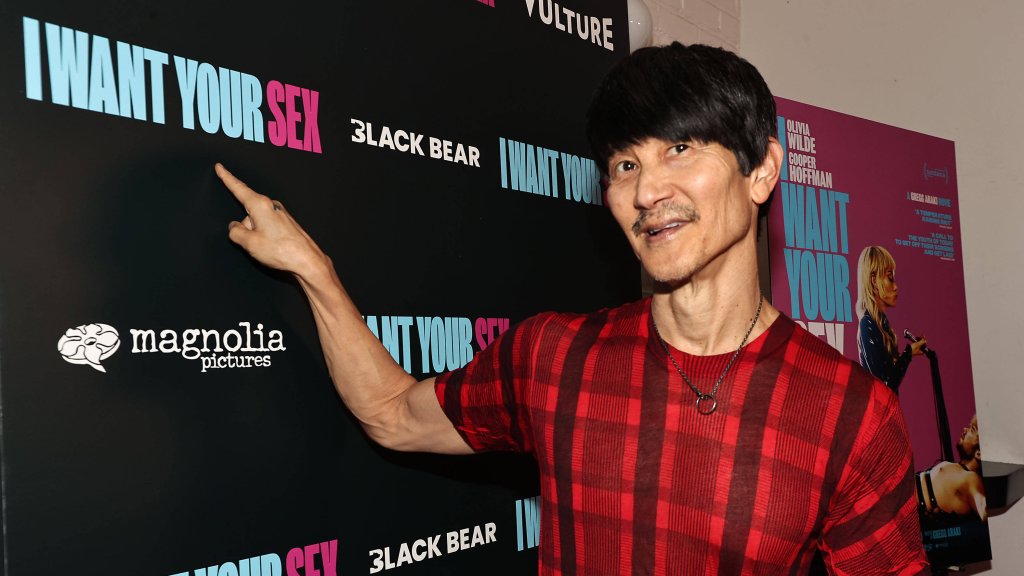
Bisexual US director Gregg Araki (66) is once again sparking debate about sexuality, social norms and queer identity with his new film “I Want Your Sex”. Desire, power and alternative forms of sexuality are at the heart of the story. “For me, this is a very queer story,” says Araki. “It is a view of kink and alternative sexuality that spans the entire spectrum between straight and queer.”
The key points at a glance
- Gregg Araki’s new film “I Want Your Sex” explores desire, power and alternative sexualities.
- The director criticises sexual repression, seeing it as a cause of hatred and violence.
- Araki accuses Generation Z of missing out on important life experiences for fear of getting hurt.
- At the same time, he is optimistic about the future of queer cinema and young filmmakers.
Queer joy for the world
The film tells the story of Elliot (Cooper Hoffman), a 23-year-old university graduate who works as an assistant to successful artist Erika (Olivia Wilde) and is drawn ever deeper into her world. Araki describes the film as deliberately provocative, but also humorous and life-affirming. Although “I Want Your Sex” is not his first film with heterosexual lead characters, the production is considered to have one of his most high-profile casts in years. The independent film is opening on around 700 screens in the US, reaching the largest audience of his career to date. “The world is so broken right now – wars, ICE, fucking genocides – that I want to bring some queer joy and positivity into the world,” says the 66-year-old.
The screenplay was originally written after “White Bird in a Blizzard” (2014). At the time, the story was conceived as “a comedic version of Fifty Shades of Grey”, in which a female intern is seduced by her male boss. After financing fell through, Araki put the project on hold. It was only after the #MeToo movement that he fundamentally reworked the concept. “I felt uncomfortable with the image of a woman being dragged around by her hair – even in a consensual situation,” the director explains. “I don’t want to judge anyone for their preferences, but as a man, I no longer wanted to put that image out there.”
Gen Z is missing out on sex
So Araki reversed the gender roles. “I made the submissive a man and the dominant person a woman.” For Araki, a committed feminist, this made Erika’s character in particular considerably more interesting. Further inspiration came from a 2022 study suggesting that Generation Z has sex less often than previous generations. This observation fed directly into the film. “When Erika says to Elliot, ‘You’re constantly afraid of missing out – and in the process you’re missing out on the sexual side of life’, that was essentially my reaction to that study.”
Araki is equally outspoken outside the film: “Why aren’t you having sex? What’s going on? Sex is a huge part of my life. My development as a person and as an artist – it’s all connected to sexuality, sexual experiences and relationships. All my films are about that. I simply can’t imagine a life without sex.” He warns against forgoing experiences out of fear of disappointment. “I’m over 60 now. And before you know it, you’ll be 40 or 50 yourselves. Will you regret not having been braver? Not having left the house? Not having taken the risk of getting hurt or confused, or experiencing heartbreak? Go on a bad date. Have a bad relationship. Fall in love with the wrong person. That’s exactly what life is! That’s how you grow up. That’s how you get to know yourself.”
Sex scenes in Heated Rivalry
Araki also sees sexuality as underrepresented in contemporary cinema. Although there is frequent talk of a new openness, many productions fail to convince him. Of the film “Babygirl”, he says: “I didn’t find it sex-positive at all. It bothered me that Nicole Kidman’s character is ultimately punished for acting on her desires.” The gay ice hockey series “Heated Rivalry” (German) also comes up in the interview. Unlike some critics, Araki takes a positive view of its sex scenes: “I think the sex scenes are well made and not watered down at all. That’s roughly my style: HBO with a German FSK 18 rating – explicit without becoming pornographic.”
Despite its provocative subject matter, Araki also describes his new film as a story about intimacy and self-discovery. The lead character, Elliot, is partly based on himself. “I was in my early twenties and trying to work out who I actually was sexually.” He had just one requirement for Olivia Wilde before filming began: “I told her: whoever plays this role must not care at all what other people think. And she replied: that’s exactly what I want.”
Sexual repression
Araki has strong words about the direction society is taking. “Things in America are worse than ever,” he says. “The level of puritanism, repression and exclusion of trans* people is terrible. That’s why the film ends with Jessie Ware’s song Free Yourself. I still believe in the old slogan: ‘Make love, not war.’” The director states his central message unequivocally: “So much hatred, misery, aggression, violence and all the fucking horrible shit in the world comes from this strange sexual repression. My film is my version of Free Yourself. The song’s message is positive, open and progressive – the exact opposite of a culture of repression and fascism.”
Despite all his criticism, Araki is optimistic about the younger generation. He is particularly impressed by young film fans. “They’re interested in auteur cinema rather than just blockbusters. That gives me hope.” The director also believes queer cinema is in a strong position, despite declining LGBTQ+ representation in major Hollywood productions. “Cannes was a real celebration of queer films this year. That shows how far we’ve come.”
Nevertheless, Araki draws a sobering parallel with the situation in the early 1990s during the AIDS crisis. “During the AIDS crisis, queer people were virtually being wiped out. That created an enormous urge to express ourselves artistically. I think that urge exists again today. Queer filmmakers see where the country is heading. The political right won’t stop at trans* people. We’re not safe.” That, he says, is precisely why an independent queer voice is indispensable. “Almost all my films come from that very need. That’s where the magic lies.”








