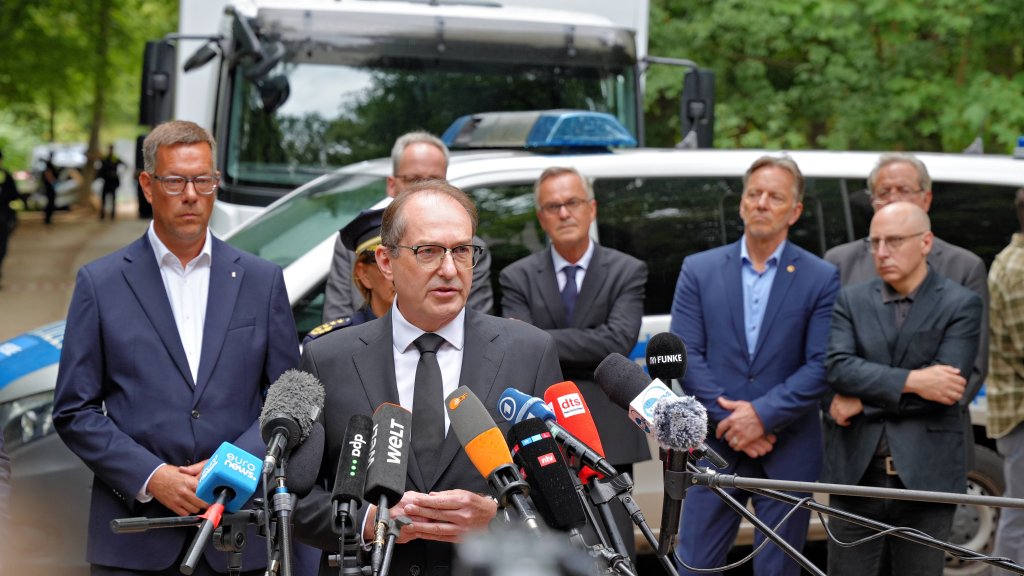
Even after the special meeting of the Bundestag's Home Affairs Committee on the Islamist-motivated terrorist attack at Christopher Street Day (CSD) in Berlin (German), several politicians specialising in home affairs believe crucial questions remain unanswered. Federal Interior Minister Alexander Dobrindt (CSU) briefed MPs yesterday on the current state of the investigation.
Key points at a glance
- The Bundestag's Home Affairs Committee discussed the CSD attack at a special meeting.
- Despite the ongoing investigation, MPs say numerous questions remain unanswered.
- Criticism focuses, among other things, on the release of the attacker, who had been classified as a potential security threat.
- Federal Interior Minister Alexander Dobrindt announced that he would provide a chronology of the authorities' actions.
- The CSU politician renewed his call for tougher laws.
- The attacker, Abdul Ballout, was buried in Berlin on Tuesday.
Many unanswered questions at the meeting
According to participants, the discussions made clear that the decisions taken by the security and judicial authorities in particular require further scrutiny. “The special meeting of the Home Affairs Committee has made it clear that key questions remain unanswered,” said Green MP Marcel Emmerich. “Why was the attacker able to remain at liberty despite the danger he posed? What information did the authorities have? And was anyone else involved?”
Because of the parliamentary summer recess, the meeting was held online and was closed to the public. It lasted almost three and a half hours. According to participants, those attending alongside Federal Interior Minister Alexander Dobrindt included Sinan Selen, President of the Federal Office for the Protection of the Constitution, Holger Münch, President of the Federal Criminal Police Office, Dieter Romann, President of the Federal Police, and Federal Public Prosecutor General Jens Rommel. Dobrindt promised committee members a comprehensive chronology of events and of the actions taken by the authorities involved. The SPD also believes further clarification is needed. For Bundestag MP Hakan Demir, one question is paramount. “Why did the court rule as it did? Given the information available about the attacker, the reaction was clear: no understanding whatsoever for the court's ruling.” The task now, he said, was to find a common approach to preventing similar acts in future. Work on this was under way.
Dobrindt presses for tougher laws
During the attack in Berlin on 25 July, the Islamist attacker drove a car into several people in the Tiergarten (German) before attacking others with a machete. A woman from Poland was killed (German) and 31 people were injured. The 21-year-old initially fled but was confronted by police officers a day later and shot dead after attacking them, according to police. Findings so far indicate that police had classified Ballout as a potential security threat. He had also already been sentenced under juvenile criminal law, although the sentence was not yet final, but remained at liberty.
Following the meeting, Federal Interior Minister Dobrindt therefore renewed his calls for tougher security laws. In his view, both the rules on suspended sentences and juvenile criminal law needed tightening: “We need provisions for preventive detention that apply throughout Germany to take potential security threats out of circulation. We need broader powers to order electronic tagging for people classified as potential security threats.”
Attacker buried in Berlin
Meanwhile, the CSD attacker was also buried yesterday in Berlin-Spandau. The burial took place at Landschaftsfriedhof Gatow, where, according to official figures, around 9,500 of the approximately 12,000 burial plots are Islamic. Several police officers were deployed to secure the cemetery grounds in western Berlin. No incidents were reported.








