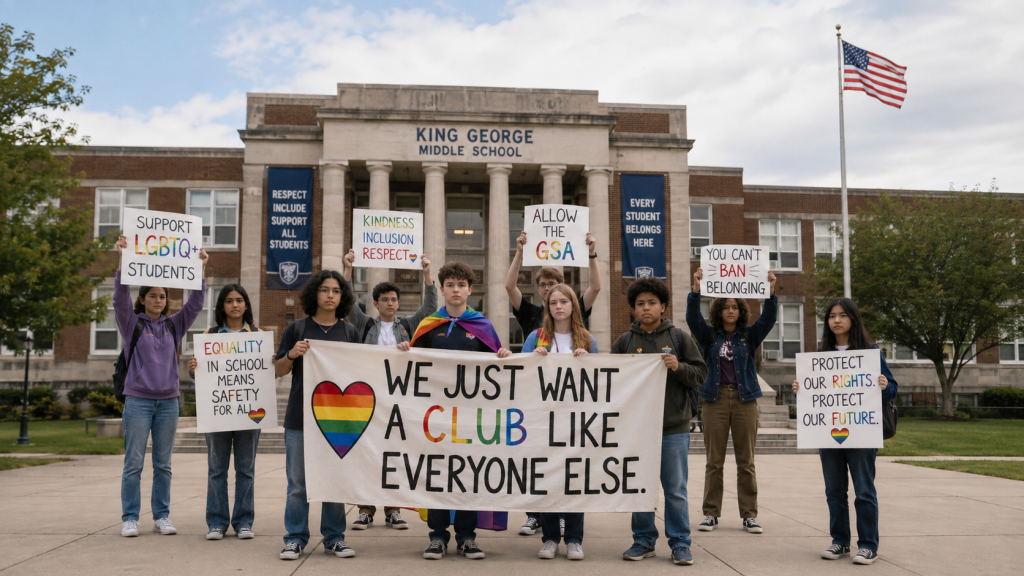
The civil rights organisation American Civil Liberties Union (ACLU) has filed a federal lawsuit over deliberate efforts to block a gay school club at a middle school in the US state of Virginia. Together with the law firm Potomac Law Group, it is representing two students and their parents in a case against the King George County School Board, superintendent Jesse Boyd and King George Middle School principal Casey Nice. The case could have nationwide significance.
Key points at a glance
- The civil rights organisation ACLU is suing a school board in the US state of Virginia.
- Two students and their parents accuse the school of deliberately blocking a gay school club.
- The lawsuit is based on the US Constitution and the Equal Access Act.
- The plaintiffs say they have been treated unequally compared with other student groups.
- They are demanding immediate approval for the club and an end to discriminatory rules.
ACLU alleges unequal treatment
The plaintiffs accuse those responsible of repeatedly introducing new rules and changes to deliberately prevent the formation of a Gay-Straight Alliance (GSA). At the same time, they say, almost all other extracurricular student groups continued to be permitted. In the plaintiffs’ view, this approach violates the First Amendment to the US Constitution, which protects freedom of speech, as well as the Equal Access Act, which requires public schools to provide equal access for extracurricular student groups.
“King George County schools cannot simply keep changing the rules to block an organisation that promotes respect and equality for LGBTQ+ students just because school board members disagree with its message,” said Julia Kahn, a lawyer with the ACLU of Virginia. She added: “The First Amendment and the Equal Access Act protect all students. The school board cannot pick and choose who the rules apply to. Why this club – and not the others?”
Club initially approved
According to the plaintiffs, a seventh-grade student began preparations to establish a Gay-Straight Alliance in August 2025. A teacher agreed to supervise the club. They say principal Casey Nice initially supported the initiative too. The students drew up a constitution, an events programme, information materials and an expression-of-interest form. The club’s aim was to create “a safe, supportive and inclusive environment” for gay students and their allies, and to promote respect regardless of sexual orientation. The documents were initially approved and published on the school’s internal platform, Canvas. Within a few days, 17 students had expressed an interest in joining.
Protests after publication
Just three days later, however, approval was withdrawn, according to the plaintiffs. The lawsuit states that parents and others shared the documents on Facebook, where they attracted hundreds of comments. The teacher supervising the club was publicly identified in a Facebook group, alongside photographs and her email address. Commenters accused her of “manipulating children and preparing them for sexual abuse” (“grooming”) and called for her dismissal. A parent also reportedly wrote to superintendent Jesse Boyd, claiming that school staff were discussing “prohibited topics” with minors. Criminal consequences for the teacher were also threatened. Principal Nice eventually informed the parents that the proposed club would be “put on hold” until further notice because of the tensions it had caused in the community. All information was removed from the school platform.
New rules instead of approval
According to the plaintiffs, what followed was not an impartial review of school rules, but an attempt to block the club permanently. The school board initially discussed new requirements for clubs at middle schools, including a minimum of ten interested students. It then adopted a new rule under which extracurricular student organisations would only be permitted at the high school. According to the plaintiffs, however, this did not apply to other groups in practice. They say the Yearbook Club, Robotics Team, Book of the Month Club, Beta Club, Outdoor Club and a student advisory council to the superintendent, among others, remained active. Clubs for activities such as crochet, board games, science, volleyball, choir and books also continued at primary schools.
The plaintiffs accuse the school of retrospectively classifying existing groups as curriculum-related so that they could continue. They say changes to a subject’s curriculum were even considered so that the Fellowship of Christian Athletes could continue to be permitted. No comparable solution was offered to the Gay-Straight Alliance. “Student clubs help young people experience community, find a sense of belonging and develop positively. When schools offer such opportunities, the law requires them to be open to all students on equal terms,” said Mary Rohmiller of Potomac Law Group. She added: “King George County schools appear to be applying a double standard to the Gay-Straight Alliance at their middle schools. The students in this case are not asking for special treatment – they are asking for equal treatment.”
A group to offer protection from bullying
According to the plaintiffs, the allegations are consistent with earlier accounts from students about the school climate. Gay students repeatedly reported facing “numerous insults every single day”. Through the lawsuit, the families are therefore seeking preliminary and permanent injunctions to allow the Gay-Straight Alliance to be established and operate under the same conditions as other student organisations. They also want the court to prohibit the school board from applying its club rules in a discriminatory manner or retaliating against the students involved, their families or teachers who support them.








