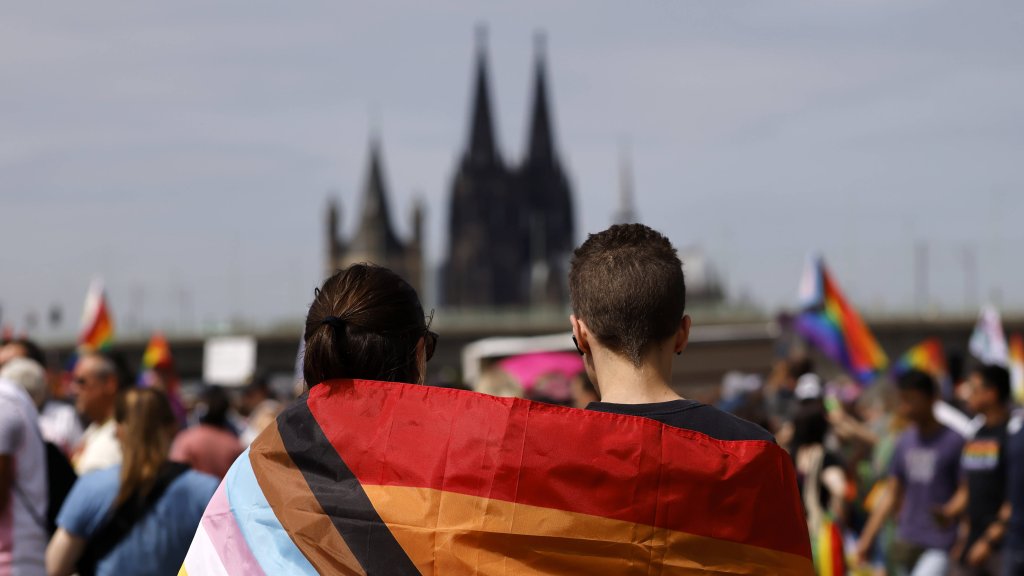
Two weeks after the Islamist attack at the Christopher Street Day (CSD) Pride event in Berlin (German), several thousand people in Cologne showed their support for the queer community. Participants marched through the city in a solidarity demonstration under the slogan “Cologne shows solidarity, Cologne takes a stand”. In Berlin, thousands of people remembered the victims at a queer park festival – one woman died in the rampage by a 21-year-old Islamist, and 31 other people were injured, some with life-threatening injuries.
Key points at a glance
- Several thousand people took part in a solidarity demonstration for the queer community in Cologne.
- According to the organisers, around 10,000 people attended – police had spoken of around 2,000 participants beforehand.
- The organisers are calling on federal, state and local governments to provide better long-term protection for queer organisations, services and spaces, and queer life.
- In Berlin-Friedrichshain, at least 2,000 people attended a queer park festival in Volkspark Friedrichshain and remembered the victims of the attack.
- Heightened security measures were in place for the park festival because of the attack at Berlin Pride.
- A woman was killed in the attack on 25 July, and 31 other people were injured, some seriously.
Concrete action
Several initiatives and associations had called for the demonstration in Cologne. It began in Deutz, a district on the right bank of the Rhine. From there, the march headed towards Cologne city centre. It was held in response to the Islamist attack on Berlin Pride. According to the organisers, attendance significantly exceeded initial expectations, with Cologne Pride putting the figure at around 10,000 people. Around 2,000 participants had been registered with the police in advance. Numerous police officers were deployed at the scene.
The organisers coupled the demonstration with a call for concrete political measures. Their appeal stated: “Words of solidarity alone are not enough”. Federal, state and local governments needed to act to provide better long-term protection for queer organisations, services and spaces, and queer life: “We demand measures from federal, state and local governments to ensure that queer structures and queer life are protected and strengthened in the long term, so that we can counter the growing hostility towards queer people in our society.” In the organisers’ view, a clear public commitment to the queer community is particularly important at present. “Taking a stand is still hot, but above all, taking a stand is now one thing: more necessary than ever!” This also echoed the slogan of this year’s Berlin Pride, which took place under the banner “Taking a stand is hot”.
Rejecting extremism
The Cologne Queer March also took a stand against extremism. “The Cologne Queer March opposes every form of extremism, whether Islamist or far-right,” the organisers said. At the same time, they warned against exploiting the attack to promote hostility towards Muslims, a point the Berlin Pride team had also emphasised shortly after the attack. The attack must not, they said, be used to stir up hatred against people of the Muslim faith. The organisers in Cologne summed up their position with the words: “We will not let hostility towards queer people grind us down – no matter where it comes from.” Several German celebrities also took part in the march.
Park festival in Friedrichshain
Solidarity with the queer community was also the focus in Berlin itself over the weekend. Numerous people gathered for a queer park festival in Volkspark Friedrichshain. According to the organisers, Arbeiterwohlfahrt (AWO), at least 2,000 visitors were at the park’s open-air cinema by early evening. Berlin police gave a positive assessment on Sunday morning. They told rbb that the event had passed peacefully and there had been no incidents.
This year’s festival was held under heightened security measures. Here too, the attack at Pride was a factor. The organisers had arranged additional security staff, and there was also a greater police presence. The event also addressed the consequences of the attack and the question of how the queer community can be protected.
Information stalls and political guests
The park festival was opened by Berlin’s former Governing Mayor Klaus Wowereit. Alongside a stage programme, visitors could also access information. Associations, initiatives and political parties were represented with information stalls. Christian Meyerdierks of Arbeiterwohlfahrt urged visitors not to leave the grounds alone. In previous years, right-wing groups had frequently gathered around the edges of the park. Individuals had been followed by them, Meyerdierks said on rbb24 Abendschau.
In previous years, the park festival in Friedrichshain had generally attracted several thousand people. After the attack, Meyerdierks had initially feared that this year’s event might draw a significantly smaller crowd. His concern had been that, following the Pride attack, nobody might come to the park festival. The actual turnout, however, told a different story: “But as you can see, it’s full.”








