
The number of young people in Germany remains at a historically low level. At the same time, queer and gay identities feature prominently within this shrinking age group: according to the latest Ipsos study, 22 per cent of young people in Germany identified as LGBTQ+. The paradox: this very group is shrinking as a proportion of Germany's population.
Key points at a glance
- At the end of 2025, around 8.3 million people in Germany were aged between 15 and 24 – ten per cent of the total population.
- Statistically, around 1.8 million of them are LGBTQ+. According to the Ipsos study, 22 per cent of young people identified as LGBTQ+.
- The proportion of young people overall therefore remains at a historically low level.
- Among people with an immigration background, the proportion of 15- to 24-year-olds is higher, at 12.2 per cent, than among those without an immigration background, at 8.5 per cent.
- Regionally, this young age group is particularly well represented in Bremen, Hamburg and Baden-Württemberg.
- Germany is below the EU average for the proportion of 15- to 24-year-olds.
1.8 million young LGBTQ+ people
The age-structure figures come from the Federal Statistical Office (Destatis), which published them for International Youth Day on 12 August 2026. According to these figures, 8.3 million people aged 15 to 24 were living in Germany at the end of 2025. This represents ten per cent of the total population. The proportion of young people has remained at this historic low since the early 2020s. This demographic trend therefore affects the generation in which, according to the Ipsos survey, a substantial proportion identify as lesbian, gay, bisexual, trans, intersex or queer, or as LGBTQ+. No other generation identifies as members of the community to such a high degree. Statistically, there are therefore around 1.8 million young people in Germany who see themselves as LGBTQ+.
Queer youth in a shrinking generation
The combination of demographic decline and the growing visibility of queer identities shapes the picture of the younger generation. While the proportion of 15- to 24-year-olds in the total population is significantly lower than in the past, the latest Ipsos study also points to a large LGBTQ+ community within this age group. Historically, the proportion of young people in Germany was significantly higher. It peaked in the first half of the 1980s. At that time, the large baby-boomer cohorts were part of the young population. In 1983, as many as one in six people in the territory of present-day Germany were aged between 15 and 24. The proportion then stood at 16.7 per cent.
Focus on immigration background
There are also marked differences depending on immigration background. Without immigrants and their descendants, the proportion of young people in the total population would be even lower. Among people without an immigration background, 8.5 per cent were aged between 15 and 24 in 2025. Among people with an immigration background, by contrast, the proportion was 12.2 per cent. According to the Federal Statistical Office, people with an immigration background are defined as those who themselves, or both of whose parents, immigrated to Germany from 1950 onwards.
According to the Federal Statistical Office, the higher proportion of young people within this group is also linked to the fact that this analysis only considers immigration from 1950 onwards, and that the resulting population of descendants has a younger age structure. Among descendants of two immigrant parents, 20.4 per cent were aged between 15 and 24. Among people with one immigrant parent, the proportion was 20.0 per cent. Among immigrants themselves, 9.5 per cent were in this age group.
Differences between Germany's federal states
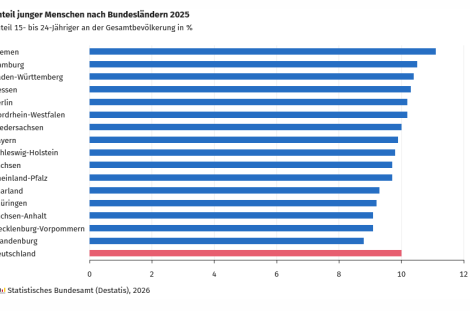
The age structure also varies within Germany. In 2025, Bremen had an above-average proportion of people aged between 15 and 24. There, this age group accounted for 11.1 per cent of the population. In Hamburg, the figure was 10.5 per cent, and in Baden-Württemberg it was 10.4 per cent. By contrast, Brandenburg, at 8.8 per cent, and Mecklenburg-Vorpommern and Sachsen-Anhalt, both at 9.1 per cent, were below the national average. This reveals regional disparities in the young population too. While some states have a comparatively high proportion of young people, this age group is smaller in several eastern German states.
Germany below the EU average
Germany is not among the countries with a particularly high proportion of young people in a European comparison either. According to the EU's statistical office, Eurostat, exactly ten per cent of Germany's population were aged between 15 and 24 at the beginning of 2025. The EU average was slightly higher, at 10.7 per cent. Ireland had the highest proportion of this age group, at 12.7 per cent. It was followed by Denmark and the Netherlands, both at 12.2 per cent. The proportion was lowest in Malta, at 9.4 per cent, and Bulgaria, at 9.5 per cent. This demographic trend means that Germany has a relatively small young population compared with other European countries. At the same time, this generation is characterised by remarkable LGBTQ+ diversity.








