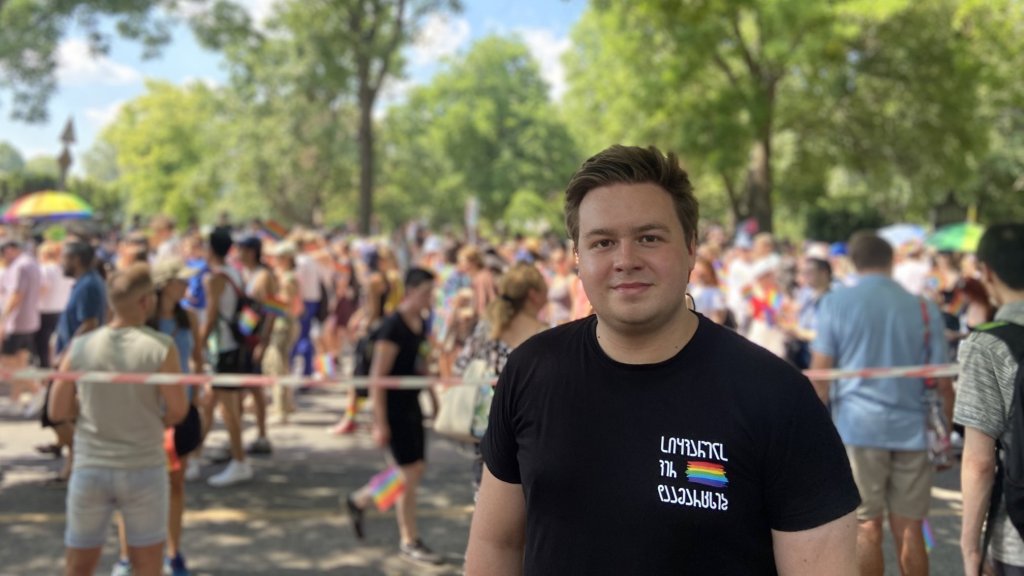
Belgian LGBTQ+ activist and international relations expert Rémy Bonny, founder of the queer organisation Forbidden Colours, has been awarded a prestigious fellowship at the Harvard Kennedy School. He has been selected for the Global LGBTQI+ Human Rights Fellowship 2026–27 at the Carr-Ryan Center for Human Rights. In academia and research, a fellowship is a funded position or research post.
Key points at a glance
- Rémy Bonny has been awarded the Global LGBTQI+ Human Rights Fellowship 2026–27 at the Harvard Kennedy School.
- The Belgian is only the second European to receive this fellowship, following former Irish Taoiseach Leo Varadkar.
- His work focuses on LGBTQ+ rights, democratic backsliding, foreign interference and the rule of law.
- Bonny plans to examine how the EU can strengthen its role as a credible defender of democracy and human rights.
- LGBTQ+ rights will serve as a “constitutional stress test” for European democracy.
- Despite the fellowship, Bonny will remain executive director of the human rights organisation Forbidden Colours.
- His project is intended to culminate in an extensive essay on the future of European democracy.
Fellowship at Harvard
Bonny is executive director of Forbidden Colours, an LGBTQ+ human rights organisation working across Europe. His appointment makes him only the second European to be awarded the fellowship. Former Irish Taoiseach Leo Varadkar received the honour before him. Bonny’s work to date has focused on the connections between LGBTQ+ rights, democratic backsliding, foreign interference and European rule-of-law policy. In particular, he has examined how ultraconservative and anti-democratic governments use attacks on LGBTQ+ people as part of their domestic and foreign policy strategies.
“It is an extraordinary honour to join the Harvard Kennedy School,” said Rémy Bonny. “But I see this fellowship first and foremost as an opportunity to strengthen the fight for democracy and human rights in Europe. The attacks we are witnessing against LGBTQ+ people are increasingly linked to attacks on independent institutions, the rule of law and democracy itself.”
In recent years, Bonny has focused particularly on the links between anti-LGBTQ+ policies, authoritarianism and foreign interference. In 2019, he exposed a coordinated international disinformation campaign allegedly conducted by Russia jointly with Viktor Orbán’s government in Hungary at the time. It reportedly targeted LGBTQ+ communities in various European countries. His investigations were among the early studies documenting the use of anti-LGBTQ+ narratives in connection with foreign interference and democratic destabilisation.
Work in Hungary
Bonny later briefed national and European politicians on subversive activities and disinformation campaigns. He also advised governments and supranational institutions on Foreign Information Manipulation and Interference (FIMI) and human rights sanctions. In 2023, he led a Forbidden Colours campaign that mobilised a coalition of 16 EU member states and the European Parliament. The coalition intervened in the case against Hungary’s anti-gay law before the Court of Justice of the European Union. The proceedings concluded with a landmark ruling in 2026. In it, the Court found, for the first time, a standalone violation of Article 2 of the Treaty on European Union, which enshrines the EU’s fundamental values.
“The European Union has powerful legal and political instruments to defend its values, but these instruments only matter if governments are willing to use them,” said Bonny. “My work at Harvard University will examine how Europe can close the gap between the values it professes internationally and the way it protects democracy and fundamental rights within its own borders.”
How can Europe become more democratic?
During his fellowship, Bonny plans to explore how the EU can regain its role as a credible global defender of democracy and human rights in the face of resurgent authoritarian forces. A book-length essay is planned. It will address democratic backsliding, the selective application of EU law and the limits of a predominantly market-oriented model of European integration. In Bonny’s assessment, these developments have weakened the EU’s political legitimacy.
The rights of LGBTQ+ people play a particular role in his research project. They will be examined as a “constitutional stress test” for European democracy. Planned case studies include Hungary, Poland, Georgia and Serbia. Bonny’s own experiences in European politics and human rights work will also inform the study. The aim is to identify reforms that could strengthen democratic safeguards, enforcement of the rule of law and protection of fundamental rights in Europe.
“If Europe wants to be credible when defending democracy in Georgia, Ukraine or elsewhere in the world, it must be equally determined to defend democracy and fundamental rights within the European Union,” said Bonny. “LGBTQ+ rights are a particularly revealing test of whether our institutions are prepared to defend their own constitutional principles when doing so becomes politically difficult.”
The future of Forbidden Colours
Despite his stay at the Harvard Kennedy School, Bonny intends to continue his existing work. He will remain executive director of Forbidden Colours throughout the fellowship. This is intended to connect his academic work at Harvard University with his political and human rights work in Europe. “I am not stepping back from Forbidden Colours,” said Bonny. “The fellowship gives us the opportunity to connect what we experience on the ground in Europe with some of the world’s leading academic insights into democracy and human rights – and to bring those insights back into European politics.”
Rémy Bonny was born and raised in Belgium. He studied political science at the Vrije Universiteit Brussel (VUB), where he earned bachelor’s and master’s degrees. He also holds a European Master in Human Rights and Democratisation from the Global Campus of Human Rights. He is a human rights activist and international relations expert. As executive director of Forbidden Colours, he works across Europe to advance human rights and democracy for LGBTQ+ people. Bonny has also given talks at institutions including Harvard University and HEC Paris.








