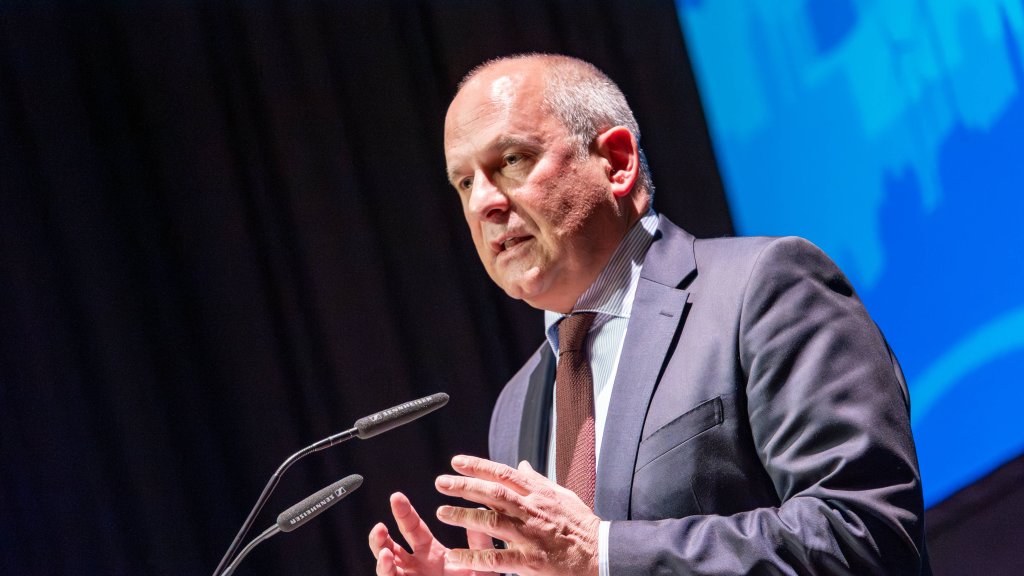
Hesse’s Interior Minister Roman Poseck (CDU) believes Germany faces a wide range of security risks. In his words, these range from extremism and terrorism to espionage, sabotage and hybrid attacks. Following the rampage at Berlin Pride (German), he stressed that, given the current situation, Germany must “expect the risk of attacks at any time”.
Key points at a glance
- Hesse’s Interior Minister Roman Poseck warns of a high threat level in Germany in light of several recent developments.
- In his assessment, the country must “expect the risk of attacks at any time”.
- The domestic intelligence service is observing increasing radicalisation online, which can sometimes take place within just a few weeks.
- The authorities are particularly alarmed by increasingly young extremists and teenagers networking through chat groups.
A range of threats
Presenting Hesse’s domestic intelligence report for 2025 in Wiesbaden, Poseck referred to Federal Interior Minister Alexander Dobrindt’s (CSU) revised assessment of the security situation. Dobrindt had “raised the threat level from abstract to high in July”. Events in recent weeks had made clear the scale the danger had now reached, Poseck said: “The Islamist attack on Christopher Street Day in Berlin and the hybrid attack scenario involving an explosives-laden drone at Leipzig Airport have dramatically demonstrated in recent weeks how real this danger is.”
In the minister’s assessment, the current situation is characterised above all by different threats occurring simultaneously. On the one hand, these involve extremist criminal offences and acts of violence; on the other, activities by other states. These include sabotage, espionage and so-called hybrid threats. This often refers to covert measures aimed at creating uncertainty or destabilising society.
Right-wing and left-wing extremism
Since the deadly attack in Hanau in 2020, no further fatal attacks have been carried out in Hesse. Poseck attributes this partly to fortunate circumstances and the work of the security authorities. He also pointed to the expanded powers that the police and domestic intelligence service in Hesse have since been granted. In terms of extremist criminal offences and acts of violence, right-wing extremism remained by far the most significant threat last year. Poseck criticised the worldviews spread by right-wing extremists, describing them as “inhumane, racist and ethnonationalist worldviews”.
Regarding left-wing extremism, Poseck pointed, among other things, to attacks on Berlin’s power supply. He also cited the “arson attacks motivated by anti-militarism on vehicles belonging to the Regierungspräsidium Gießen and on civilian Bundeswehr operational vehicles in Kassel”. The minister also sees a connection between sections of left-wing extremism and antisemitic positions. Left-wing extremism was “a dangerous driver of antisemitism; it allies itself with those who hate Israel and Jews”.
Online radicalisation
Alongside traditional forms of extremist violence, espionage and hybrid threats also came into sharper focus in 2025. According to the Interior Ministry, Russia is considered the greatest threat in this area. China is also seeking to expand its influence. According to the authorities, this includes the use of cyberattacks. Bernd Neumann, president of Hesse’s domestic intelligence agency, called for increased vigilance in light of the activities of Russian intelligence services.
Developments online are a particular concern for the domestic intelligence service. In Neumann’s assessment, radicalisation processes are increasingly shifting into digital spaces. At the same time, radicalisation is happening ever faster. “Extremists are getting younger and younger,” Neumann said. Hesse’s domestic intelligence service had recently “dealt with 12- to 17-year-olds who exchange messages in chat groups and plan actions. The platforms’ algorithms mean that just a few clicks are enough, and you are already caught in the web of the particular form of extremism.”
According to the domestic intelligence agency’s president, extremist and anti-constitutional content is not always presented openly. Instead, such messages are “skilfully hidden in supposedly harmless short videos, songs or challenges”. In the agency’s assessment, the time it takes for someone potentially to become radicalised can be very short. Sometimes this process takes only a few weeks. Schools and media regulators must therefore also contribute to protecting democracy in the digital sphere, Neumann said.








