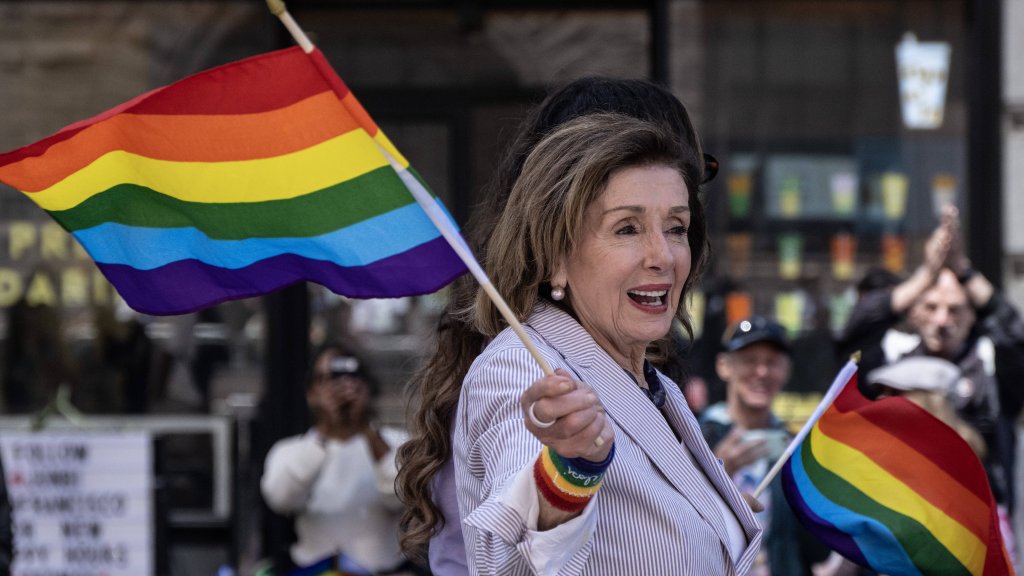
Nancy Pelosi (86) is approaching her departure from the US Congress. After almost four decades in the House of Representatives and two terms as Speaker, the Democrat is looking back on her political career. The 86-year-old speaks at particular length about her work for people with HIV and AIDS and for the rights of the LGBTQ+ community.
Key points at a glance
- Veteran US politician Nancy Pelosi takes stock of her work for LGBTQ+ rights ahead of her departure from Congress.
- Pelosi says Republicans have largely lost their battles against gay men and lesbians and are therefore now targeting trans people.
- She points to her role in legislation on hate crime, military service, marriage and discrimination.
- She also defends her firm stance on including protections for trans people in the Hate Crimes Prevention Act.
- Pelosi sharply criticises the Trump administration’s policies towards queer people.
- Looking ahead to the forthcoming midterm elections, Pelosi says: “We have to win! We have to win decisively!”
Fighting HIV and AIDS
Last November, Pelosi announced that she would not run for the House of Representatives again after her current term. Her political career has been marked by numerous historic firsts: she was the first woman to lead the House of Representatives and is regarded as one of the most successful parliamentary strategists of her generation. Asked whether she now allows herself to reflect personally on her achievements, Pelosi replies: “Yes. As long as it shows collaboration” – adding that it must also make visible “the courage of members of Congress and the activism of groups outside Congress”.
Pelosi’s commitment to the LGBTQ+ community began at the very start of her time in Congress. In 1987, she won a special election in San Francisco. In her first speech in the House of Representatives, she declared that she had come to Washington to fight AIDS. Pelosi still describes the AIDS crisis of that era as an existential emergency. People were dying while activists were criticised for their determined actions. “When we talk about HIV/AIDS, it was a matter of life and death,” Pelosi says. “I saw my role as being able to tell people: ‘You’re wrong. This is appropriate.’” For Pelosi, the AIDS movement became an example of how social change happens. People could not wait for institutions to notice their problems of their own accord. They had to organise and generate political pressure.
Pelosi also recalls the creation of the AIDS Memorial Quilt. Developed by activist Cleve Jones, the memorial quilt made the epidemic visible through personal stories, photographs and fabrics. Initially, she had doubted Jones’ idea. “Who still sews these days?” she remembers wondering. Yet thousands of people eventually took part. Pelosi later worked to ensure that the full installation could be displayed on the National Mall in Washington. The National Park Service had initially proposed showing only a few panels along a road.
Challenging prejudice
Pelosi also recalls the efforts to bring the 1984 Democratic National Convention to San Francisco. At the time, competing cities had stoked fears about gay people and the spreading AIDS epidemic. Among other things, it was claimed that delegates would not be able to eat safely in San Francisco. When members of the selection committee visited San Francisco, Pelosi invited them to her home. Representatives of the Black, Asian, Latin American, gay and lesbian communities were also present. She instructed her children to expose prejudice while also dispelling it.
“There will be guacamole and dip and all these things on the table,” she recalls. “When these people come to the table, make sure – and I did this myself too – that you have a gay person right next to you and that you both dip into things at the same time.” The aim was to counter fears that AIDS could be transmitted through sharing food or casual contact. Pelosi also helped secure billions of dollars in federal funding for research, treatment, housing and prevention. “We’re not talking about money,” she says. “We’re talking about saving lives.” She remembers people with AIDS who initially sought help with wills or obtaining medicines from abroad. That changed as medical advances were made.
Today, she distinguishes between the power she once held and the influence she can still exert. Power is immediate and tied to decisions. As Speaker, she says, you have to balance different interests and seize opportunities. “If you hesitate, you’ll lose your opportunities,” she says. Influence, by contrast, is more of a suggestion, a “gentler touch”: the effect of experience without direct control over votes or the agenda. “I’ve given up the power,” Pelosi says, “but I haven’t given up the influence.”
Attacks on trans people
Pelosi’s record on LGBTQ+ policy includes the Hate Crimes Prevention Act, the repeal of the “Don't Ask, Don't Tell” policy affecting openly gay and lesbian service members, the Respect for Marriage Act providing nationwide recognition of same-sex marriages, and the repeated passage of the Equality Act in the House of Representatives. For her, these achievements also explain why the political right is now increasingly attacking trans people. “They know there’s no debate about LGB,” Pelosi says. “So they single out trans people.”
Years of political mobilisation had made sweeping attacks on gay men and lesbians less likely to succeed. Republicans had therefore identified trans people and issues such as toilets, sport and military service as areas where unfamiliarity could more easily trigger fear. “They’ve lost the fight against HIV/AIDS, against discrimination and everything else,” Pelosi says. “What they’re doing with the military now is harmful to our national security.” Since Donald Trump’s return to the White House, the administration has attempted, among other things, to exclude trans people from military service, restrict gender markers on passports and limit government support for gender-affirming treatment.
“It’s heartbreaking,” Pelosi says. “These are people’s children.” Pelosi herself has a cousin whose trans daughter is very close to her. She also says she has met homeless trans young people who had been rejected by their families, but also families who accepted their children and “were proud of them”. She stresses: “That’s where we want everyone to get to!” The current policies, she says, represent a bitter reversal of the repeal of “Don't Ask, Don't Tell” – a rule that had required some service members to keep their identity secret. Pelosi also rejects the idea that her politics have been characterised by incremental change. “I’m not an incrementalist. That’s just not my thing.”
Legislation against hate crime
One significant controversy remains, however. In 2007, Pelosi supported a bill against workplace discrimination that would have protected sexual orientation but not gender identity. The bill passed the House of Representatives but failed in the Senate. Many trans people regarded the omission as a betrayal. Pelosi points to the later debate over the Hate Crimes Prevention Act. Members of Congress had told her at the time that the bill could not get through committee if it included protection for gender identity. “We won’t pass it in a hundred years if we take trans people out,” she recalls saying. “We’ll never bring this bill to the floor. It’s for everyone.” The legislation remained comprehensive and became law in 2009.
Strengthening same-sex marriage
The following year, Congress repealed “Don't Ask, Don't Tell”. Pelosi recalls promising at a memorial event for Harvey Milk to complete the work by Christmas. President Barack Obama signed the repeal into law on 22 December 2010. In 2022, Congress passed the Respect for Marriage Act. It requires the US federal government and the states to recognise valid same-sex and interracial marriages. It was the last piece of legislation Pelosi signed as Speaker of the House of Representatives. Asked whether she ever sits alone and thinks, “Damn, look at what I’ve achieved,” Pelosi pauses for a moment. “Maybe I’ll do that soon,” she says with a smile.
Asked what she would like the LGBTQ+ community to remember her for, Pelosi rejects the idea of a personal story of heroism. “I really don’t think it’s about me.” Instead, she hopes people will give her credit for not having stood in the way. “For everything we’ve done, I want the story to be that I was part of something. That it was a collaboration, a combination of political work within the system, mobilisation outside the system and respect.” Her work, she says, was guided by “respect for the dignity and worth of every person”. She is also “particularly honoured to be connected to the LGBTQ+ community”.
Midterm elections in November
Pelosi is leaving Congress during a second Trump administration, which she views with clear disapproval. She avoids naming the president where possible, instead referring to “you-know-who”, and adds: “Any time spent with him is just repulsive to me”. Pelosi accuses Republicans in Congress of having abandoned the independence of the legislature. Among the things she sees as under pressure are free and fair elections, an independent judiciary, the rule of law, the right to due process and freedom of the press. Pelosi expects the Democrats to regain a majority in the House of Representatives in November’s midterm elections. She also hopes for success in the Senate. “We have to win,” she says. “We have to win decisively.”








