Iceland’s national flag was long seen as a unifying symbol for a small country. Now it is increasingly associated with political conflict. This is particularly apparent at a Lutheran church in Reykjavík. Anyone entering the church in the Grafarvogur district has to walk down 16 steps. They are painted in the colours of the Progress Pride flag – with rainbow colours and white, pink, blue, brown and black chevrons. The design has now been deliberately destroyed – more than a trivial news item on the sidelines.
Key points at a glance
- A Lutheran church in Reykjavík whose entrance steps are painted in the colours of the Progress Pride flag has been attacked.
- Unknown perpetrators painted over the rainbow colours with the design of Iceland’s national flag.
- Pastor Arna Sigurðardóttir sees this as part of growing resistance to human rights.
- The vandalism has caused considerable alarm in the community, as Iceland has so far been considered one of the world’s most LGBTQ+-friendly countries.
- Politicians are now warning that the national flag could be appropriated by the political right.
- At the same time, there are calls for the flag to be seen more strongly again as a shared symbol for all Icelanders.
- The church in Grafarvogur has since decided to restore the Pride colours on its steps.
An act of hate in liberal Iceland
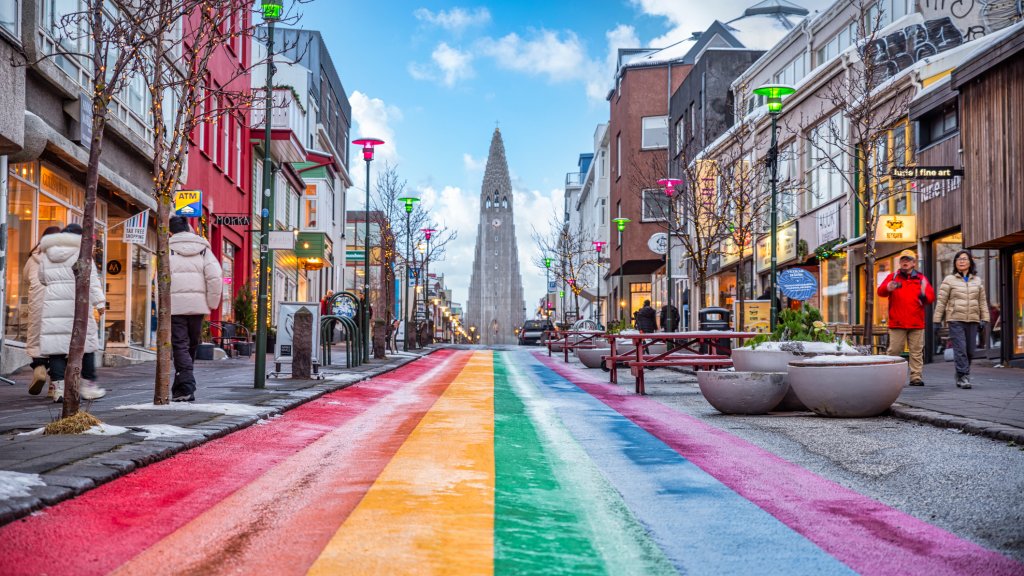
The message behind the artwork was clear: the church wanted to show its support for the LGBTQ+ community and underline its “need to be visible and accepted”. That is how Arna Sigurðardóttir, now the senior pastor, explained it. A similar explanation was given for the rainbow street leading up to Hallgrímskirkja, the Evangelical Lutheran place of worship belonging to the Church of Iceland in the centre of the capital, Reykjavík. The church in Grafarvogur has now fallen victim to vandalism – all the rainbow colours on the steps were painted over with the three colours of the Icelandic flag.
A trivial matter? Far from it: the LGBTQ+ community in particular attaches great significance to the incident in a country ranked among the world’s most LGBTQ+-friendly. If such homophobic hatred is already happening here, what does that say about the state of the community overall? What is more, this was not the first attack on the church’s Pride symbolism. The steps had already been damaged twice before. During one incident, unknown perpetrators added black lettering alluding to a verse from the Old Testament. This time, Pastor Sigurðardóttir felt the situation was even worse: “More systematic, in a way – much more methodical. We are seeing this resistance to human rights everywhere, and they are starting to wrap the whole thing in national flags.”
The flag as a political symbol
The way a national flag can turn from a unifying symbol into an expression of political exclusion is familiar from other countries, including Germany. But for many Icelanders, it is a relatively new experience. The country, with just under 400,000 inhabitants, had previously been considered comparatively unpolarised. The history of the flag itself is also closely bound up with the country. Blue stands for the North Atlantic, white for the glaciers and red for the lava from its roughly 33 active volcanic systems.
Ása Berglind Hjálmarsdóttir, a member of Iceland’s parliament, the Althing, says that until about a year ago, she could not remember the national flag being used in a controversial way. That changed in spring 2025. Hjálmarsdóttir, a member of the Social Democratic Alliance, encountered an anti-immigration demonstration outside the Althing. A “small group of extremists”, as she describes those involved, had wrapped themselves in the Icelandic flag. “I had this uneasy feeling in my stomach,” says Hjálmarsdóttir, “because that had never happened before.” For her, it was a visible sign: modern far-right politics had reached Iceland. It was not long before far-right extremists in the country also singled out gay and queer people as targets – another familiar phenomenon in several countries around the world.
Human rights in Iceland
Ragna Sigurðardóttir, a 33-year-old member of the Althing, by contrast, explicitly sees the flag’s significance in her country’s liberal achievements. She is not related to Pastor Arna Sigurðardóttir. “Our history with the first openly gay prime minister, renewable energy, women’s rights … for me, that is exactly what the Icelandic flag symbolises,” Ragna Sigurðardóttir said. “We must have the courage to fly it.”
Hjálmarsdóttir therefore wants to prevent the national flag from becoming associated with one particular political position. “It is very important that we do not allow unease about the flag to grow,” she said. The central idea: the flag should not belong exclusively to anyone, but to everyone – including gay and queer people. Alongside the debate over national symbols, Iceland faces another fundamental political decision. At the end of August, citizens will vote on the first step in a possible process of moving closer to the European Union. Following recent incidents, there is also fear within the community that this could lead to the political shift to the right and anti-LGBTQ+ sentiment in parts of Europe spreading more strongly to the island in the far north.
Church puts its faith in dialogue
According to Arna Sigurðardóttir, the EU question does not play a decisive role in her congregation. She says this also applies to people who object to the Pride colours on the church steps. Instead, the congregation is grappling with a fundamental question: which is more harmful? Offending people with the Pride colours – or, by removing the colours, taking symbolic support away from those who need it? The church ultimately decided to repaint the rainbow colours on the steps. The pastor is also inviting interested members of the public to talk: “It is about trying to reach the people who are still unhappy.”








