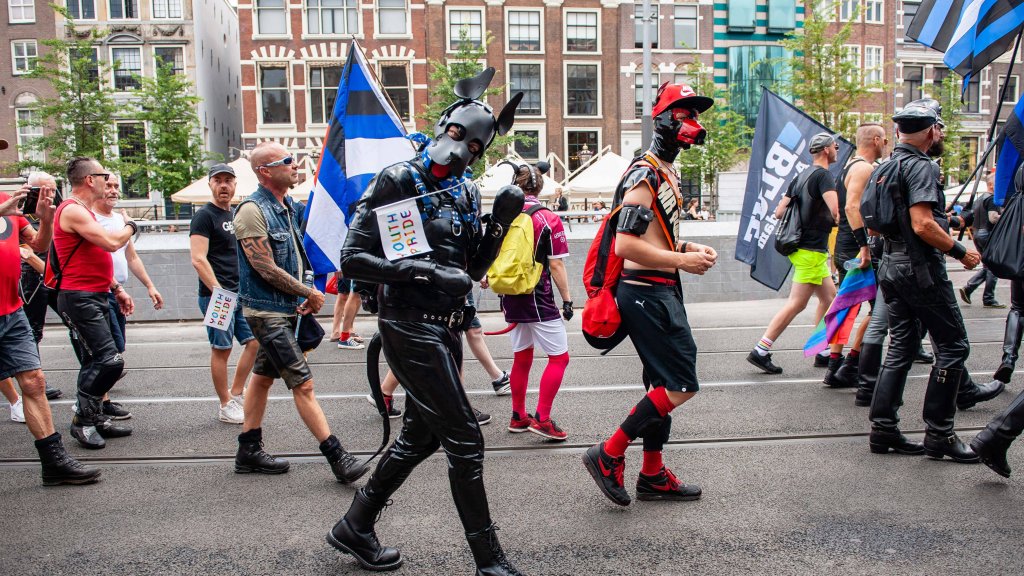
In the Netherlands, immediately after World Pride in Amsterdam, the search is now beginning for a new face of an unusual subculture that has gained international visibility. The Dutch Puppy Contest is looking for the next Mr., Ms. or Mx Puppy Nederland. The chosen person will then represent the Dutch puppy and fetish community for a year. In the Netherlands, this is much more than just a title.
The key points at a glance
- The search is under way in the Netherlands for the next Mr., Ms. or Mx Puppy Nederland.
- The Dutch Puppy Contest 2026 aims to find someone to represent the Dutch pup and fetish community publicly for a year.
- The title is therefore not just an award, but is intended to fulfil an important function within the scene.
- Applicants do not need years of experience or an extensive collection of gear.
- Pup play has historical roots in gay leather and BDSM culture.
- Many pup players no longer define themselves solely through sexuality:
- Community, play, relaxation and identity also matter to many pups.
- The Dutch contest takes place in Amsterdam in October 2026.
Political engagement
Specifically, the organisers are concerned with more than a sash or a title. The winner is expected to act as an ambassador for the scene, be approachable and represent the community both within the Netherlands and internationally, including in Germany. The role is also intended to actively counter prejudice both within and outside the LGBTQ+ community. This is precisely why the contest has particular significance for the scene. The titleholder is also expected to help hold a community together, welcome newcomers and encourage openness towards one another. Less show, more political engagement for pup enthusiasts and allies. As with equal marriage (German), the Netherlands wants to take a pioneering role here too.
Ambassador for a growing scene
According to the organisers, one of the most important tasks is to “create and foster a happy, safe and accessible pup community that everyone can enjoy”. The contest is therefore not aimed exclusively at experienced members of the scene. Rather, the organisers are looking for someone who can inspire others and make the community’s different facets visible. They explicitly stress that the barriers to entry are low. “You don’t need a handler to take part, nor do you need an extensive collection of pup gear or years of experience,” they say. What matters instead is openness and how people treat others: “Have a big heart and be pawesome to your fellow pups.” A handler is someone who accompanies a pup and, for example, plays with them, guides them or supports them at events.
The Dutch contest is thus also an example of how pup play has developed from a relatively small subculture into a large, visible community – something that could also be seen repeatedly at this year’s World Pride. Academic studies describe pup play as role play in which adults take on the role or characteristics of a dog or puppy. At the same time, the scene has developed in different directions: while sexual aspects are and remain important for some participants, others focus on play, relaxation or community.
Roots in gay leather culture
The history of pup play is closely linked to the development of the gay leather and BDSM scene. Historians locate important roots in US leather communities from the 1940s to the 1980s. Over the decades, various forms of dominance and submission role play developed into a distinct puppy culture. Its precise origins cannot, however, be reduced to a single time or place. This development had particular significance for gay culture. At a time when homosexuality was heavily stigmatised by society and subject to persecution, the leather scene offered spaces for community, identity and sexual self-determination.
Historically, pup play belongs to this tradition, even though today’s scene is considerably more diverse. One academic study explicitly locates its historical roots within the gay leather subculture, while also pointing to a development in which sexual and non-sexual pup play are increasingly becoming distinct from one another. Pup play remains closely linked to the gay scene today, and most pups are still gay.
Community, not just fetish
Public perceptions often reduce pup play to its sexual or fetish-related aspect. Research paints a more nuanced picture. Alongside sexual pleasure, studies identify relaxation, playful behaviour, self-exploration and social relationships as important motivations. A sense of belonging to a community can play a particularly central role for participants. This also explains the great importance of events such as the Dutch Puppy Contest. A contest for a title can serve a unifying function within a subculture: it creates visibility, offers opportunities to meet and gives the community someone who can represent its interests and values to the wider world. In mid-October, Amsterdam will once again become the centre of the country’s community. The current Mr Puppy NL 2026 is Pup Mozi, who will then hand over his title to the scene’s new representative.








