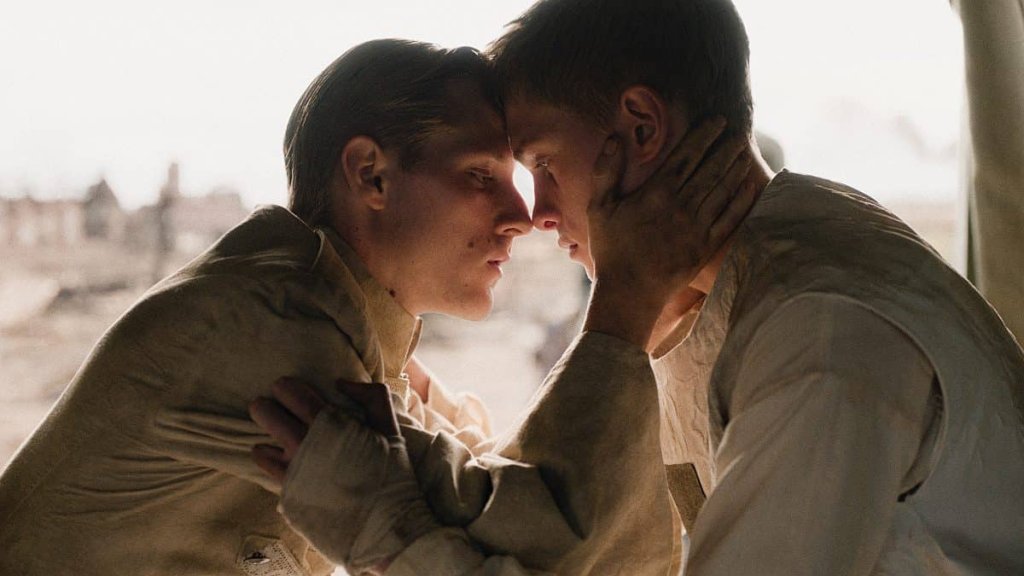
The title “Coward” (“Feigling” in German) initially points us in the wrong direction. In the context of war, the term can readily be associated with soldiers seeking to avoid combat. Yet filmmaker Lukas Dhont and his co-writer Angelo Tijssens interpret the title far more broadly – and captivate their audience with a distinctive gay love story between soldiers (German). Further details and images have now been released.
The key points at a glance
- Lukas Dhont’s new film “Coward” is set in 1916 during the First World War.
- It centres on Belgian soldiers Pierre and Francis, played by Emmanuel Macchia and Valentin Campagne.
- The film is less interested in military strategy than in fear, waiting, exhaustion and the psychological effects of war.
- Francis organises theatre and dance evenings behind the front lines, allowing soldiers to step into other roles for a while.
- A tentative romantic relationship develops between Francis and Pierre.
- Paradoxically, war becomes a space in which Francis can express a side of his personality for which there is little room outside these exceptional circumstances.
- “Coward” combines war drama, a love story and an unusually tender portrayal of male, specifically gay, intimacy.
- The film was acclaimed at the 79th Cannes Film Festival in 2026.
A war film without heroic bombast
As the film progresses, the question of who can actually be considered a coward becomes increasingly pressing. Is it those who struggle to survive in the face of war? Is it men who hide their feelings behind a façade of military toughness? Or perhaps those who can only allow themselves to feel because the exceptional circumstances of war offer them a protected space? Dhont’s film is set in 1916 and follows young Belgian soldiers during the First World War. Although the trenches and the violence of war are present, “Coward” is not a conventional battlefield epic. Military tactics and heroic fighting are not its focus. Far more important is the waiting. Fear and exhaustion become visible in the long stretches between battles. The threat lies not only in the fighting itself, but also in the constant anticipation of the next attack.
Discovering another world
The story initially follows Pierre, a rather reserved soldier played by Emmanuel Macchia. At the front, he tries to fit in with the group. He joins in his comrades’ sometimes coarse jokes and carries out his duties without drawing much attention to himself. At the same time, he becomes increasingly fascinated by a group of soldiers who have created their own little alternative world away from the front.
Pierre is particularly drawn to Francis. Valentin Campagne plays a young man who organises theatrical performances and dances. Soldiers deemed unfit for frontline service put on improvised women’s clothes and, for a few hours, can forget the world they actually live in. What might initially seem like a bizarre distraction from everyday life at the front takes on far greater significance in “Coward”. For the men, it is not simply about entertainment. Amid surroundings defined by violence and death, a space emerges for beauty, imagination and play. It is precisely here that Dhont’s characters reclaim a measure of freedom.
Between dressing up and desire
A relationship gradually develops from the encounter between Francis and Pierre. The two cautiously draw closer, observing and feeling their way towards their emotions. Their love story remains closely bound to the exceptional circumstances of war. Cinematographer Frank van den Eeden captures these moments in images of pronounced sensuality. Particularly striking is the tenderness with which the film portrays the later love scenes between the two men.
In this way, “Coward” offers a counterpoint to the brutality of war. Against the destructive daily reality of the front, the film sets a form of intimacy that is still relatively rarely portrayed with such naturalness and sensitivity in gay cinema. Yet the relationship between Francis and Pierre is not without tension, as each has different expectations of their closeness.
Freedom after the war
Francis initially approaches Pierre with determination. At the same time, the question soon arises of what will become of their relationship once the war is over. Francis seems to have only limited interest in that future. It repeatedly becomes clear that it is precisely the war that opens up an opportunity for him that would not exist under normal circumstances. He can act, design costumes, make music and dress up. Above all, however, he can reveal a side of his personality that would have no readily accepted place outside these exceptional circumstances.
For Francis, war is thus both a prison and a space of freedom. It destroys lives and bodies – yet, paradoxically, creates a situation in which he can live out his own identity more openly. Valentin Campagne embodies this contradictory character with tremendous presence. Francis has a zest for life, inventiveness and charm. At the same time, an elusive melancholy remains visible beneath his energy. Emmanuel Macchia counters this spirited character with an almost stoic physicality. It is precisely the contrast between the two actors that creates a tension sustaining the film for much of its running time.
Tenderness as an alternative to violence
With “Coward”, Lukas Dhont has made his most impressive film to date. His story depicts war not primarily as a succession of battles, but as a condition in which people change and seek closeness and freedom under extreme circumstances. It is precisely the combination of brutality and tenderness that makes the film unusual. Where the military world demands toughness, Pierre and Francis offer other ways of connecting. And so the title “Coward” takes on an additional meaning: perhaps it is less about who is brave or cowardly in war than about the courage it takes to accept one’s own vulnerability. The film has already received an enthusiastic reception at the Cannes Film Festival (German). It opens in cinemas in the US and Canada in late December. A German cinema release date has not yet been set, but a date close to the international release could be targeted.








