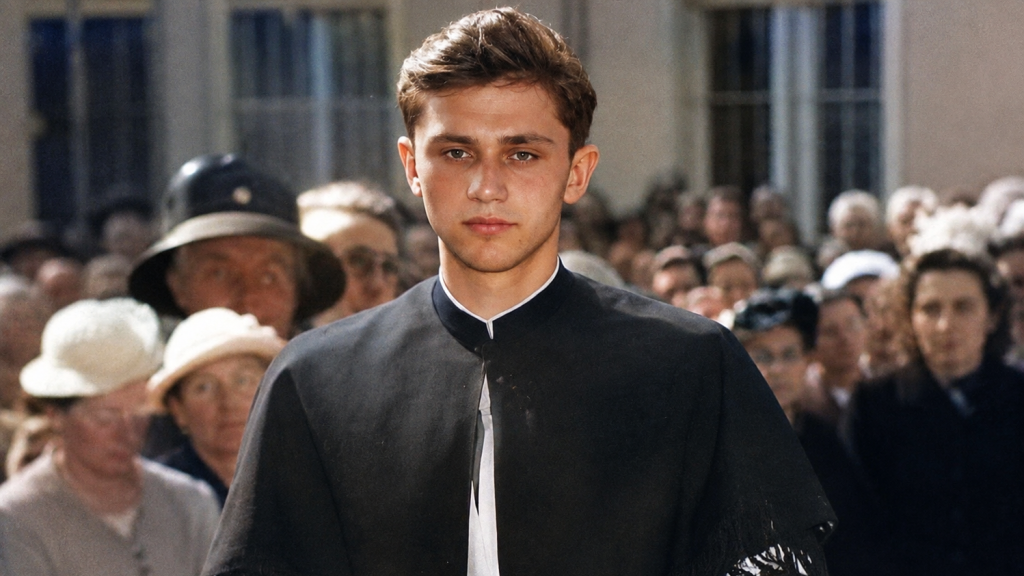
A photograph of the young man who would later become Pope Benedict XVI is currently attracting unusual levels of attention on social media. On X, gay users are describing the young Joseph Alois Ratzinger as anything from a ‘Vatican heartbreaker’ to an ‘evil twink’ or even a ‘devilishly sexy twink’. The image from the 1950s has duly gone viral.
The key points at a glance
- A photograph of the young Joseph Ratzinger, who later became Pope Benedict XVI, is prompting viral reactions on X.
- In the gay community, the young Ratzinger is jokingly being described as an ‘evil twink’ or a ‘Vatican heartbreaker’.
- At the same time, a look at his biography recalls his conservative stance on homosexuality.
- According to the late Pope Francis, Ratzinger apparently later supported his advocacy for LGBTQ+-friendly civil partnerships.
A ‘devilish’ twink
‘Imagine wasting your life devoting yourself to religion when you look like this,’ wrote one user. Another commented: ‘Giving up sex with that face? What an attitude – holy moly.’ Another commented: ‘I know an evil twink when I see one.’ Someone else wrote: ‘I know a demon when I see one.’ Another called him an ‘Evil Twink’, clearly intending it as an erotic compliment. Another made it clear that the young man had been the ‘Vatican heartbreaker’. For one more user, a single word said it all: ‘Benedictwink’. The term is now going viral, and the image itself is being widely shared: more than 3.5 million people have viewed it on X alone so far. Other users, however, questioned whether the photograph was genuine, suspecting an artificially generated image. The black-and-white version of the picture has been circulating online for years, however; the image itself was apparently colourised later.
A viral joke with a serious backdrop
Research suggests that the picture dates from 1951 and shows the then 24-year-old Joseph Ratzinger as a newly ordained priest, immediately after his ordination in Freising Cathedral. He is wearing light-coloured vestments for his first Mass, looking directly into the camera with dark, intense eyes, his hair thick and dark and his hands clasped. Today's online hype stands in stark contrast to Ratzinger's historical role. Born in Germany in 1927, he was one of the most influential men in the Catholic Church, first as a theologian and later as Prefect of the Congregation for the Doctrine of the Faith. As Benedict XVI, he led the Church from 2005 until his resignation in 2013. He died in late 2022 at the age of 95.
Ratzinger held distinctly conservative positions, particularly on homosexuality. In 1986, he described homosexual orientation as ‘an objective disorder’. In 2005, he was also involved in implementing a ban that made it harder or impossible for gay men to enter seminaries. His stance towards LGBTQ+ people is regarded as a significant part of his controversial legacy.
His youth is also being discussed in this context. As a teenager, Ratzinger was a member of the Hitler Youth. During the Second World War, he was conscripted into military service and deserted towards the end of the war. This gives the joking description ‘demon twink’ a second, distinctly less harmless meaning. Nevertheless, online reactions remain shaped above all by the contrast between Ratzinger's youthful appearance and his later public role.
Later support for Francis
The story is not solely one of confrontation, however. Following Benedict XVI's resignation, Jorge Mario Bergoglio was elected pope as Francis in 2013. Francis was regarded as significantly more open towards LGBTQ+ people, without fundamentally abandoning the Catholic Church's traditional teachings. In a book published a year before his death, Francis reported that Ratzinger had even supported his advocacy for LGBTQ+-friendly civil partnerships.
‘They came to Ratzinger to practically put me on trial, accusing me before him of supporting same-sex marriage,’ Bergoglio wrote. Ratzinger reportedly rejected this and told his critics that supporting LGBTQ+ rights was ‘not heresy’. This presents a strikingly contradictory picture: the man who had previously been one of the Catholic Church's leading conservative voices on sexuality later supported his successor, at least in one specific political dispute. The relationship between Francis and Benedict was also explored in the 2019 film ‘The Two Popes’.








