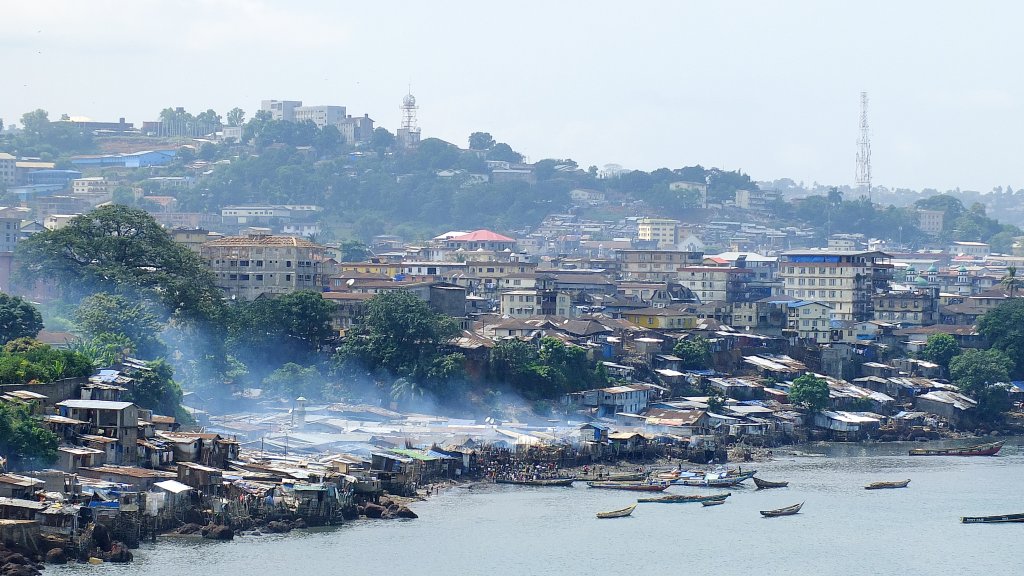
Police in Sierra Leone have raided a private party for gay men in the capital, Freetown. The raid took place at the Hill Valley Hotel in the hills above the city. According to the newspaper Daybreak News, police arrested “dozens” of men.
Key points at a glance
- Police in Sierra Leone have raided a private party for gay men in Freetown.
- According to the newspaper Daybreak News, “dozens” of men were arrested.
- Between 50 and 60 people are reported to have attended the party at the Hill Valley Hotel.
- LGBTQ+ activist George Reginald Freeman Browne and his partner Edwin Bolaji Deen managed to evade arrest.
- Arrest warrants were issued for both men over “homosexuality and LGBTQ+ social activities”.
- Sierra Leone still has a law dating from British colonial rule that makes homosexual acts between men punishable by up to life imprisonment.
- Human rights organisations report discrimination, violence, blackmail and arbitrary arrests.
Raid on a gay safe space
It is currently unclear exactly how many people were taken into custody and whether any of those arrested remain in police custody. George Reginald Freeman Browne, executive director of the LGBTQ+ organisation Pride Equality, said there had been around 50 to 60 guests, although some had managed to flee. Freeman Browne himself was at the party with his partner, activist Edwin Bolaji Deen. According to his account, both left the event when police arrived. Arrest warrants were later issued for them. The allegations concern “gay homosexuality and LGBTQ+ social activities”, which police said were “liable to disturb the public peace”. Police are offering a “generous” reward for information leading to the arrest of the two men.
Other activists said the event had been “intended as a rare safe space for gay men”. Police further stressed that “men were engaging in consensual sexual activities” during the gathering, as many gay men in Sierra Leone have no safe or private places in which to be intimate. It was also one of the few opportunities for gay people to spend intimate time with their partners and friends, the activists added.
Old law against homosexuality
Sierra Leone is a small English-speaking country on West Africa’s Atlantic coast. It still retains a law from 1861, introduced under British colonial rule. It provides for prison sentences ranging from ten years to life for men convicted of “buggery” – a term that includes homosexual acts. The law was retained after Sierra Leone gained independence in 1961.
Until now, however, enforcing it had apparently not been a high priority. The Human Dignity Trust has now reported: “There is limited evidence that the law has been enforced in recent years. Homosexual people have occasionally been subjected to arrest and arbitrary detention in recent years, but there appear to have been no prosecutions under this law, either successful or unsuccessful.” Recently, however, the situation appears to have worsened. There have also been reports for years of discrimination and violence against LGBTQ+ people. These include assaults, threats, harassment, blackmail, rejection by families and the denial of basic rights and services.
According to current reports, there is consequently widespread fear within the LGBTQ+ community. Local media contribute to this by regularly publishing police wanted notices. In some cases, rewards are offered for information about people suspected of being homosexual. Freeman Browne said that “the colonial law is still being used as leverage to extort money from LGBTQ+ people”.
Activist describes the raid
Freeman Browne gave a detailed account of the police operation: “In the middle of the night, about ten police officers stormed into the hotel room, where around 50 or 60 guests had gathered. It was clearly a raid targeting gay men, and the police were apparently looking for condoms and lubricants or other incriminating evidence that could justify the presence of a police patrol. As the hotel had two exits, some of us were able to escape. Others were nevertheless arrested. I also received calls on my mobile phone from unknown numbers. People with malicious intentions tried to blackmail me. I cannot explain who is behind these actions or how my phone number became known.”
The same questions apparently also arise in connection with the organisation of the party – namely, who informed the police that this party was taking place at a private venue, and how. “This is worrying. My partner Edwin Bolaji Deen is also wanted by the police, and members of his family have already been questioned about his whereabouts. As for me, just a few days ago I was refused permission to return to Spain when I went to the airport, even though I am of both Spanish and Sierra Leonean descent. In a rather confusing way, I was told that I did not meet the requirements for leaving Sierra Leone. I found that very strange,” Freeman Browne continued.
For Freeman Browne, however, the raid is not an isolated incident. He first fled to Spain in 2013 to escape homophobic attacks and death threats in Sierra Leone, but later returned to his home country. The latest police operation has therefore not only raised fresh questions about the enforcement of the historic law against homosexuality. It is also heightening concerns within the gay and lesbian community about possible further arrests and the authorities’ treatment of sexual minorities.








