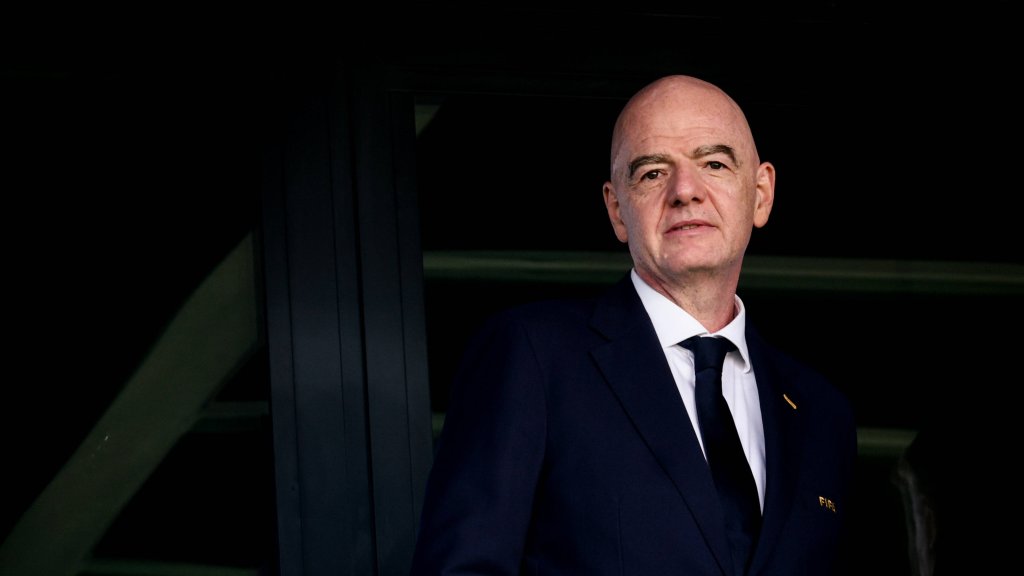
Criticism of FIFA President Gianni Infantino continues to grow. The focus has long since moved beyond how football’s world governing body handles its commercial rights. The awarding of major football tournaments to countries with serious human rights problems is also meeting sustained opposition. Particular attention is being paid to the choice of Qatar to host the 2022 World Cup and the awarding of the 2034 World Cup to Saudi Arabia.
The key points at a glance
- EU Commissioner for Sport Glenn Micallef accuses FIFA under President Gianni Infantino of increasingly commercialising football.
- Criticism of Infantino goes far beyond the now-abandoned plans to sell World Cup rights.
- Human rights organisations have criticised FIFA for years for awarding major tournaments to countries where human rights, particularly the rights of gay people, are severely restricted.
- Qatar hosted the 2022 World Cup, and Saudi Arabia is set to host the 2034 World Cup; homosexuality is a criminal offence in both countries.
- Micallef declines to call personally for Infantino’s resignation and sees responsibility as lying with the national associations.
- UEFA is considering filing a criminal complaint against Infantino and says it intends to put forward a rival candidate if he stands again in 2027.
- In a complaint to the FIFA Ethics Committee, human rights organisation FairSquare accuses Infantino of eight breaches of the ethics rules.
Criticism from EU Commissioner for Sport
Homosexuality is a criminal offence in both countries. Human rights organisations have therefore criticised FIFA for years for failing to take sufficient account of human rights issues when awarding its most important tournaments. Organisations such as Amnesty International have repeatedly accused football’s world governing body of failing to give adequate consideration to the human rights impact of its decisions. EU Commissioner for Sport Glenn Micallef is also sharply critical of FIFA’s leadership.
The Commissioner responsible for Intergenerational Fairness, Youth, Culture and Sport was particularly critical of the world governing body’s now-abandoned plans to sell stakes in the commercial rights to the football World Cup to private investors. Speaking to Deutsche Welle (DW), Micallef described the plans as “another episode in a series of poor leadership decisions that excessively commercialise the sport”. That harms football, he said.
No direct call for resignation
Despite the growing pressure on the FIFA chief, however, Micallef declined to support a call for Infantino’s resignation. Asked whether the world governing body remained fit for purpose under Infantino’s leadership, the EU Commissioner for Sport pointed to the responsibility of the national member associations. “That is a decision for the national associations and federations,” Micallef said. He hoped for an open process in which these issues would be discussed and accountability ensured. The question of FIFA’s political and social responsibility extends well beyond individual business decisions. Critics see a fundamental problem in the awarding of the World Cups to Qatar and Saudi Arabia: the world governing body claims global social significance, yet human rights organisations believe its decisions fail to take sufficient account of the situation of affected groups.
The treatment of gay people in particular repeatedly takes centre stage. Homosexuality was already a criminal offence in Qatar before the 2022 World Cup. Saudi Arabia, which is set to host the 2034 World Cup, also faces international criticism over its criminalisation of same-sex relationships and its overall human rights situation. In both countries, homosexuality remains punishable by death. Human rights organisations such as Amnesty International see this as a recurring pattern. In their view, it raises the question of how much weight human rights actually carry in the decisions of football’s world governing body. The criticism is that FIFA’s economic and political interests apparently often outweigh the protection of human rights.
UEFA increases the pressure
Micallef’s comments are in line with the increasingly critical stance towards Infantino taken by UEFA and its President Aleksander Ceferin. European football’s governing body said in August that it was considering filing a criminal complaint against the FIFA President. UEFA also announced that it would put forward a rival candidate if Infantino seeks re-election as planned at the FIFA Congress in March 2027. Opposition to the FIFA chief is therefore also growing within international football organisations. Alongside UEFA, there are numerous other critics of Infantino. They include human rights organisation FairSquare, which filed a complaint against the President with the FIFA Ethics Committee, backed by 100,000 supporters.
The complaint accuses Infantino of breaching FIFA’s ethics rules on eight occasions. The points raised include the plans for partial privatisation of the World Cup and the lifting of US international Folarin Balogun’s suspension following a red card. All the allegations relate to Infantino’s relationship with US President Donald Trump. In the complaint, which DW has seen, FairSquare stated: "At the very least, Infantino has abused his power, breached his duty of political neutrality and his duty of loyalty by attempting to ingratiate himself with the US President. The indications that he sought to benefit personally from this pattern of behaviour further increase the seriousness of the allegations.”
Dispute over sale of World Cup rights
For Micallef, the planned involvement of private investors in the World Cup’s commercial rights also remains an example of what he sees as world football heading in the wrong direction. In July, FIFA announced plans to sell 20 per cent of the commercial rights to the World Cup to private investors. The proposal sparked widespread outrage and has since been abandoned. “Football is not for sale,” Micallef stressed to DW. Investment was necessary, he said, but that did not mean football had to sell itself. FIFA’s leadership had to ensure that the sport grew and reached more people, but must not make a profit at its expense. “Football belongs to us, the fans.” The statement also reflects a more fundamental conflict over the direction of the world governing body. With no signs of a change of course, FairSquare Director Nicholas McGeehan is calling for EU intervention and questioning the ability of sports organisations to regulate themselves effectively.
European Commission considers further action
FIFA’s role as both an organiser of competitions and football’s global regulator has also long attracted criticism. This dual role raises questions about potential conflicts of interest. A complaint concerning control of the international match calendar is already before the European Commission. It was submitted by the umbrella organisation of Europe’s professional football leagues. The allegation is that FIFA uses its position to favour its own competitions. On Tuesday, the complaint was extended to women’s football. Micallef did not rule out further EU measures. “The autonomy of sport does not exempt it from its legal obligations,” he said. Competition policy was one of the available tools, he said, although he preferred to resolve problems through dialogue rather than competition law proceedings. If passionate football fans and institutions came together to send a strong signal, they would be a force to be reckoned with. “We deserve good governance. That is not too much to ask.”








