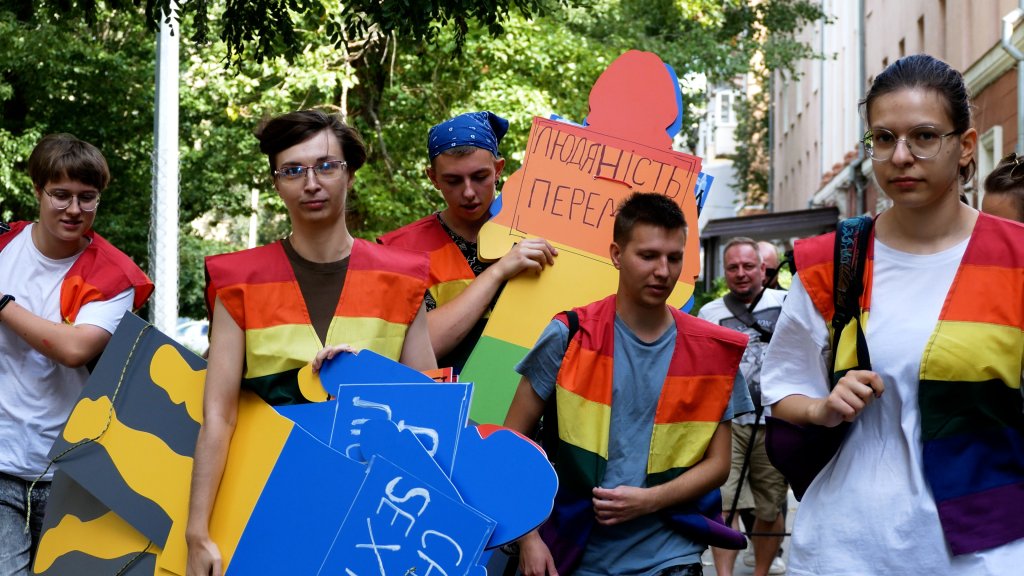
Around 200 people took part in this year’s Pride in the eastern Ukrainian city of Charkiw under strict security measures. They initially gathered at Universitet metro station. The organisers had kept the venue secret until shortly before the event began.
Key points at a glance
- Around 200 people gathered at a metro station in Charkiw for Pride 2026.
- The exact venue was kept secret until the last moment for security reasons.
- Participants’ demands included registered partnerships for same-sex couples and better protection against hate crimes.
- The demonstration took place under heavy police protection.
- A counter-demonstration was held by right-wing “supporters of traditional family values” dressed in black.
- The Pride event also focused on the role of LGBTQ+ people in the Ukrainian armed forces.
- A bill on registered partnerships has been before the Ukrainian parliament since March 2023 but has not yet been passed.
- The bill does not provide for same-sex marriage or adoption by couples in registered partnerships.
- President Wolodymyr Selenskyj recently made a U-turn on the rights of gay and queer people.
Calls for equal rights
The secrecy was prompted by the dangers posed by Russia’s war of aggression. The organisers wanted to prevent a public announcement from drawing the Russian army’s attention to the gathering. They also wanted to deny a planned counter-demonstration the opportunity to block the venue. The metro proved to be a particularly well-protected location. An air raid alert was in force in Charkiw as participants gathered there. Among other demands, the demonstrators called for legal recognition of registered partnerships for same-sex couples. They also demanded more effective prosecution of hate crimes against members of sexual minorities.
Many participants carried rainbow-coloured banners and placards. Their messages included “I stand for freedom”, “Homophobia belongs to the Russian world” and “Equal rights for all”. “Once again, we are demanding equal rights for members of the LGBTQ+ community and the right to marry. We are holding Charkiv Pride because we want this city to be a European city,” spokesperson Vira Tschernigina told public broadcaster Suspilne.
Police protect demonstrators
After the rally in the metro, participants moved to Freedom Square and then continued onto the street. A large police presence secured the demonstration and kept participants apart from counter-demonstrators. Right-wing “supporters of traditional family values” dressed in black had gathered on Freedom Square, Ukraine’s largest city square. One of their black banners read: “Putin is gay too. That’s why he’s proud of you”. The counter-demonstrators had also brought a rainbow flag. Towards the end of their protest, they stamped on the flag and then set it alight. After Pride ended, participants were taken by bus under police protection to safe locations. From there, they could make their way home.
Charkiw Pride had already begun the previous week with a two-day festival. The programme included a market where businesses from Charkiw presented their products. There were also talks, panel discussions, workshops and first-aid training sessions. Visitors could also get tested for HIV and STIs free of charge. Some of the participating businesses announced that they would donate part of their proceeds to a support centre. The centre provides free support to LGBTQ+ people and women.
LGBTQ+ people in the armed forces
Another focus of this year’s Pride was the role of LGBTQ+ people in the Ukrainian armed forces. A memorial area was set up at the festival, displaying portraits and stories of soldiers who had been killed or were missing. There was also criticism of the Ukrainian parliament. A bill on registered partnerships introduced in March 2023 has yet to be passed by the Verkhovna Rada, Ukraine’s parliament. The bill incorporates at least some of the community’s demands. If it becomes law, two adults would be able to register their partnership. Assets acquired during the partnership would be considered joint property. Partners would also be able to inherit from one another.
The planned provisions would also be significant in dealing with the consequences of the war. If one partner died or went missing, the other would be able to claim social entitlements. The bill would therefore represent a step towards legal equality for same-sex couples. However, it does not provide for same-sex marriage. Nor would couples in registered partnerships be allowed to adopt under the planned provisions. Recently, the community was shocked by a new legislative proposal, a civil code, that would severely curtail the fundamental rights of gay and queer people (German). President Wolodymyr Selenskyj, who initially declared his support for the community, made a U-turn at the outset. Whether Selenskyj actually supports the legislative proposal, thereby breaking all his promises to LGBTQ+ people, remains an open question.








