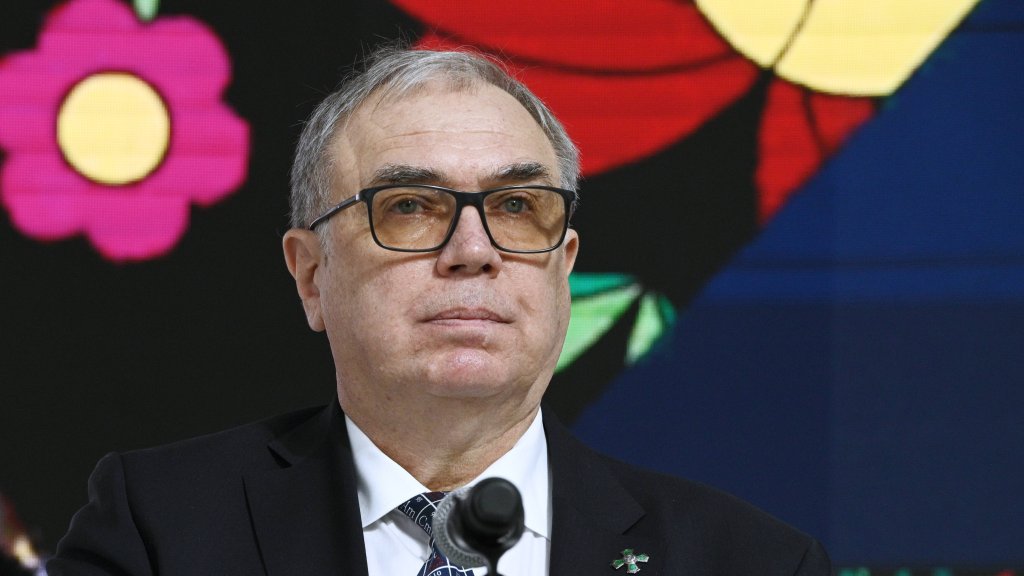
The International Atomic Energy Agency (IAEA) has launched an ethics investigation into its Russian Deputy Director General, Mikhail Chudakov. The official has also been suspended from his duties. The investigation concerns a book he published under a pseudonym containing controversial statements about gay people and women.
Key points at a glance
- The International Atomic Energy Agency (IAEA) has launched an ethics investigation into Russian official Mikhail Chudakov.
- Chudakov has been suspended from his duties as Deputy Director General and Head of the Department of Nuclear Energy.
- The investigation was triggered by his book “Treatise on Life”, published in 2025 under the pseudonym “Valentin Voyutin”.
- In it, Chudakov attacks gay people and feminist movements, among others.
- He calls homosexuals “perverts and sodomites” and same-sex relationships “sinful deviations”.
- The book also contains statements supporting a “dictatorship”, strict hierarchies and the persecution of dissidents.
- Chudakov distributed the book to participants at a UN event in Vienna. The IAEA Ethics Office was subsequently alerted.
- Former US ambassador to the IAEA Laura Holgate described the publication as “highly inappropriate”.
- Chudakov has a long career in the Russian nuclear industry and holds a doctorate in nuclear engineering.
A “guide” for young people
Chudakov has served as the IAEA’s Deputy Director General and Head of the Department of Nuclear Energy since 1 February 2015. The organisation reports to the United Nations General Assembly and Security Council. Chudakov attracted attention at a UN event in Vienna focusing on “young generations in the nuclear sector”. There, he distributed copies of his book “Treatise on Life” to participants. The work was published under the pseudonym “Valentin Voyutin”. Chudakov dedicated the book to his children. According to his account, it is intended to serve as an ethical guide for young people. After the event, however, some participants contacted the IAEA Ethics Office to draw attention to the statements in the book.
Attacks on women, lesbians and gay men
In the book, Chudakov urges readers not to support feminist movements. He argues that women have more rights than men. He describes leaders of the women’s rights movement as “hysterical fanatics”. Gay people are also portrayed in derogatory terms in the book. Chudakov calls gay men and lesbians “perverts and sodomites”. He describes same-sex relationships as “sinful deviations”. He calls their influence on young people “poison”.
But the book’s political statements go beyond attacks on women, lesbians and gay men. Chudakov, or rather his alter ego “Voyutin”, advocates a dictatorship, strict leadership hierarchies and the persecution of dissidents. He also calls for a particular form of “loyalty to Russia”. The book, published in 2025, also refers to Chudakov’s work at the IAEA. In it, the author advocates “strict authoritarian leadership” and a “dictatorship” disguised as a democracy. Elsewhere, Chudakov calls for loyalty to “one’s own country, Russia, and one’s own government” and supports the persecution of dissidents.
IAEA rules require restraint
The IAEA’s internal rules prohibit staff from engaging in discrimination or actions that could jeopardise a safe working environment. Staff wishing to publish a book need approval from headquarters and are expected to avoid sensitive subjects. The ethical standards also require international officials to exercise “restraint and tact”. Breaches can have disciplinary consequences. The current investigation could become a difficult political issue for IAEA Director General Rafael Mariano Grossi. Grossi must seek re-election next year and depends on support from Moscow, among others. The appointment of the Director General requires the unanimous approval of China, France, Russia, the United Kingdom and the United States.
Laura Holgate, the former US ambassador to the IAEA, has meanwhile already openly and strongly criticised the publication and distribution of the book by an international official. She described it as “highly inappropriate”. In her view, its content does not meet the standards of neutrality and professionalism required of staff at international organisations. The IAEA press office, Director General Grossi and Chudakov himself declined to comment.
A long career in the nuclear industry
Chudakov has decades of experience in the Russian nuclear industry. From 1983 to 1993, he worked at the Kalinin nuclear power plant in Russia. His roles there included senior reactor operator and senior reactor engineer. Other positions included control room supervisor, plant shift supervisor and plant operations shift supervisor. From 1993 to 1995, Chudakov worked as an adviser to the WANO Moscow Centre and as a WANO adviser in London. He then held various management positions at the Russian nuclear company Rosenergoatom from 1995 to 1999. In April 1999, Chudakov was appointed Deputy Director General of Rosenergoatom and Director of the Bilibino nuclear power plant. He later moved to the IAEA. Chudakov holds a doctorate in nuclear engineering.








