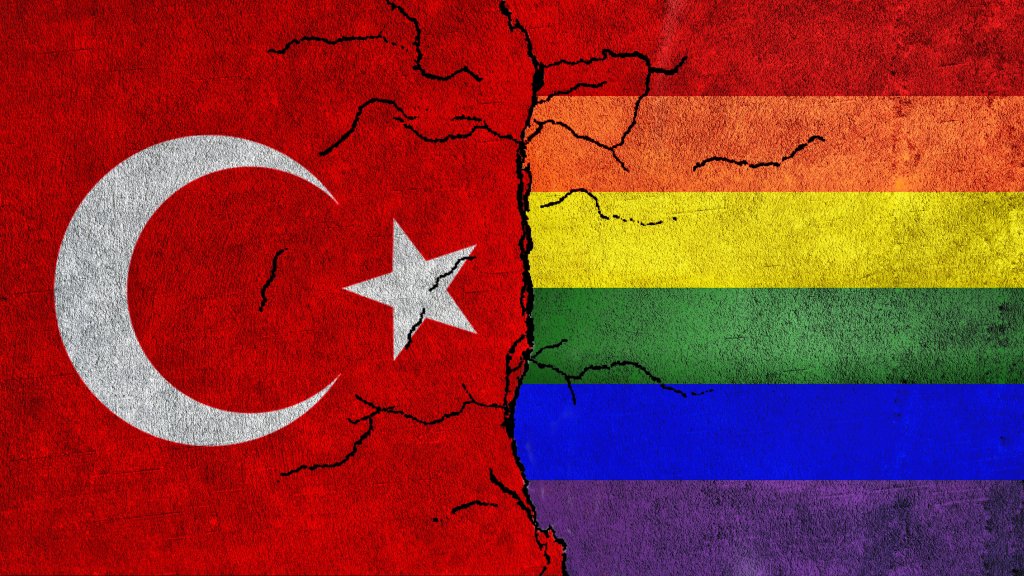
The Turkish authorities’ actions against the LGBTQ+ community have triggered a fresh wave of criticism. Over the weekend, raids targeted activists and associations in several cities, with a reported 47 people arrested in total. Numerous digital services and social media accounts were also blocked. Most recently, there were further mass arrests of around 120 demonstrators who had protested against the government’s actions in Istanbul.
Key points at a glance
- Turkish authorities took action against LGBTQ+ activists and associations in Istanbul, Ankara and Izmir over the weekend.
- 47 people were arrested, and more than 100 websites and social media accounts were blocked.
- Those affected included Amnesty International Türkei, Kaos GL and several human rights, women’s rights and media organisations.
- Protests against the government’s actions in Istanbul saw further mass arrests of around 120 people.
- 120 LGBTQ+ associations and human rights organisations condemned the actions as part of an increasingly authoritarian policy.
- The government justifies the measures on grounds including the protection of families and children, as well as national security.
- Same-sex relationships remain legal in Turkey.
- The EU expressed concern and pointed to Turkey’s obligation to protect human rights.
- Human rights organisations see the arrests as an attempt to restrict and criminalise the LGBTQ+ movement.
Raids draw criticism
The latest incidents are linked to the “Decade of the Family” proclaimed by President Recep Tayyip Erdogan (German). The national strategy was announced in May 2025; previously, there had been talk of a “Year of the Family”. The initiative is intended to counter the sharp decline in Turkey’s birth rate while strengthening a traditional, conservative model of the family. In response, people took to the streets of Istanbul again on Tuesday to protest against the actions – around 120 people were arrested. Turkish LGBTQ+ organisations said in a joint statement that neither founding an association nor campaigning for the community’s rights was a criminal offence. “Freedom of assembly, freedom of expression, protection of privacy and the presumption of innocence also apply to LGBTQ+ people,” their statement said.
The community also received support from women’s rights organisations. A total of 120 organisations signed a joint statement opposing what they see as growing authoritarianism in the country. “Pressure is being exerted on our bodies, our lives, our identities and our right to organise. We know that this is an expression of the government’s authoritarian policies. Neither being LGBTQ+ nor organising as LGBTQ+ people is a crime!” the organisations declared.
Long-term strategy
Yildiz Taghizade of the “Verein für die Menschenrechte der Frau” (KIH), which co-signed the statement, accuses the Turkish government of deliberately working towards the criminalisation of the LGBTQ+ community. In her assessment, this development did not begin with the latest raids but has been unfolding for several years. “The aim here is not just to target LGBTQ+ people, but to make it effectively impossible for the LGBTQ+ movement to engage in politics, organise, demand rights and be present in public spaces,” Taghizade told Deutsche Welle.
She also considers the decision to call the operation “My Family Is Safe” a calculated political choice. “The government is trying to justify its actions through rhetoric about protecting families and children, but this narrative does not work. Because if we look at what actually makes families insecure in Turkey today, we find very concrete problems such as poverty, the housing crisis, unemployment, care work shifted onto women, such as looking after and caring for relatives, and male violence against women,” Taghizade said.
Medical association and workers’ party
The measures also met with opposition outside the LGBTQ+ movement. The Turkish Medical Association (TTB) described the actions as a human rights violation and demanded an end to what it sees as discriminatory policies. It said it was unacceptable to treat gender identity and sexual orientation as a criminal offence. The medical association also criticised people being taken from their homes at night and digital communication channels being blocked – all in the name of family and security.
Erkan Baş, leader of the Workers’ Party of Turkey (TIP), also demanded the immediate release of those arrested. The mere “existence of LGBTQ+ people” was not a crime, Baş said. According to him, people who do not share the government’s positions are “'brought into line' through the courts, batons and censorship. If they had their way, they would love to enshrine the criminal offence of 'being an opponent of the government' in law and sit back!” Baş added.
More than 100 accounts blocked
The raids took place on Sunday in Istanbul, Ankara and Izmir. At the same time, the authorities took action against numerous websites and social media accounts associated with LGBTQ+ associations, activists and other organisations. A further 32 accounts were blocked on the day of the raids alone. By the following day, the total number of blocked accounts had exceeded 100. The organisations affected included Amnesty International Türkei, the left-leaning newspaper Evrensel, the Academics for Peace initiative, the Jurists’ Association for Justice, the women’s rights organisation Mor Dayanışma, the LGBTQ+ media portal Kaos GL and the Media and Law Studies Association (MLSA).
The blocks were based on a decision by an Istanbul court, announced on 13 September. The Bakırköy public prosecutor’s office justified the action by citing investigations into accounts through which “obscene content and LGBTQ+ propaganda” had allegedly been disseminated. According to various media reports, “national security” was also cited as grounds for the blocks. Critics described the action as digital censorship. Same-sex relationships, meanwhile, remain legal in Turkey. At the same time, the Turkish government has repeatedly launched fierce attacks on the LGBTQ+ community, describing it, among other things, as a “perverse movement”. Justice Minister Akin Gürlek had previously accused LGBTQ+ associations of “promoting immorality”. He also said the government would not tolerate “criminal structures, networks of exploitation and illegal activities” directed against children, young people and families.
EU warns against discrimination
The European Union also expressed concern over the developments. European Commission spokesperson Christian Wigand pointed to Turkey’s obligations as a candidate for EU membership. These included protecting the human rights and dignity of all people, regardless of gender identity or sexual orientation. Stigmatisation and discrimination were contrary to the values of the European Union, Wigand said. Human Rights Watch also criticised the arrests. Emma Sinclair-Webb, the organisation’s Turkey representative, sees them as an indication that the government wants to criminalise LGBTQ+ people without passing new laws to do so.








