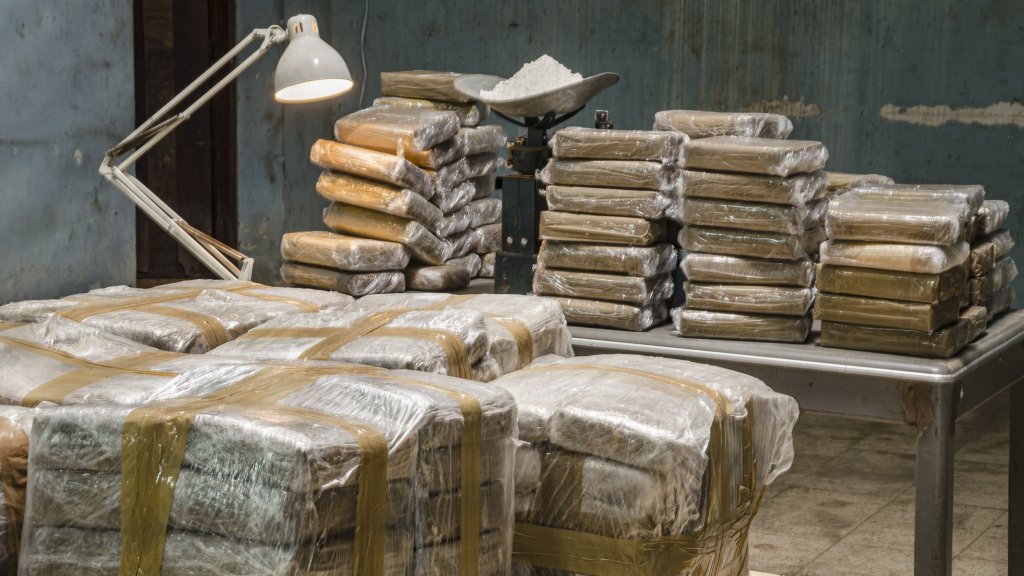
The figures just presented by German Federal Interior Minister Alexander Dobrindt (CSU) are stark. “We are experiencing a flood of cocaine in Germany. We are seeing a record number of drug-related deaths. We are seeing children being exploited as criminals.” His conclusion is correspondingly clear: “Organised crime in Germany continues to advance.” The number of drug-related deaths has also continued to rise.
Key points at a glance
- Interior Minister Alexander Dobrindt warns that organised crime is growing in Germany.
- Just over ten tonnes of cocaine were seized in 2025, around two-thirds of it at German ports.
- According to the authorities, 2,150 people died as a result of their drug use – 13 more than in the previous year.
- Drug Commissioner Hendrik Streeck warns of the health and social consequences of drug use.
- Drugs are also used in connection with sex in sex-positive sections of the gay community.
- According to the Federal Criminal Police Office, profits from drug trafficking are channelled into the legitimate economy through property, among other means.
- Drug trafficking is increasingly shifting to smartphones, social networks, gaming platforms and the darknet.
- According to the drug commissioner, criminal groups are now also recruiting minors through social media and gaming platforms.
- The BKA is also observing a new generation of offenders who ostentatiously showcase violence and power on social networks.
Drug trafficking as a business
According to the Federal Criminal Police Office (BKA), just over ten tonnes of cocaine were seized last year. Around two-thirds of the seized quantity was discovered at German ports. At the same time, 2,150 people died as a result of their drug use. That was 13 more than in 2024. Together with Dobrindt, BKA President Holger Münch and the Federal Government's Drug Commissioner, Hendrik Streeck, presented the latest national situation reports on organised crime and drug-related crime. For the authorities, the connection between the two areas is clear: drug trafficking is considered a particularly lucrative illegal business for internationally connected criminal networks.
Billions from cocaine trafficking
According to the BKA, the proceeds from drug trafficking and other illegal businesses are subsequently channelled into the legitimate economy. Property plays an important role in this. The amount identified in this context totalled just under €1.4 billion. Münch describes the criminal networks' financial resources as considerable. “They use their considerable financial clout for bribery and influence, and bring the money into the legitimate economy through money laundering.” In the BKA chief's view, cocaine in particular has become a danger that extends far beyond drug use itself. He says the most widespread drug poses a threat to the state, the economy and society as a whole.
Drug use mainly affects men
Drug Commissioner Streeck focuses more closely on the people at the end of the illegal business chain. “It is not just the state that suffers harm; above all, it is people.” The average age of those who die from drug use is 41. Of these, 83 per cent are men. Streeck describes users as part of a market whose consequences extend far beyond damage to health: “They are all customers of a market that trades in deadly substances and is underpinned by violence, environmental destruction, blackmail and exploitation.” This also brings into focus the question of the social and cultural contexts in which drugs are used. In parts of the sex-positive gay community, particularly in so-called chemsex, drug use can be directly linked to sexual encounters. Such patterns of use can lend additional relevance to the market for certain drugs.
Streeck calls for prevention
Streeck sets out his policy ambitions through two principles: zero tolerance towards those who profit from addiction, and no indifference towards people who have become dependent. That is why the drug commissioner is also focusing on prevention. This includes a public awareness campaign intended to address not only the health consequences of drug use, but also its environmental impact. Streeck cites cocaine production as an example. He says rainforest is cleared to grow the raw material. At the same time, farmers and their families in the growing regions are subjected to extortion. Streeck sees a connection between rising demand in Germany and the consequences in producing countries. He says cocaine is becoming increasingly popular in Germany. His warning is: “Every gram of cocaine consumed for fun has blood on it.”
From street dealer to smartphone
It is not just the quantity of drugs being traded that concerns the authorities. Distribution channels have also changed. The market has become increasingly digital, says Streeck. “The dealer is no longer on the street corner; the dealer is on your smartphone. For example, a cocaine taxi can be ordered using simple QR codes,” the drug commissioner says, describing the new routes from supplier to consumer. In his view, a particularly serious problem is that criminal groups are now using social networks to recruit new members. “It is particularly alarming that criminal groups recruit minors through social media or gaming platforms,” says Streeck. “Organised crime is now looking for its next generation where young people spend their free time.”
Violence is publicly staged
This is also changing the work of the security authorities. BKA President Münch observes that traditional organised crime structures are increasingly disappearing. Discretion, secrecy and clearly defined groups are becoming less characteristic of the scene, he says. Instead, some of the new generation of offenders are presenting themselves publicly. “In Germany too, we are observing a new generation of offenders, for example the so-called Generation Z Mafia of Turkish descent, aggressively showcasing their acts of power and violence on social media.” According to Münch, criminal services can now also be organised digitally. Such services can be purchased on the darknet. For the BKA, this development means a fundamental change in investigations. “It is not just a question of who committed the crime, but who commissioned it, who brokered it, who financed it, who benefits from it?”
Digital crime
BKA investigators also highlight digital and criminal milieus that are becoming ever harder to penetrate. The focus is on the platform “Archetyp Market”. According to the BKA's assessment, it was the world's largest and longest-running digital trading platform used primarily for selling drugs. The marketplace's administrator was arrested in June 2025. Under his leadership, cocaine, heroin, cannabis and other drugs were traded on the darknet. Turnover amounted to €250 million. According to the BKA, 3,200 sellers were registered on the platform when it was shut down. There were also 612,000 customer accounts.








