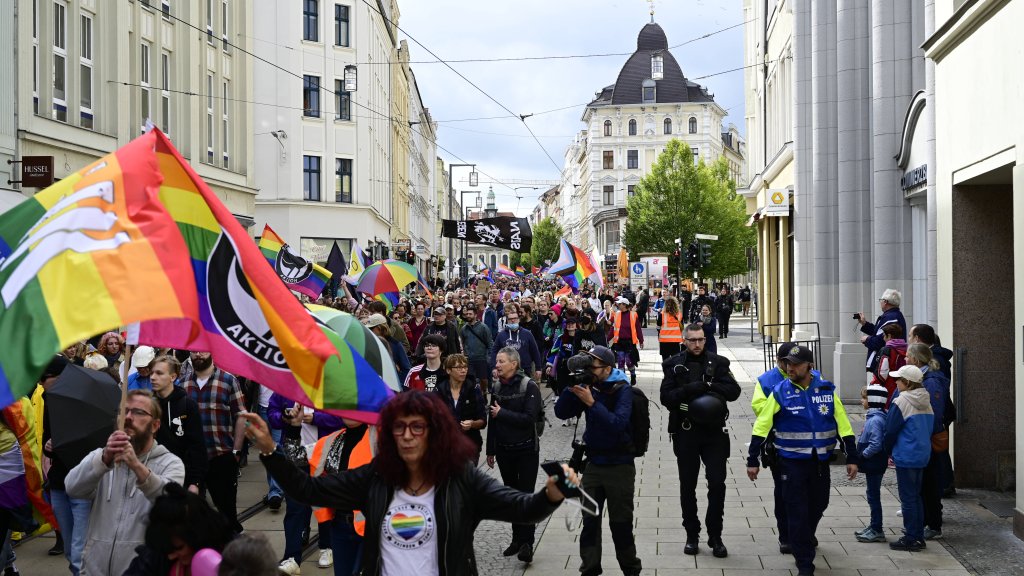
Just days before Christopher Street Day in Görlitz, Saxony, the event has also become a matter for the courts. At issue is whether the “Picnic of Diversity” on the Obermarkt is protected under Germany’s Basic Law as part of a political assembly.
Key points at a glance
- Twelve days before Christopher Street Day (CSD) in Görlitz, a dispute has arisen over the legal classification of a central part of the event.
- The Görlitz district administration does not recognise the “Picnic of Diversity” as an assembly protected by constitutional rights.
- According to the CSD organiser, the demonstration march may only go ahead subject to numerous conditions.
- The association CSD Görlitz-Zgorzelec has therefore filed an urgent application with Dresden Administrative Court.
- The organiser expects up to 1,500 participants at CSD on 26 September.
- The programme includes an opening rally, a demonstration march through Görlitz to Zgorzelec and a rally on the Obermarkt.
- Speakers on the Obermarkt are set to include politicians and representatives of queer organisations and human rights organisations.
- The case recalls a similar legal dispute over Dresden CSD.
- CSD Görlitz-Zgorzelec is due to take place on 26 September regardless of the outcome of the urgent proceedings.
Dispute over a central part of CSD
According to CSD Görlitz-Zgorzelec e.V., the Görlitz district administration does not recognise the picnic as an assembly. The association says the demonstration march has also been made subject to numerous conditions. It has therefore now filed an urgent application with Dresden Administrative Court, twelve days before the planned day of action. CSD is scheduled for 26 September 2026. The association explains that in previous years the event took place in the form notified to the authorities without any objections. This year, too, it says it originally notified the authorities of a single, unified assembly. Plans include an opening rally on Berliner Straße, a demonstration march through Görlitz city centre and across the Altstadtbrücke into the Polish town of Zgorzelec, followed by a stationary rally on the Obermarkt.
Around 1,500 people expected
The CSD programme there traditionally includes the “Picnic of Diversity”. Numerous speeches and performances by queer artists are planned. According to the organisers, between 1,200 and 1,500 participants are expected. They want to use the event to draw attention to the queer community’s demands. According to the association, these include visibility for queer people’s lived realities, equal rights and protection from discrimination and violence. In CSD’s view, the rally on the Obermarkt is directly linked to the political nature of the entire day of action. The association says the district administration, by contrast, regards the picnic as a separate, non-political event.
Representatives from politics and civil society are also set to take to the stage. Confirmed speakers include Katharina Brinck, deputy federal chair of the party Volt Deutschland; Sophie Koch, the Federal Government’s Commissioner for Queer Affairs; and Alfonso Pantisano, the state of Berlin’s contact person for the acceptance of sexual and gender diversity. Others announced include Bundestag member Katrin Michel (SPD), the state chairs of Die Linke Sachsen and Bündnis 90/Die Grünen Sachsen, the board of LSVD+ Sachsen, Alina Szeptycka, the equal treatment officer for the mayor of Wrocław, Monika Tychy, chair of Lambda Polska, and Patrick Orth, president of the European Pride Organizers Association.
CSD chair criticises decision
Wojciech M. Urlich, chair of CSD Görlitz-Zgorzelec e.V., criticises the authority’s decision. He says the association spent months trying to work with the authority and answering its queries: “We cooperated for months, answered every query and, in the end, even provided written explanations for every single person on stage as to why their contribution is political. For the authority then to conclude that our programme is not an assembly is absurd. Speeches, music and information stalls are not incidental to our demonstration; they are its core. Queer visibility does not happen only during the march.” In his view, this is about more than the specific event on the Obermarkt. “When an authority arbitrarily decides which forms of political protest it recognises and which it does not, it interferes with the organisers’ right to self-determination – and that is precisely what Article 8 of the Basic Law protects. We will not accept this attack on queer people’s freedom of assembly in Görlitz.”
For the organiser, the district administration’s decision has concrete consequences. According to CSD, without the protection of Article 8 of the Basic Law, the “Picnic of Diversity” would no longer be a rally protected by constitutional rights. Instead, it would constitute a special use of public space requiring a permit and the payment of fees. This could entail charges for barriers, security measures and cleaning, among other things. According to the association, a substantial part of Görlitz CSD is therefore at stake.
Dispute recalls proceedings in Dresden
In CSD’s view, the current conflict has parallels with a legal dispute over Dresden CSD (German). In spring this year, that case also concerned whether a CSD event lasting several days should be classified as an assembly. The Landesdirektion Sachsen had instructed the city of Dresden to withdraw recognition of the multi-day street festival as an assembly. Dresden Administrative Court agreed with this position. A few days later, the Saxon Higher Administrative Court reversed that decision. In a ruling dated 2 June 2026, the court provisionally placed the entire CSD event under the protection of freedom of assembly. In doing so, the Higher Administrative Court emphasised the fundamental importance of freedom of assembly. Of particular relevance to Görlitz CSD is that, according to the association, the Görlitz district administration expressly cites the first-instance Dresden ruling in its reasoning. That ruling was subsequently overturned by the Higher Administrative Court.
Urgent application to the Administrative Court
CSD Görlitz-Zgorzelec e.V. now wants the district administration’s decision reviewed in urgent court proceedings. The association is being supported by Gegenrechtsschutz, a joint legal assistance project run by FragDenStaat and the Gesellschaft für Freiheitsrechte. The project previously supported Dresden CSD in its successful challenge to the withdrawal of its recognition as an assembly. Through its application, the association seeks to ensure that the “Picnic of Diversity” is also protected by freedom of assembly and can therefore take place as part of the political day of action. Regardless of the Administrative Court’s decision, the organiser remains committed to holding the planned Christopher Street Day. CSD Görlitz-Zgorzelec is scheduled for 26 September 2026. The opening is planned for 12 noon on Berliner Straße. From there, the demonstration march is set to pass through Görlitz and cross the Altstadtbrücke to Zgorzelec.








