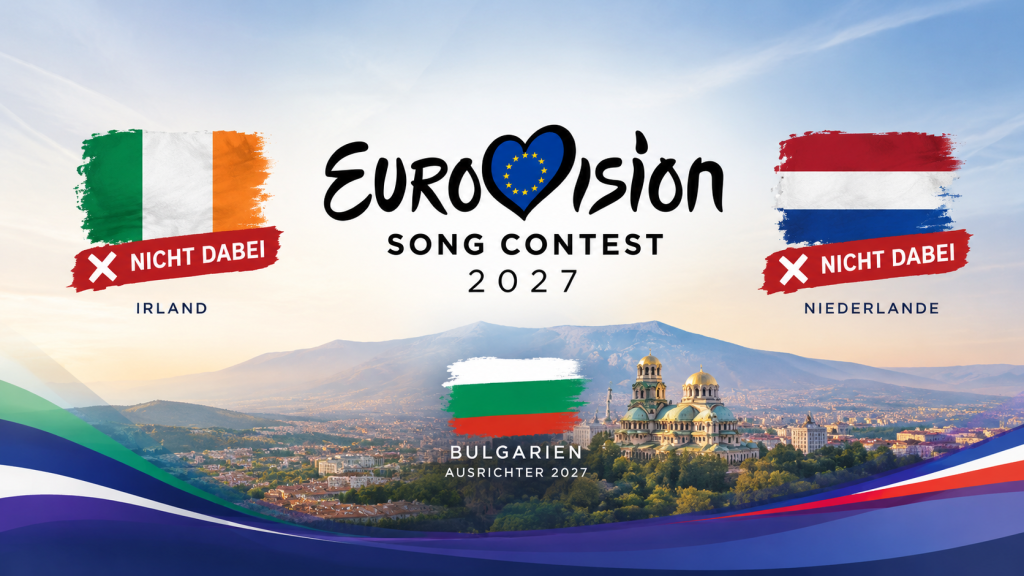
Ireland will not take part in the Eurovision Song Contest in 2027. Irish public broadcaster RTÉ has now confirmed that the country will not be represented at the contest in Burgas. The broadcaster also announced that it would not broadcast the Eurovision Song Contest. Most recently, the Netherlands also announced in August that it would not take part.
Key points at a glance
- Ireland will stay away from the Eurovision Song Contest 2027. Public broadcaster RTÉ confirmed the boycott and will not broadcast the contest either.
- RTÉ cites the situation in the Gaza Strip as the reason for its decision. The broadcaster points to the continuing loss of life and the humanitarian crisis.
- Ireland had already declined to take part in 2026. Spain, the Netherlands, Iceland and Slovenia also boycotted the contest that year.
- The Netherlands has also announced its withdrawal for 2027. However, another broadcaster there could potentially take over responsibility for participation.
- Eurovision 2027 will take place in Bulgaria: the semi-finals are planned for 11 and 13 May, with the final on 15 May in Burgas.
- The German national selection will take place in February next year.
Ireland takes action
RTÉ said its position on participation had not changed. The situation in the Gaza Strip was a decisive factor in particular. In a statement, the broadcaster said: “RTÉ believes that Ireland’s participation cannot be justified in light of the appalling and continuing loss of life in the Gaza Strip and the humanitarian crisis there, which continues to endanger the lives of so many civilians.” The broadcaster also stated: “RTÉ also remains deeply concerned that international journalists continue to be denied independent access to the territory.” Ireland had already boycotted the Eurovision Song Contest 2026 in Vienna. This followed the European Broadcasting Union’s (EBU) decision to continue allowing Israel to compete despite criticism of its participation. Alongside Ireland, Spain, the Netherlands, Iceland and Slovenia also declined to take part in 2026.
The Netherlands withdraws
The 2026 boycott was the largest withdrawal of multiple countries from the Eurovision Song Contest since 1970. That year, Finland, Norway, Portugal, Sweden and Austria did not take part. The reason was a dispute over the voting rules at the time, following a four-way tie in 1969. The Netherlands will also not be taking part in the 2027 contest for now. Broadcaster AVROTROS had already announced this in August, citing geopolitical tensions in the Middle East among its reasons. However, the public broadcasting umbrella organisation NPO is examining whether another Dutch broadcaster could take over responsibility for participation.
Other countries yet to decide
It remained unclear whether Spain, Iceland and Slovenia would continue their boycott in 2027. The final list of participating broadcasters and countries is to be published at a later date. The Eurovision Song Contest 2027 will take place in Burgas, Bulgaria. The first round is scheduled for 11 May, the second semi-final for 13 May and the final for 15 May. Bulgaria is hosting after singer Dara won the 2026 contest in Vienna with “Bangaranga”. Germany will take part in 2027, with its national selection taking place in February next year. Nevertheless, Ireland’s decision increases the pressure on the contest’s organisers. Following the 2026 boycott, the EBU had already said that it took the concerns of the broadcasters involved seriously.








