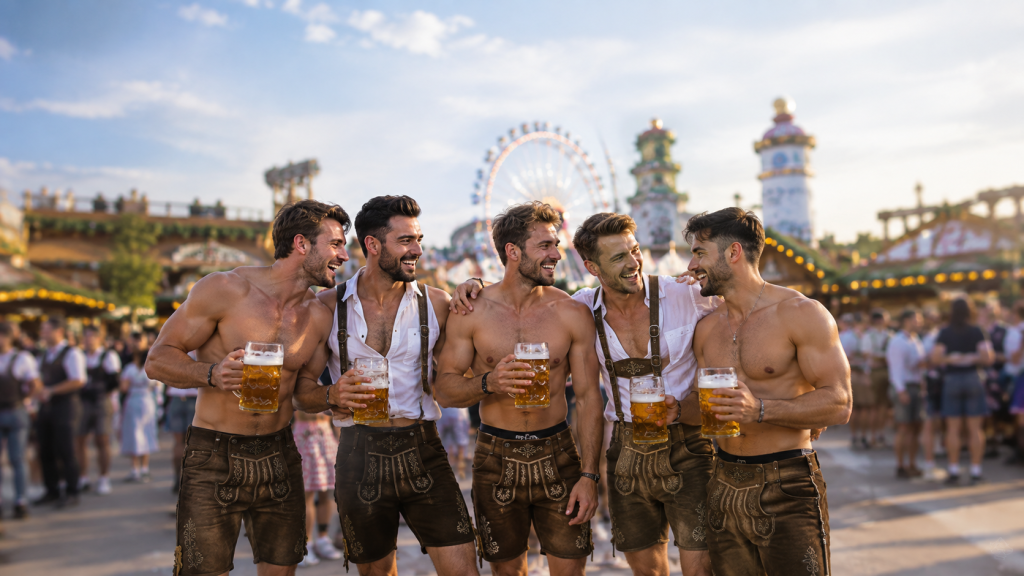
When Oktoberfest begins on Saturday, Munich will once again become a catwalk for lederhosen – much to the delight of many gay men. There are clothes you put on. And there are clothes you put on – that suddenly turn heads. Bavarian lederhosen definitely belong in the second category.
The key points at a glance
- Lederhosen turn heads: their close fit and distinctive leather make this traditional attire particularly appealing to many gay men.
- Leather with character: the material softens with wear, moulds to the body and develops an individual patina.
- The famous opening: the traditional front flap is practical – but its name and position also provide plenty of material for risqué Oktoberfest jokes.
- Masculinity on display: calves, stockings, traditional Haferl shoes and lederhosen create a look that encourages some eyes to linger a little longer.
- Oktoberfest as a catwalk: Munich once again becomes a grand stage for Bavarian traditional dress – and, with it, the occasional piece of male eye candy.
Lederhosen with a history
When Oktoberfest starts on Munich’s Theresienwiese this coming Sunday, thousands of men in knee-length or short lederhosen will once again be making their way between beer benches, fairground rides and roast chicken stalls. For many gay men, this is not just Bavarian tradition, but also a rather delightful side effect of the world’s largest folk festival. Lederhosen have qualities that make them particularly interesting as a garment: they fit closely, are made of sturdy leather and develop a distinctive look over time. The more often they are worn, the more individual they become. The leather softens, develops creases and shows signs of wear – in short, eventually these trousers tell a story. And that can be decidedly attractive.
Trousers with attitude
While other trousers try to be as inconspicuous as possible, lederhosen make no secret of their material. Deerskin, cowhide and other types of leather feel different from denim or cotton. They are firmer, heavier and mould to the body with wear. For the wearer, this has a pleasant side effect: well-fitting lederhosen give you the feeling of being properly dressed while, at the same time, wearing surprisingly little.
That is, of course, a matter of personal perception. But this particular combination of traditional clothing, a close fit and a rustic look can fire the imagination. For gay men, there is also a cultural factor: the male body is not hidden in the lederhosen aesthetic, but is, in a sense, part of the overall picture. Add strong calves, knee-high stockings, Haferl shoes and, quite often, a shirt worn with considerable confidence. It is enough to make your gaze linger on the outfit a little longer.
That special opening
Particularly famous, of course, is the part of the lederhosen whose very name inspires countless risqué jokes: the front flap, or traditional fly opening. The flap is the characteristic overlapping front section found on many traditional lederhosen. It is typically fastened with buttons and originally served a thoroughly practical purpose: it provides relatively straightforward access without having to take the trousers off entirely. Practical? Yes. Innocent? Well – there is plenty of scope for joking about that at Oktoberfest.
After all, few other clothing details so reliably invite remarks about the male equipment. Even the German term “Eingriff”, which can suggest reaching inside, sounds suspiciously like an invitation when used in connection with tight-fitting lederhosen, although it initially describes nothing more than a functional design. And this is where classic lederhosen humour begins: what originally served convenience is now a dependable source of double entendres. And one thing is certain: on the right man, that opening can quickly become very erotic – a little sexual adventure is almost always possible at Oktoberfest, particularly at the festivities specifically for the community.
Why men look sexy in them
The effect of lederhosen is not just down to the cut. The attitude of the man wearing them is also crucial. Lederhosen are rarely worn looking prim and polished. They are allowed to look used. They are allowed to have creases. They are allowed to show that their owner did not take them out of the packaging just five minutes before the festivities. That makes them an interesting alternative to perfectly pressed fashion. And perhaps that is part of their fascination: lederhosen convey something down-to-earth, physical and self-assured. In a way, they say: I’m here, I know I’m wearing lederhosen – and now let’s have a beer. For some gay men, there is something else too: men look at men. And at Oktoberfest, there is an unusual amount to look at.
A grand catwalk for men
Of course, Oktoberfest is not a gay folk festival. But the combination of traditional dress, a lively atmosphere and figure-hugging clothing also makes it a special place for gay visitors. It does not have to be about sex, though it can be. A good-looking man in lederhosen can simply look good. A particular glance, a smile or an especially well-chosen outfit is sometimes quite enough. Imagination does the rest. And that, as we know, has a front flap of its own. Ultimately, lederhosen become what they may always have been: a garment with a practical function, a long tradition and a surprisingly rich potential for risqué thoughts. Or, to put it in thoroughly Bavarian terms: at Oktoberfest, people do not just enjoy getting their hands on a full measure of beer – sometimes they take the measure of a man, too.








