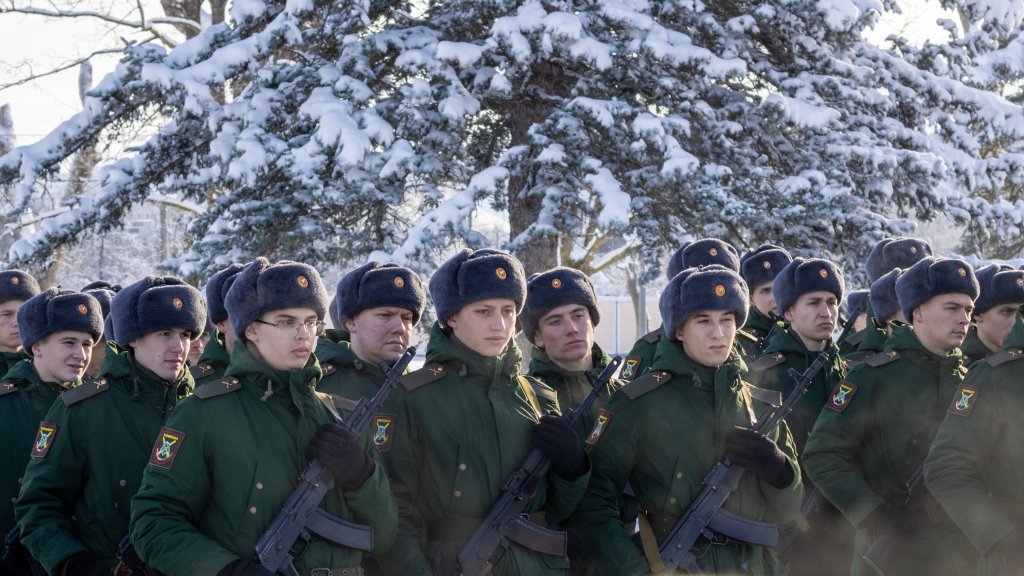
Russia’s parliamentary election is over – fears of an expected new mobilisation are growing by the day and could once again pose a particular threat to gay men (German). According to the Central Election Commission, the Kremlin’s United Russia party was declared the winner with 57.83 per cent of the vote. It is set to hold 355 of the 450 seats in the State Duma. Critics accuse the authorities of restricting political competition and manipulating the election.
Key points at a glance
- The Russian Duma election is over. According to the election commission, the Kremlin’s United Russia party received 57.83 per cent of the vote.
- There had been speculation about a new wave of mobilisation before the election.
- Regular conscription is also continuing: 261,000 men aged between 18 and 30 are due to be called up this year.
- Human rights organisations report numerous cases in which men were allegedly pressured or forced through violence to sign military contracts.
- Gay men are particularly at risk: reports document pressure, threats and attempts to make men undertake military service because of their sexual identity.
- Armenia remains an important destination for many Russians leaving the country. It can be entered using a Russian internal passport, among other documents.
Hundreds of thousands for the military
Before the vote, military analysts had already speculated about a possible new wave of mobilisation in view of the Russian army’s personnel needs. Ukrainian President Wolodymyr Selenskyj had also warned of a possible new mobilisation, citing intelligence information. However, no new general mobilisation has yet been announced following the now-concluded election. Nevertheless, military service remains a pressing issue for many men. Russia has extended the conscription process to cover the whole of 2026. Under a decree issued by President Wladimir Putin, a total of 261,000 men aged between 18 and 30 are to be called up for military service in 2026.
Reports of coercion and violence
Alongside regular conscription, there are reports of numerous men being pressured into signing military contracts. The Russian anti-war and aid organisation “Idite lesom” reports cases in which men were allegedly detained by police officers and taken to police stations. Iwan Tschuwiljajew of “Idite lesom” told MDR: “Previously, this was mainly the responsibility of the military administration. The police could detain someone, check his papers and take him to the local military authority. Now, it is reportedly the police themselves who get men to sign military contracts: a man is walking down the street, a police car pulls up beside him and the officers demand his papers. They then refuse to return the documents and take him to the police station, where he is threatened or tortured to make him sign a military contract. On paper, however, this is voluntary.”
Gay men come under pressure
Gay men face a particular situation. Homosexuality alone is not a legal ground for exemption from military service in Russia. According to a study on the situation of gay people in Russia, many try to avoid disclosing their sexual orientation to the military authorities or to leave the country. Reports by LGBTQ+ organisations also document cases in which gay men were allegedly put under pressure because of their sexual orientation (German). A study by the Russian organisation Coming Out and the Sphere project found that around two per cent of respondents said state authorities had threatened them with military service or blackmailed them over it because of their sexual orientation. Attempts to force those affected to sign military contracts were also cited.
A joint report also highlights the situation in the North Caucasus, stating that gay men there had allegedly been forced through prolonged unlawful detention, threats and torture to sign military contracts for deployment in Ukraine. An additional concern, particularly for gay men, is that the Russian authorities have classified the “international LGBTQ+ movement” as extremist. Under this legal framework, a gay man can easily face charges – meaning that blackmail aimed at forcing men into military service also appears to be increasing further.
Fleeing Russia
The uncertainty is also being felt by organisations that help people leave the country. “Idite lesom” recorded almost 5,100 consultations in August – around three times as many as in the same period the previous year. The “Kowtscheg” (“Ark”) project, which helps Russian opponents of the war leave the country, also reported a sharp rise in enquiries. According to Anastasia Burakowa, the founder of “Kowtscheg”, Armenia, Serbia, Georgia and Argentina, along with other Latin American countries, are particularly popular destinations. Interest in the European Union and the US, by contrast, has reportedly declined.
Armenia plays a particular role. The country was already an important destination for Russians following the partial mobilisation in September 2022. One practical advantage is that Russian citizens can still enter Armenia using their Russian internal passports. After mobilisation began, many people therefore fled to Armenia and Kazakhstan, among other countries. While human rights organisations say Kazakhstan has since also arrested Russians facing political persecution and extradited them to Russia, “Kowtscheg” regards Armenia as comparatively safe. The organisation says it knows of no case in which Armenia has extradited someone facing political persecution to Russia. The political leadership in Yerevan has also recently made clear that Russian citizens seeking to avoid the war should not be turned away as a matter of principle.
At the end of August, Alen Simonjan, Secretary of Armenia’s Security Council, commented on the current situation: “At the border, no one is asked why they have come. I can say only one thing to Russians: welcome to Armenia. Here, we love and respect everyone. Armenia will put no obstacles in their way – and if necessary, we will help them.” Russian Foreign Ministry spokeswoman Maria Sacharowa described Simonjan’s remarks as provocative. In her account, they would put a strain on bilateral relations and give traditional Armenian hospitality a “toxic political undertone”.








