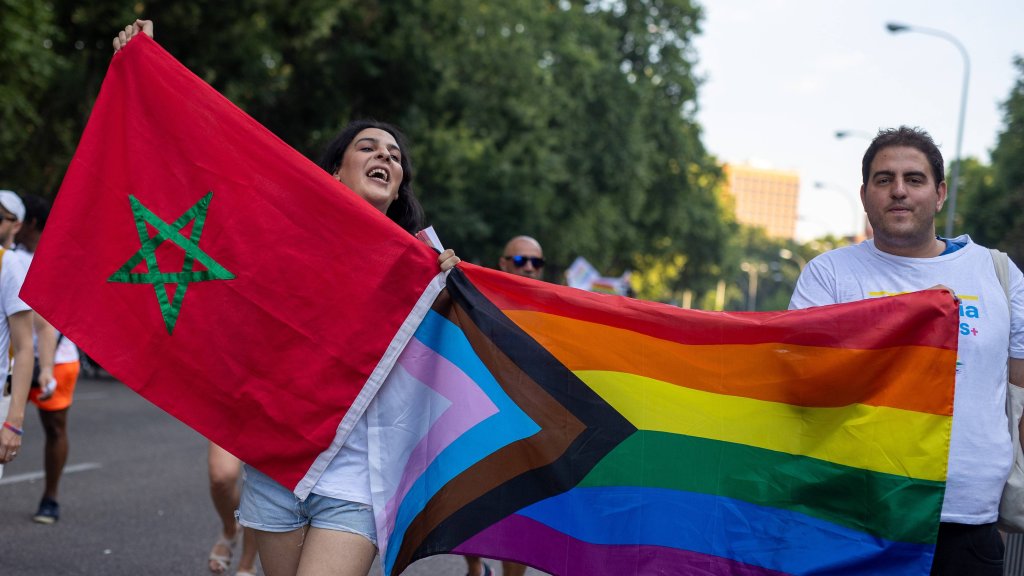
Morocco is electing a new parliament today. Around 15.8 million people are registered to vote. More than 7,200 candidacies have been submitted for the 395 seats in the House of Representatives. Official figures list 28 political groupings, including an alliance of parties formed specifically for the election, as well as two lists of independent candidates. For the LGBTQ+ community, the question is how and whether their living conditions might change and improve.
Key points at a glance
- Morocco is electing a new parliament with 395 seats today.
- The election is relevant to LGBTQ+ people in part because same-sex relationships remain a criminal offence.
- Under Article 489 of the Criminal Code, these carry a sentence of up to three years in prison; Amnesty International also reports arbitrary arrests, harassment and prosecution of LGBTQ+ people.
- Parliament can debate legislation and scrutinise the government. However, King Mohammed VI retains extensive powers on strategic matters.
- The main election campaign issues are jobs, the cost of living, education, health and housing. LGBTQ+ rights, by contrast, barely feature in the publicly visible campaign.
- The case of LGBTQ+ activist Ibtissame “Betty” Lachgar, who was sentenced to two and a half years in prison, also illustrates the scope for political change.
The community's future
The election campaign centres primarily on economic and social problems. Parties are campaigning on new jobs, better public services and investment. The governing parties Rassemblement National des Indépendants (RNI) and Parti Authenticité et Modernité (PAM) are promising, among other things, around one million new jobs. Preparations for the 2030 FIFA World Cup also play a role because of the extensive infrastructure projects involved. For many LGBTQ+ people, however, the question is quite different: can a new parliament help change the legal and social situation of a group that continues to face significant risks?
Same-sex relationships
The legal starting point is clear: same-sex relationships remain a criminal offence in Morocco. Article 489 of the Criminal Code provides for a prison sentence of up to three years. Amnesty International reports that in 2025, LGBTQ+ people continued to face arbitrary arrests, harassment and prosecution (German). The human rights organisation views the criminalisation of consensual same-sex relationships as part of a legal framework that remains discriminatory.
Even beyond prosecution by the state, coming out can still have serious consequences. In previous years, Human Rights Watch documented cases in which people believed to be gay were outed online, threatened or forced out of their families and homes. The organisation reported on a campaign in 2020 in which private photographs and information about men were circulated on social media. For LGBTQ+ people, the election is therefore about more than whether the law changes. The state's approach to freedom of expression, human rights activists and discrimination in society also matters.
Activist remains in prison
The case of feminist LGBTQ+ activist Ibtissame “Betty” Lachgar (German) shows how risky public activism can be. She was arrested in August 2025 after posting a photograph of herself on social media wearing a T-shirt that read “Allah is a lesbian”. In September 2025, a court in Rabat sentenced her to two and a half years in prison and a fine of 50,000 dirhams, equivalent to around €4,600, for “insulting Islam”. An appeal court upheld the judgment in October 2025. Amnesty International continues to call for her release and describes the action against her as a violation of her right to freedom of expression.
What can the new parliament achieve?
The House of Representatives does have influence. It passes laws and scrutinises the government. According to the Moroccan think tank Tafra, MPs put more than 26,000 questions to the government during the first six parliamentary sessions of the 2021–2026 legislative term. At the same time, parliament's room for manoeuvre is limited. Although the 2011 constitution expanded its powers, important strategic areas remain closely tied to the office of the king. These include, in particular, foreign policy, security, the military and religious affairs.
The king appoints the head of government from the largest party in the House of Representatives and chairs the Council of Ministers. Political changes through the election are therefore possible, but do not automatically alter the fundamental distribution of power in the country. For LGBTQ+ people, this means that a new parliament could, in principle, debate changes to criminal law. However, any reform of Article 489 would not depend solely on the election result. Political majorities, the priorities of the future government and the country's institutional framework would also be decisive.
Little trust in politics
There is also little trust in political institutions in the country. Citing an Afrobarometer survey, Reuters reported ahead of the election that only around a third of 18- to 35-year-olds trusted parliament, the government or political parties. Young people in particular play an important role in potential social change, but are significantly underrepresented on the electoral rolls. Only around four per cent of registered voters are aged between 18 and 24. For the LGBTQ+ community, there is the additional issue that, according to the available reports, their concerns barely feature publicly in the election campaign. The major parties are focusing their campaigns primarily on employment, social benefits, education, health and economic development.








