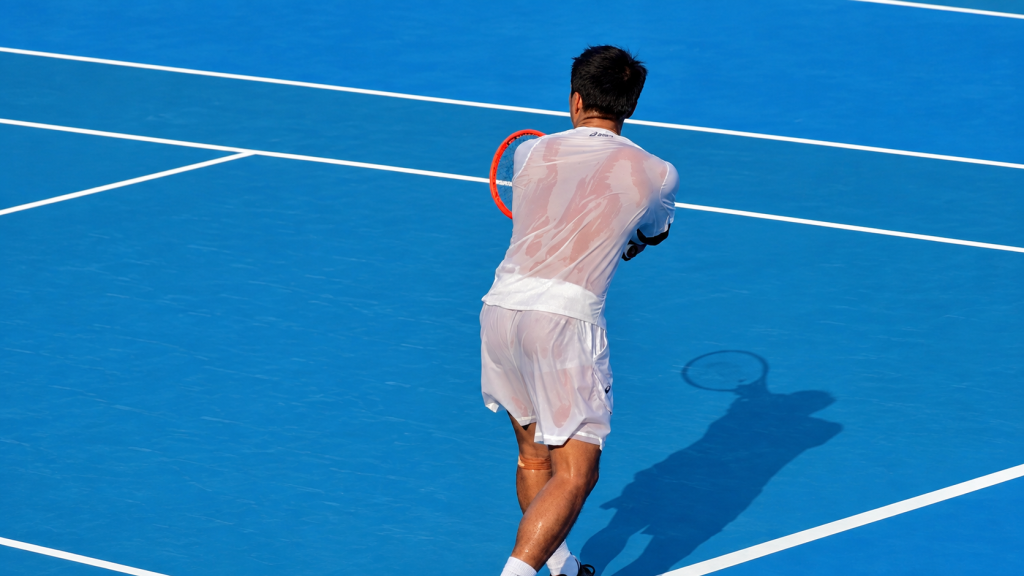
A sweat-soaked tennis outfit and a jockstrap visible underneath have brought Chinese professional tennis player Sun Fajing unexpected attention online. A video of the athlete at the Guangzhou Challenger has now attracted more than 20 million views – and reminded many gay users of the original purpose of a garment now also widespread in gay fashion and fetish culture (German).
Key points at a glance
- A video of Chinese professional tennis player Sun Fajing at the Guangzhou Challenger has been viewed more than 20 million times.
- His sweat-soaked white outfit revealed that the athlete was apparently wearing a jockstrap.
- Many gay users reacted with surprise – even though jockstraps were originally developed as sportswear.
- In 1897, C. F. Bennett developed a “jockey strap” intended to protect cyclists from injury on cobblestones.
- Jockstraps were later used in sports including boxing, while also becoming an established part of gay fashion and fetish culture.
- Sun himself was knocked out of the tournament in the second round.
Sweat-soaked tennis professional goes viral
Sun took to the court for his match dressed entirely in white. During play, his clothing eventually became so soaked with sweat that the contours of his body were clearly visible. This also revealed what the player was apparently wearing underneath his tennis kit: a jockstrap. The footage then spread rapidly on social media, with posts on individual profiles quickly attracting more than 20 million views. As its reach grew, the video also reached more and more gay users – some of whom expressed surprise that an athlete was wearing a jockstrap.
Other users responded to this surprise by pointing to the garment’s history. “What do you think jockstraps were invented for?” read one widely noticed reply. Long before the jockstrap became an established part of gay fashion and fetish culture, it served a distinctly practical purpose in sport.
The history of the jockstrap
In 1897, C. F. Bennett developed what was known as a “jockey strap”. It was intended to protect cyclists from injuries caused by jolts against the bicycle saddle while riding over cobblestones. At the beginning of the 20th century, jockstraps were advertised as a way to prevent injuries. Later, health benefits were even attributed to the concept for a time. One example was the so-called Heidelberg Electric Belt. Equipped with batteries and electrodes at the front and back of the hip area, the product promised to help with various medical complaints. These supposed health benefits, however, proved to be illusory.
The genuine protective function of jockstraps, by contrast, continued to play a role in sport. Boxers, for example, also began wearing them to protect their genitals from blows “below the belt”. Later, purpose-made protective cups were increasingly used for this. Nevertheless, jockstraps remained part of sporting culture. At the same time, the garment evolved far beyond its original purpose. In gay culture in particular, sportswear with homoerotic associations was repeatedly adopted and reinterpreted. A comparable example is the singlet, originally associated with wrestling.
From sportswear to a gay fashion classic
Jockstraps became a particularly prominent garment in this context. They appeared in drawings by Tom of Finland, among other places, as well as in softcore magazines for adults. In supposed “fitness” magazines from the mid-20th century, bodybuilders often posed in skimpy clothing such as bikinis, G-strings or jockstraps. After declining in popularity in the 1980s and 1990s, jockstraps have made a comeback over the past two decades.
Today, both fashion brands popular in the gay community and major mainstream fashion companies such as Calvin Klein and Versace offer their own versions. While singlets often appear primarily in fetish and kink contexts, jockstraps are now much more widespread. With the advent of PrEP and the decline of so-called “bottom shaming”, particularly skimpy designs have also become a garment that many gay men use to show off their bodies. There is a certain irony in this: the jockstrap was originally developed to support and protect the genitals at the front – while the back of the garment remains largely open. Today, the garment is more about showing off. And Sun? For the Chinese tennis professional himself, the appearance brought enormous attention online, but the tournament was less successful in sporting terms – he was knocked out in the second round.








