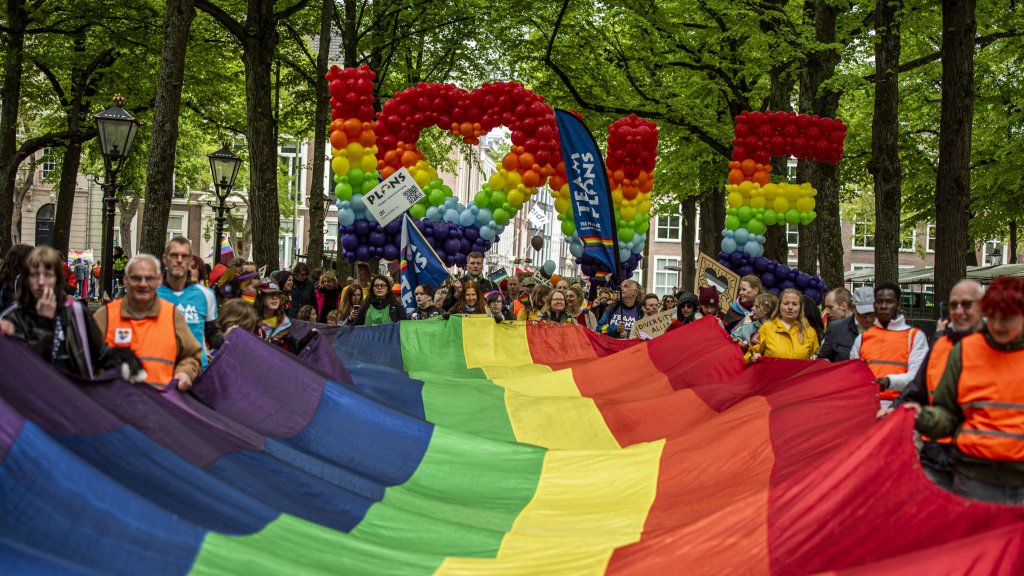
The Dutch government wants to invest more money in protecting LGBTQ+ people and promoting their social acceptance. To this end, the municipal programmes “Regenboogsteden” (Rainbow Cities) and “Veilige Steden” (Safe Cities) are being extended and expanded. An additional €2.6 million is earmarked for the Rainbow Cities alone.
Key points at a glance
- The Dutch government is expanding the “Regenboogsteden” and “Veilige Steden” programmes and providing millions in additional funding.
- An additional €2.6 million is earmarked for the Rainbow Cities programme.
- The move follows data showing that LGBTQ+ people experience discrimination, insecurity and violence more frequently than heterosexual people.
- A further study points to a sharp decline in acceptance of gay people among young people in the Netherlands.
- Currently, 56 municipalities participate in the “Regenboogsteden” programme.
- A further 30 municipalities are to be recruited for either the Rainbow Cities or the “Veilige Steden” programme.
- Participating municipalities can decide for themselves which measures to implement locally — for example, Pride activities, educational provision or closer cooperation with the police.
- From 2027, the Caribbean islands within the Kingdom of the Netherlands are also to be invited to participate.
- An evaluation finds that the programmes have positive effects on municipal engagement. However, it is difficult to measure how much they actually improve safety and acceptance.
Acceptance is declining
According to the newspaper Volkskrant, the government is also responding to recent research into the situation of gay and queer people in the Netherlands. Current data from the “LGBTQ+ Monitor” reportedly shows that, compared with heterosexual people, LGBTQ+ people experience discrimination more frequently, feel unsafe more often and are more likely to be victims of violent crime. In addition, a further study by Utrecht University and the Trimbos Institute recently highlighted a sharp decline in acceptance of gay people among young people in the Netherlands. Among boys under 18, the proportion with a positive attitude towards homosexuality fell to 22 per cent; four years earlier, it had been almost twice as high. Acceptance also fell significantly among girls — from 78 to 51 per cent.
Municipalities play an important role
The government is therefore focusing particularly on local measures. Cities and municipalities are to be given more opportunities to develop their own approaches to protecting gay and queer people and promoting their social acceptance. “The safety of LGBTQ+ people really must improve,” said State Secretary Judith Thielen, who is responsible for education and emancipation. “Municipalities can make an important contribution to this.” The existing “Regenboogsteden” programme is central to the strategy. Municipalities that participate sign a declaration of intent. In it, they commit to actively working to improve the safety, resilience and social acceptance of their LGBTQ+ residents. Municipalities can largely decide for themselves how to do this in practice.
This freedom reflects the fact that challenges can differ considerably between regions. Measures needed in a large city do not necessarily meet the needs of a smaller municipality. Possible activities include visibility campaigns and Pride events. Additional LGBTQ+ educational provision and relevant materials for schools can also form part of municipal plans. Cities and municipalities can also work more closely with local police authorities and civil society organisations to identify and address safety issues affecting queer people. Currently, 56 Dutch municipalities are part of the “Regenboogsteden” programme.
More municipalities are to take part
The government wants to use the additional funding to expand the programmes significantly. A further 30 municipalities are to be recruited for either “Regenboogsteden” or the parallel “Veilige Steden” programme. The latter focuses particularly on the safety of women and girls. The government is providing an additional €2.6 million for the Rainbow Cities alone. This is intended to give municipalities more opportunities to implement relevant local projects. The programme is also to expand geographically in future. From 2027, the Caribbean islands within the Kingdom of the Netherlands are also to be invited to take part.
Positive effects
An evaluation covering the past three years provides insights into what the programmes have achieved so far. It finds evidence of positive effects. The programmes are reported to have helped strengthen local support and increased municipalities’ willingness to address questions of safety and acceptance. However, this does not readily establish how much the individual measures have actually improved the situation of LGBTQ+ people. This is highlighted by Movisie, the organisation responsible for implementing the programmes. “It remains difficult to adequately measure the effects on the safety, acceptance and resilience of LGBTQ+ residents,” its report states.
The additional millions are now intended to give Dutch municipalities more opportunities to respond to their particular local circumstances. The government is deliberately opting for different municipal approaches rather than a uniform concept for the entire country. At the same time, the latest research shows why the government sees a need for further action. According to the findings, LGBTQ+ people continue to report discrimination and a sense of insecurity disproportionately often.








