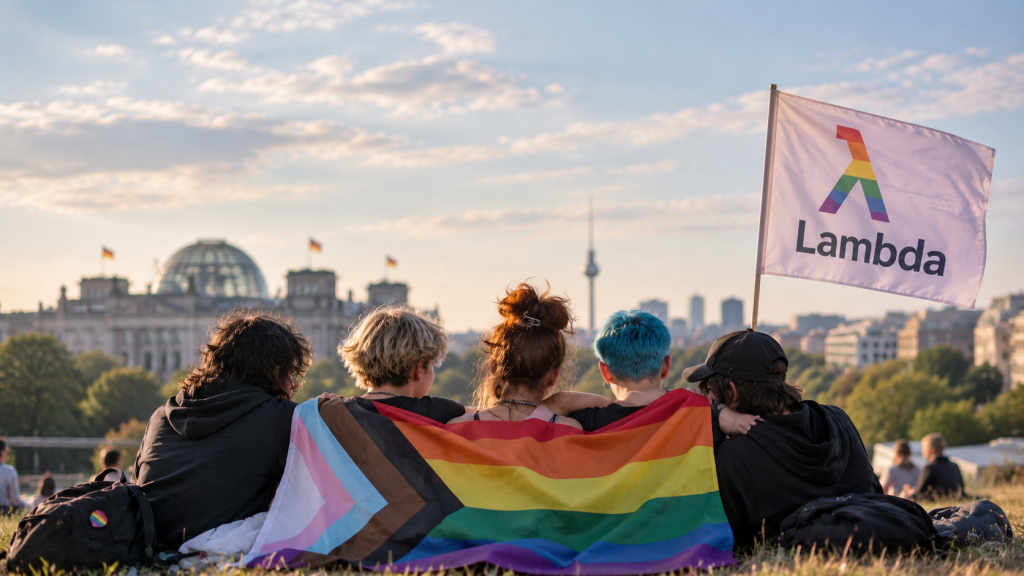
141 academics are now calling for long-term funding for the queer youth network Lambda. Their appeal follows the termination of a framework agreement by the Federal Youth Ministry (BMBFSFJ), effective at the end of 2026 (German). The researchers warn of consequences for queer young people and challenge the view that dedicated provision for this group could be replaced by general youth work.
Key points at a glance
- 141 academics are campaigning for long-term funding for the queer youth network Lambda.
- Their appeal follows the Federal Youth Ministry's termination of the framework agreement, effective at the end of 2026.
- The researchers believe dedicated provision for queer young people remains necessary, despite sexual and gender diversity becoming more firmly embedded in other youth organisations.
- They highlight the importance of dedicated safe spaces, peer support and self-organisation among queer young people.
- The academics also cite the rise in anti-queer crime as an argument for dedicated provision.
- The youth network Lambda has existed since 1990 and organises activities and support for queer young people.
Young people at risk
In a newly published academic statement entitled “Terminating ‘what sustains the future’?”, the researchers examine the importance of dedicated provision for lesbian, gay, bisexual, trans, intersex and queer young people. They conclude that dedicated spaces, peer interaction and opportunities for self-organisation are particularly important for queer young people. “The termination of the BMBFSFJ's framework agreement with the queer youth network Lambda jeopardises queer young people's development and pluralist democracy,” the statement says.
A distinctive role
The youth network Lambda has provided dedicated services and activities for queer young people since 1990. These include provision based on the peer-to-peer principle, enabling interaction and mutual support within the age group. The organisation currently offers workshops and international youth exchanges for young queer people, among other activities. The academics argue that such provision supports self-determined identity development and creates spaces in which young people can build a sense of community, form relationships and develop ways to express themselves.
They say easily accessible provision is particularly important for young people facing psychosocial challenges. This work can also promote queer young people's participation in society. The signatories state their position clearly: “Professional queer youth work is indispensable – for queer young people, for the professional development of youth provision and for a pluralist, democratic society.”
Academics challenge ministry
At the heart of the dispute is the question of whether separate federal funding for queer youth work remains necessary. The Federal Youth Ministry justifies allowing the existing agreement to expire by arguing that gender and sexual diversity are now more widely embedded in youth organisations' structures. The 141 academics consider this justification insufficient. In their view, general youth provision cannot replace the specific work of a queer youth organisation. They say queer young people continue to face conflicting realities: while visibility and legal recognition have increased, they still face structural discrimination, violence and social disadvantage. Young people experiencing multiple forms of social disadvantage are particularly affected.
Warning over anti-queer violence
The academics cite trends in anti-queer crime as another reason to retain specialist provision. The statement points to an increase in such offences. Alongside physical and sexual violence, these include stalking and online violence. In the researchers' view, dedicated spaces are therefore more than simply an addition to general youth work. They can offer queer young people protection while also creating opportunities to connect with others and organise themselves. Support from people with similar experiences plays a central role here. The youth network explicitly directs its events at young queer people; age limits vary depending on the activity.
Call for long-term funding
The academics are calling not only for continued support but also for lasting financial security for the national organisation. They also advocate institutional and legal support for queer self-organisation. In doing so, they explicitly link their demand to the Federal Youth Ministry's Child and Youth Plan and its guiding principle of “strengthening what sustains the future”. The signatories see independent queer youth work as contributing both to support for the young people directly affected and to participation in society.
With their statement, they therefore reject the assumption that greater consideration of sexual and gender diversity in general youth work makes an independent queer youth organisation unnecessary. Instead, the academics call for “sustainable and long-term funding for the queer youth network Lambda and institutional and legal support for queer self-organisation”. The 141 academics include professors and doctorate holders from universities and higher education institutions across Germany, as well as prominent figures in social, cultural and media studies, among other fields. Queer associations and LGBTQ+ institutions have also joined the appeal. Only a few days ago, Lambda announced that it was establishing its own youth foundation. In the long term, the foundation's assets are intended to grow to around €1.5 million.








