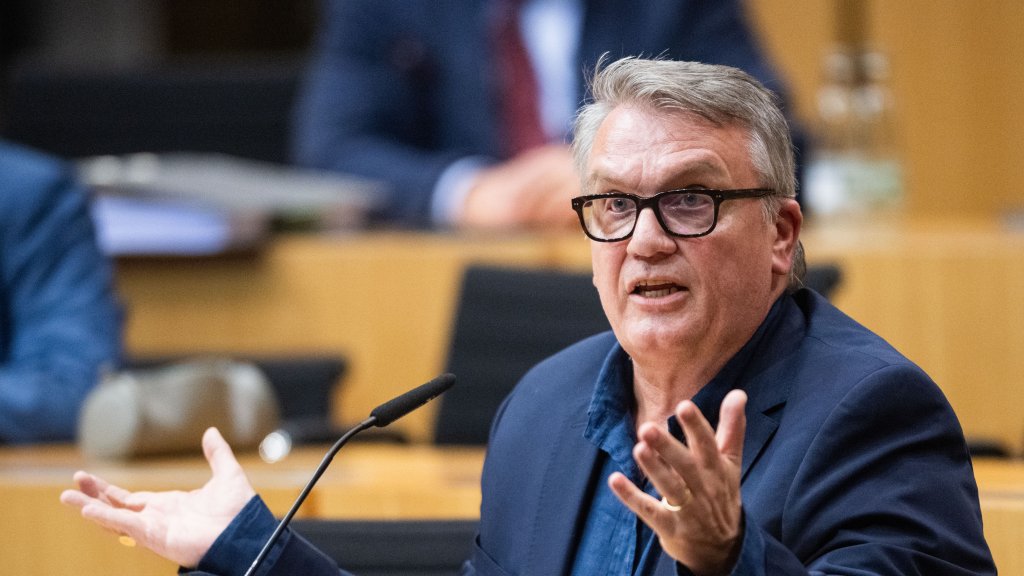
Entertainer Hape Kerkeling (61) made an impassioned case for proceedings to ban the AfD at a hearing in the Thuringian state parliament. The actor, author, comedian and director appeared before the justice committee on Wednesday evening at the invitation of the Left Party's parliamentary group. Public and media interest in the hearing was high, partly because of his participation.
The key points at a glance
- Entertainer Hape Kerkeling strongly advocated initiating proceedings to ban the AfD in the Thuringian state parliament.
- The AfD asked Kerkeling no questions during the hearing and said it had gained no new insights from his remarks.
- Kerkeling reported severe hostility from people associated with the AfD and accused leading party figures of failing to exert a moderating influence.
- Former domestic intelligence chief Hans-Georg Maaßen opposed ban proceedings and said that, in his view, the AfD was committed to the free democratic basic order.
- Maaßen also confirmed that he had had lunch with Björn Höcke, the AfD's parliamentary group leader in Thuringia, before his appearance.
- Of the eight legal experts heard, five supported ban proceedings and three opposed them.
Hatred against minorities
Kerkeling was not, however, among the legal experts. Eight lawyers and legal experts had already spoken before his appearance. There was no consensus among the experts who spoke at the hearing. Five supported ban proceedings and three opposed them. At the outset, Kerkeling made clear the perspective from which he approached the debate. He was speaking not as a constitutional lawyer, but as the descendant of a victim of Nazism. His grandfather was deported to Buchenwald concentration camp during the Nazi era. “Buchenwald lies just a few kilometres from here,” Kerkeling said. Referring to Thuringia's history, he added: “This state of Thuringia has experienced first-hand how a democracy abolishes itself when enough people look away.” The Nazi Party had come to power in Thuringia as early as 1930, three years earlier than in the German Reich as a whole.
In his statement, Kerkeling drew a connection between experiences during the Nazi era and today's political debate. "Fear, lies and hatred were the ingredients of Nazi ideology, and today they underpin the direction of this far-right party,” he said in the debating chamber of the state parliament in Erfurt. The entertainer continued: “A party whose existence feeds on stirring up hatred against minorities has no place in our country with its horrific history. Anyone who relativises, downplays or trivialises the crimes of 1933 to 1945 abandons the principles of the Basic Law.”
Kerkeling calls for Bundesrat initiative
Kerkeling explicitly addressed his appeal to the members of parliament. He urged them to use their political influence on the Thuringian state government to set a corresponding initiative in motion in the Bundesrat. “Anyone who votes for extremists is not engaging in legitimate protest, but celebrating the capitulation of facts to sheer volume (…) Anyone who votes for right-wing populists is not voting in protest. They are knowingly ruining their own future and that of their children,” Kerkeling said. He also stated: “I don't believe this party can still be challenged with arguments. Any overture to the AfD would lead to the dismantling of the CDU.” The 61-year-old also criticised the AfD's election campaign slogan, “Anything is possible”. Kerkeling warned that, historically, “anything” had indeed been possible in Germany, with disastrous consequences. If fundamental democratic values were hollowed out, he said, a place like Buchenwald could ultimately become possible again under such forces.
The hearing arose from a Left Party initiative. Its parliamentary group had submitted a motion to the Thuringian state parliament the previous year. It calls on the state government to “swiftly and actively advocate to the federal government and in the Bundesrat for the initiation of ban proceedings" against the AfD. The motion continues: “The aim is to apply for ban proceedings before the Federal Constitutional Court in order to protect democracy from its organised opponents."
Criticism of Kerkeling's remarks
Following Kerkeling's statement, the committee chair, Ringo Mühlmann of the AfD, spoke. He described the accusation of fascism as “problematic”. Addressing Kerkeling directly, he expressed the hope that he could refrain from making that accusation as the hearing continued. Kerkeling disputed this account. He had not spoken of fascism, he said, but of a possible beginning of fascism in Germany. He also stated: “If I expressed myself ambiguously, that was unintentional.” During the subsequent questions, Kerkeling also described his personal experiences of hostility on social media. According to his account, this came from people associated with the AfD. A democratic party could be expected to exert a moderating influence on its supporters, Kerkeling said. In his view, that was precisely what the AfD was failing to do. “You will never see one of the leading AfD politicians come to someone's defence. That alone is truly frightening.”
Risks of ban proceedings
Thuringia's justice minister, Beate Meißner of the CDU, took part in the hearing with several questions. Speaking to Kerkeling, she focused particularly on the risk that ban proceedings might fail. The deputy committee chair, Wolfgang Weißkopf of the CDU, also expressed doubts. He said the hearing had given him new insights. However, he could not understand the assumption that ban proceedings might prompt AfD supporters to rethink their position.
Kerkeling, by contrast, was confident. He could scarcely imagine such proceedings failing. For a brief moment, the questioning then strayed from the actual subject of the hearing. CDU member Marion Rosin wanted to know whether Kerkeling would stand for the office of Federal President. Kerkeling responded with a question of his own: “Would you vote for me, then?” Rosin is not, however, a member of the Federal Convention. The AfD parliamentary group itself subsequently asked Kerkeling no questions. Its deputy leader, Daniel Haseloff, said: “We have gained no new insights here”. At the same time, he said he was grateful for Kerkeling's remarks. Kerkeling interjected: “Now I'm intrigued”. Haseloff explained that, from the AfD's perspective, Kerkeling had confirmed the parliamentary group's suspicion “that these are political proceedings”. Kerkeling retorted: “What a pity, once again you haven't taken the opportunity to distance yourselves fully from all the accusations.”
Maaßen opposes AfD ban
After Kerkeling, Hans-Georg Maaßen, the former president of the Federal Office for the Protection of the Constitution, addressed the committee. Maaßen has said that he sympathises with some of the AfD's political aims. On the question of a possible party ban, he took a different position from Kerkeling. Looking at the party manifesto and statements by the AfD leadership, Maaßen said, “I have to assume that it advocates the free democratic basic order and is committed to it”. Maaßen's remarks about possible international consequences of ban proceedings also attracted attention. He could imagine the United States imposing sanctions on Germany in such a case.
Left Party member Katharina König-Preuss also asked Maaßen about a meeting with Björn Höcke, the AfD's parliamentary group leader in Thuringia. Maaßen confirmed that he had had lunch with Höcke in the state parliament. “I had lunch here with Mr Höcke today because I wanted to form my own impression of him,” Maaßen said. He also said he would be willing to share a meal with König-Preuss.








