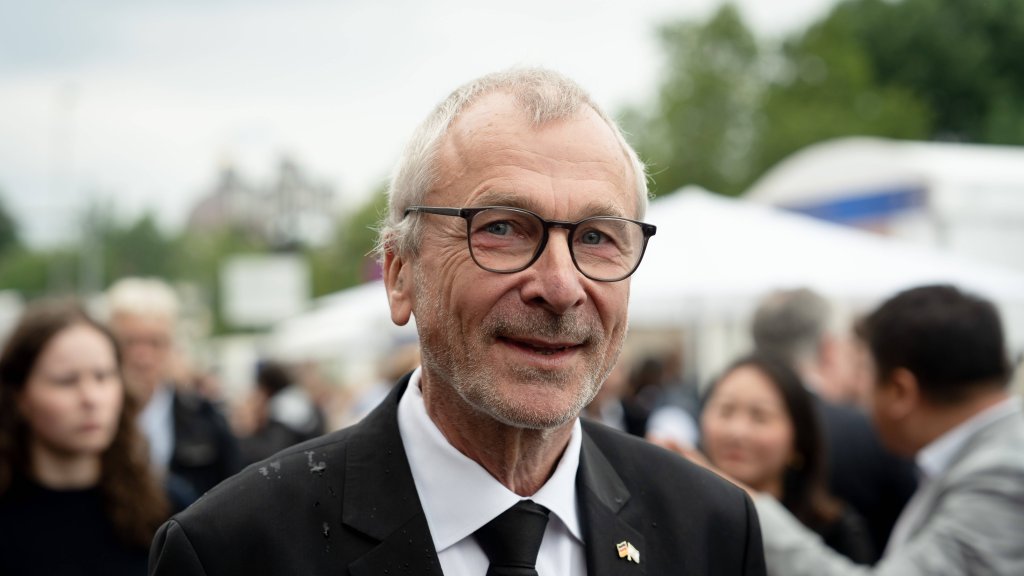
Prominent members, former senior politicians and voters of the CDU, SPD and Bündnis 90/Die Grünen have urged their parties to hold talks on forming a joint government in Berlin. In a “Berlin Appeal for Responsibility”, they oppose a red-green-red government led by Die Linke and call for cross-party cooperation in the face of the capital’s political and economic challenges.
Key points at a glance
- Members and voters of the CDU, SPD and Bündnis 90/Die Grünen have issued a joint appeal to the parties’ Berlin leaders and members of the state parliament.
- They oppose a red-green-red state government led by Die Linke and call on the CDU, SPD and Greens to seriously examine the possibility of forming a joint government.
- Green politician Volker Beck is among the initiators. Uwe Lehmann and former Minister of State Kerstin Müller are also named.
- The initial signatories include former Bundestag President Wolfgang Thierse (SPD), former Federal Foreign Minister Joschka Fischer and former federal minister Peter Altmaier.
- The initiators cite the budget situation, a housing shortage, economic uncertainty, problems in public administration and demands relating to security, social cohesion, climate and transport policy among the reasons for their initiative.
- The appeal warns at particular length about antisemitism and calls for the protection of Jewish life and a clear rejection of extremism.
- The signatories make serious allegations against sections of Die Linke in Berlin and express doubts that a government led by the party would meet these requirements.
Broad alliance against the left
The initiators include gay Green politician and “father” of same-sex marriage in Germany Volker Beck (German), President of the Deutsch-Israelische Gesellschaft. Other initiators named are Uwe Lehmann of Bündnis 90/Die Grünen in Berlin-Pankow and former Minister of State Kerstin Müller of the Berlin Greens. The list of initial signatories also includes well-known former senior politicians and public figures. Among those named are former Bundestag President Wolfgang Thierse (SPD), former Federal Foreign Minister Joschka Fischer and former federal minister Peter Altmaier. Other signatories to the appeal include presenter and journalist Jörg Thadeusz and Seyran Ateş, a lawyer and founder of the queer Ibn Rushd-Goethe Mosque (German).
The appeal is addressed to members of the party executives, members of parliament and party conference delegates of the CDU, SPD and Bündnis 90/Die Grünen in Berlin. The initiators cite the political situation in the capital as the reason for their unusual joint initiative. Berlin, they say, faces major challenges concerning security, finances, social cohesion and its economic and transport policy future. The signatories said they believed that Berlin’s state and district politics had gone off the rails. At the same time, they call on the three parties to reflect on their shared roots and values. Only then, they argue, can the city’s growing divisions be reduced and policies developed that bring together different sections of its society. In the signatories’ view, what unites the CDU, SPD and Greens is greater and more important than what divides them. They say this is also about the democratic foundations of Berlin and the Federal Republic.
Shared history
The initiators place their appeal in a detailed historical context. They refer to the three parties’ experiences with the GDR and the division of Germany. Bündnis 90, they note, emerged from the GDR civil rights movement and resistance to the SED dictatorship. Social Democrats faced persecution and immense pressure during the forced merger of the SPD and KPD to form the SED in 1946. In 1989, courageous people re-established social democracy in the GDR. The SDP, they say, was a key player in the Peaceful Revolution of 1989 and the last GDR government in 1990.
The authors cite Demokratischer Aufbruch as another historical root. Following its merger with the CDU, they say, its political tradition continued to have an influence, particularly within the Berlin CDU. The CDU, SPD and Bündnis 90/Die Grünen also helped shape Berlin’s reunification in 1990 and the years that followed. In the authors’ view, this shared history fundamentally distinguishes the three parties from Die Linke. It must not be disregarded in current political decisions either. On the basis of this history and their shared values, the three parties could shape policy over the next five years.
The budget and housing
In terms of policy, the signatories identify a series of pressing problems facing the capital. These include a strained budget, a housing shortage, economic uncertainty and an overstretched public administration. Added to these, they say, are growing demands on domestic security and social cohesion. Climate and transport policies must also be developed that finally create a “city for everyone”. Berlin therefore needs a stable government that unites rather than divides. Economic, social and environmental responsibility must be brought together, and liberal democratic institutions protected. A government committed to the constitution is a prerequisite, they say.
At the same time, the signatories explicitly acknowledge the election result. “Berlin has voted. This result deserves respect,” the appeal states. However, they argue, this does not mean that coalitions with the election winner, Die Linke, must be accepted unconditionally. Instead, a governing majority must be sought that represents the interests of the broadest possible range of social groups and whose partners share fundamental convictions on the rule of law and democracy.
Criticism of Die Linke’s policies
The signatories do not believe that a red-green-red government would meet these requirements. They oppose several policy proposals they associate with such a coalition. These include the expropriation of housing companies, what they see as a potential weakening of the police and the possible abolition of the domestic intelligence service. They also reject a rent cap, describing it as “a dead end that has failed before”. Berlin needs concrete solutions to its problems, not unaffordable promises, the authors argue. In their view, pledges that cannot be fulfilled could lead to further disappointment among voters. The signatories also see this as a risk that right-wing populists could gain further strength.
Protecting Jewish life
The appeal devotes particular attention to antisemitism and Germany’s responsibility towards Israel. Berlin, it argues, bears a special responsibility as Germany’s capital and the city in which the Holocaust was planned and directed. Antisemitism must never again be tolerated. This applies regardless of whether it stems from a far-right, far-left or Islamist ideology. Nor should any abandonment of Germany’s responsibility towards the State of Israel as a homeland for Jewish people be accepted.
“There can be no debate about or understanding for hostility towards Israel and hatred of Jews,” the appeal states. It is the responsibility of democratic parties to prevent such convictions from ever returning to power. In the authors’ view, antisemitic and anti-Zionist incitement harms social coexistence far beyond Berlin. It must be firmly opposed in every form. At the same time, the signatories emphasise the importance of contentious debate in an open democratic society. A democracy must be able to withstand criticism of Israeli governments’ policies, as well as misguided, polarising positions. However, the authors draw a line where Jewish life is endangered or the security and existence of Israel as a Jewish and democratic state are downplayed or called into question.
Allegations against Die Linke in Berlin
Against this backdrop, the signatories express serious concerns about a state government led by Die Linke. They fear that this could create a climate “in which the safety of Jewish people in Berlin can no longer be guaranteed”. The authors base this concern on current developments within the party and its wider circles, particularly in Neukölln. They allege that Die Linke Berlin is “a party that is antisemitic in parts”. In the signatories’ view, it has yet to clearly distance itself from antisemitic, Islamist, terrorist and criminal structures.
They also see overlaps between pro-Palestinian and pro-Russian circles. In their view, this could also affect Berlin’s policies in the Bundesrat and its partnerships with Israeli and Ukrainian cities. Representatives of the wing criticised by the signatories would, they say, sit in the Berlin House of Representatives in future and gain political influence. This must not be ignored when forming a coalition. The authors also raise the question of what consequences there could be for the capital’s security if staffing of the state administration were led by a party whose members, according to their account, include people with an open relationship with terrorist groups, or at least with their wider circles, as well as with organised crime circles. They say Die Linke has so far left this question unanswered.
Clear standards for government
The signatories therefore demand that democratic parties make their decision on forming a government not according to “political habits”, but on the basis of clear criteria. These include protecting Jewish life and unequivocally distancing themselves from extremism. Further benchmarks, they say, are Berlin’s financial stability, economic strength, affordable housing and a functioning public administration. Strong security agencies and sustainable transport policies are also required.
The CDU, Bündnis 90/Die Grünen and SPD now have a duty, they argue, to seriously examine how they could jointly assume political responsibility for the capital against this backdrop. The aim must be to form a stable and responsible government. The appeal ends with a direct call to the members and decision-makers of the three parties: “This is about Berlin, our home.” It is now up to them, together with their parties’ members, to live up to this responsibility.








