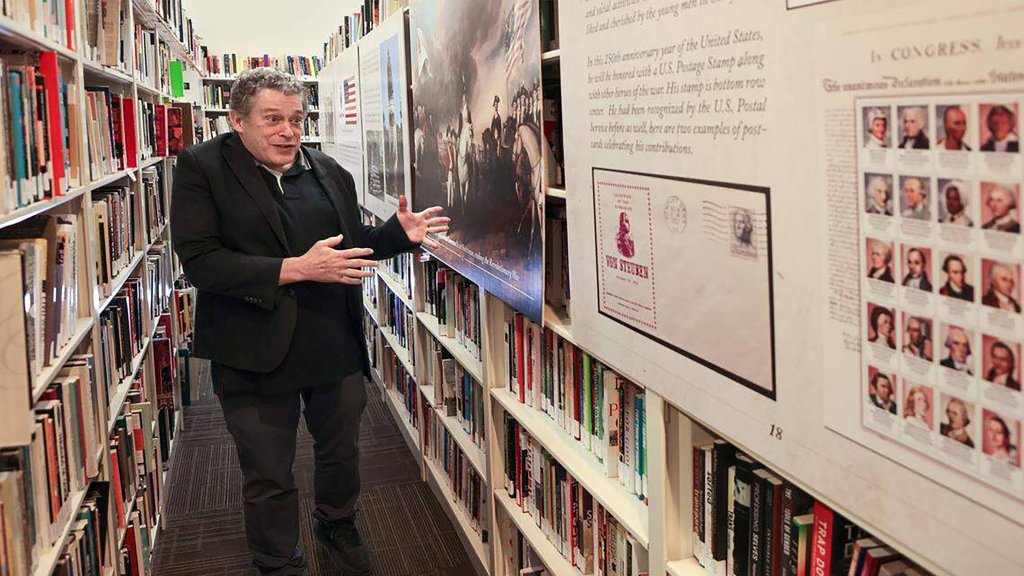
Preserving queer books, personal life stories and historical documents – while making them accessible to future generations: the Stonewall National Museum, Archives & Library in Florida sees this as an increasingly important task amid political disputes over LGBTQ+ rights in the US.
Key points at a glance
- The Stonewall National Museum, Archives & Library aims to preserve queer history and do more to share it with future generations.
- President and CEO Robert Kesten sees LGBTQ+ history, queer books and equality in society under political pressure in the US.
- Stonewall wants to strengthen dialogue between the media, the public and the LGBTQ+ community.
- The museum has more than 30,000 books, organises travelling exhibitions and works with teachers, authors and educational institutions.
- Kesten considers the museum’s location in Florida important despite the political disputes over LGBTQ+ rights there.
- Looking at political developments in the US, Kesten is hopeful but cautious. He says the pursuit of equality and justice will continue regardless of election results.
Creating new dialogue
Museum president and CEO Robert Kesten warns of a loss of trust between the media and society. Through its “Focus on the Future” event series, the institution now aims to bring journalists, cultural practitioners and the public into conversation. Topics include media responsibility, representation and the preservation of queer history. “For much of history, there was no real exchange between the media and the LGBTQ+ community,” Kesten said. In his view, the US government has now “made an enemy” of the community and instilled fear in publishers and journalists. “None of us can succeed if we constantly have to look over our shoulders. The aim is to open a dialogue between the public and the media and find ways to restore balance, trust and honesty.”
Political headwinds
According to Kesten, the Stonewall National Museum, Archives & Library is working on several fronts to counter attempts to push queer books and history out of the public sphere. The institution’s newsletter includes editorial articles, staff contribute opinion pieces and exhibitions address controversial topics. Stonewall also hosts gatherings with people who, according to Kesten, are being attacked by politically influential figures. “Not a day goes by when we don’t feel part of this fight – even though we always feel we can and must do more,” Kesten said. The museum has a library of more than 30,000 books as well as an extensive film collection. Stonewall places particular emphasis on educational work.
Through the “Heroes and Honors” project, people’s life stories are documented online and made accessible worldwide. “This is an educational resource that is available worldwide and gives people an insight into what others have done and are doing today to make this planet safe for everyone,” Kesten said. The museum also works with teachers, school leaders, authors and other partners. Its exhibitions are shown outside Florida too. It also offers what it calls starter-kit libraries, intended to enable smaller organisations to provide a selection of queer books. Kesten adds that Stonewall is constantly looking for new ways to reach people.
Florida as a deliberate choice
The museum is based in Fort Lauderdale in the US state of Florida. In recent years, the state has seen particularly fierce political disputes over LGBTQ+ issues and how they are addressed in schools and other public institutions. Kesten therefore sees the location as more than just a challenge. “You have to be where the fight is if you want to change something.” He says the museum’s presence in Florida reminds LGBTQ+ people in cities such as New York or Los Angeles “that we deserve the right to live anywhere and still be ourselves”.
Asked about the political direction of the Republicans in Florida, Kesten was sharply critical. “Politicians do things to gain power; they look for the easiest targets, cause division and try to pull communities apart to create conflict and weaken the opposition,” he said. “Bad politicians will do anything to win an election, twist the truth and use the system to their advantage, regardless of the harm they cause.” Kesten said the LGBTQ+ community had resisted this and would continue to do so. “There is no room for defeat in this fight.”
Lessons from the AIDS crisis
Kesten also draws on his earlier international experience in his work today. He says his activism contributed to the decriminalisation of homosexuality in Ukraine. That work gave him a different perspective on political and social developments. According to Kesten, his experience of campaigning against HIV and AIDS also plays a role. Among other things, he was involved in events for the first AIDS day treatment centre in the US. For him, this is not solely about the LGBTQ+ community. “The fight is for all communities. We must recognise that we do not all have equal rights, but that universal equality must be the ultimate goal.”
Kesten warns against viewing the disadvantage faced by individual social groups in isolation. “When one group is treated unjustly, it is only a matter of time before the next group, and then the next, faces the same. Either we make things better, or they will get worse.” Looking ahead to upcoming elections in the US, Kesten is both hopeful and cautious. “I will remain hopeful until proven otherwise,” he said.








