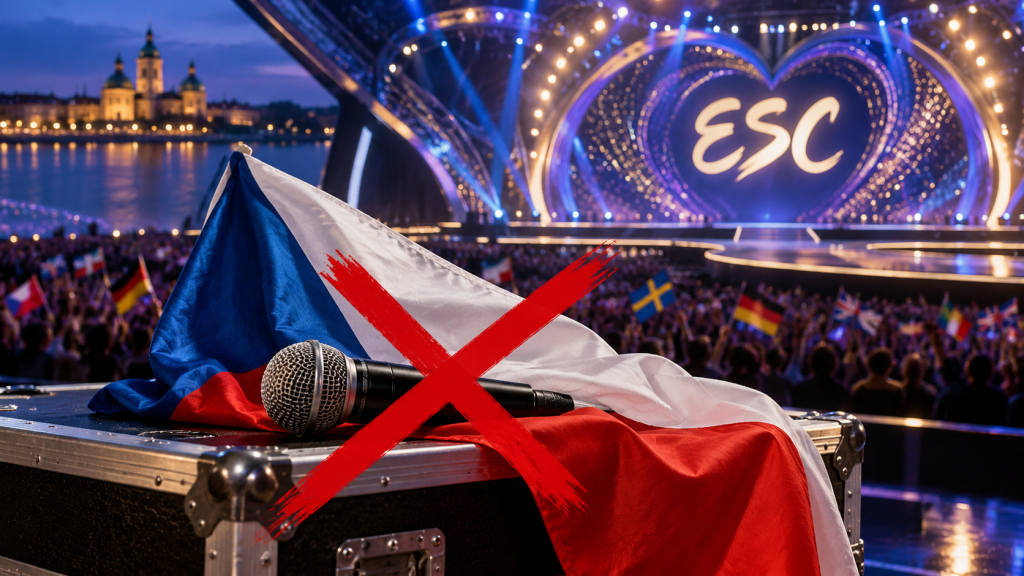
The Eurovision Song Contest 2027 will take place without Czechia. The public television broadcaster Česká televize (ČT) has decided not to send a delegation to the competition in Burgas, Bulgaria. The decision is driven by the financial circumstances of the broadcaster, which must prepare for significant changes to its funding.
Key points at a glance
- Participation cancelled: Czechia will not be represented at the Eurovision Song Contest 2027 in Burgas, Bulgaria.
- Financial reasons: Public broadcaster Česká televize must adjust its budget and is therefore cutting its Eurovision participation.
- High expenditure: The broadcaster spent around €376,000 on external project costs for the 2024 contest.
- Broadcasting reform planned: The Czech government wants to abolish the existing broadcasting licence fees and replace them with funding from the state budget.
- No political boycott: Unlike several other countries, Czechia is not citing Israel's participation as the reason for its withdrawal.
- A return remains possible: The broadcaster has not ruled out participating in the Eurovision Song Contest again in the coming years.
Restructuring public broadcasting
The withdrawal comes at a time when the future of public broadcasting in Czechia is being renegotiated at a political level. While the government prepares a fundamental change to its funding, Česká televize already has to factor savings into its budget planning. Its participation in the largest international music competition is now also affected. “In 2027, we will not see the Czech flag on stage,” the broadcaster said. It explained that organising a Eurovision entry required considerable funds and involved substantial work on programming, production and logistics. Under the current financial circumstances, the broadcaster had therefore decided against participating next year. However, this does not mean a final farewell to the contest. Česká televize is explicitly keeping open the possibility of entering a Czech act again at a later date.
Eurovision withdrawal is not a boycott
The European Broadcasting Union (EBU), which organises the Eurovision Song Contest, confirmed the Czech broadcaster's withdrawal. Eurovision director Martin Green pointed to Česká televize's strained finances. He said these difficulties were not an isolated case: public broadcasters in many places had to operate with limited financial resources while their expenditure was rising. According to the broadcaster, political disputes over Israel's participation played no part in the Czech decision. This distinguishes its withdrawal from those of several European countries from the Eurovision Song Contest 2026 in Vienna.
Spain, the Netherlands, Ireland, Iceland and Slovenia declined to participate at that time. Their decision was a protest against Israel's involvement in the contest. Ireland does not intend to return in 2027 either. Irish broadcaster RTÉ has already announced that it will once again not send an entry. It cites the continuing loss of life and the humanitarian situation in the Gaza Strip as its reasons. While Ireland's withdrawal is thus politically motivated, Česká televize is focused on the costs of the competition and uncertainty over its future income.
Czechia and Eurovision
The expenditure for 2024 illustrates the financial outlay involved in participating in Eurovision. Česká televize published the relevant figures in response to a request under the Czech freedom of information law. According to these figures, external costs for the Czech Eurovision entry totalled 9.18 million crowns, around €376,000. This amount covers numerous services required to prepare and stage a performance. In addition to the participation fee payable to the EBU, costs include selecting the contest entry and handling the technical aspects of international broadcasts.
There are also costs for the delegation's accommodation and transport, as well as fees for the artists and staff involved. The artistic staging of the performance also has to be funded. This includes developing the choreography, costumes, make-up and stage lighting. Further costs arise from producing the television version that Česká televize presents to its audience in Czechia. The published figure of 9.18 million crowns therefore covers a broad range of external project costs and is not limited to the right to take part.
Germany's Eurovision participation fee
The German figures illustrate how much the financial burden varies between participating broadcasters. Germany paid the EBU a fee of €454,905 to participate in the Eurovision Song Contest 2024. A year later, this payment amounted to €451,216. Germany's participation fee alone was therefore higher than the total external costs reported by Česká televize for its Eurovision appearance in 2024. However, these amounts do not allow a direct comparison of the two countries' total expenditure. While the Czech broadcaster published a figure for external project costs, no similarly comprehensive information is available from Germany's ARD.
In particular, the additional expenditure on the German delegation, staging the contest entry and accompanying programming is not included in the participation fee quoted. Germany's total Eurovision costs therefore cannot be determined from the published figures. The EBU also calculates participation fees using a cost-sharing system. Large member broadcasters have to make correspondingly higher contributions. Germany is among the countries whose broadcasters bear a particularly large share of the costs.
Broadcasting licence fees in Czechia
For Česká televize, the question of funding the Eurovision Song Contest arises against the backdrop of its regular income. The public television broadcaster is funded in part through fees paid by Czech households. The monthly amount currently stands at 150 crowns, equivalent to around €6.14. The payment is levied once per household and funds public television. In Germany, by contrast, the monthly broadcasting contribution is €18.36, significantly higher than the Czech television licence fee. Česká televize must save around €14.3 million next year.
For Czechia, the decision means another interruption in its Eurovision Song Contest history. The country first took part in the international music competition in 2007 and has also made its mark in the final over the years. Czechia achieved its best result to date in 2018, when singer Mikoláš Josef competed with “Lie To Me” and finished sixth. Whether a Czech entry will be back on stage in 2028 remains open. In any case, Česká televize has not announced a permanent withdrawal from Eurovision.








